La Nuit utérine (1981)
A founding book on a theme dear to Alfred Tomatis: uterine life as the first school of listening. Published by Éditions Stock in 1981, illustrated with drawings by Guy Plomion, the work offers, through a clinical path resting on more than twenty-five years of observation, a veritable anthropology of prenatal listening. Tomatis reveals what the fœtus hears, how it is impregnated by the maternal voice, and how this impregnation conditions the first psychological structurings after birth.
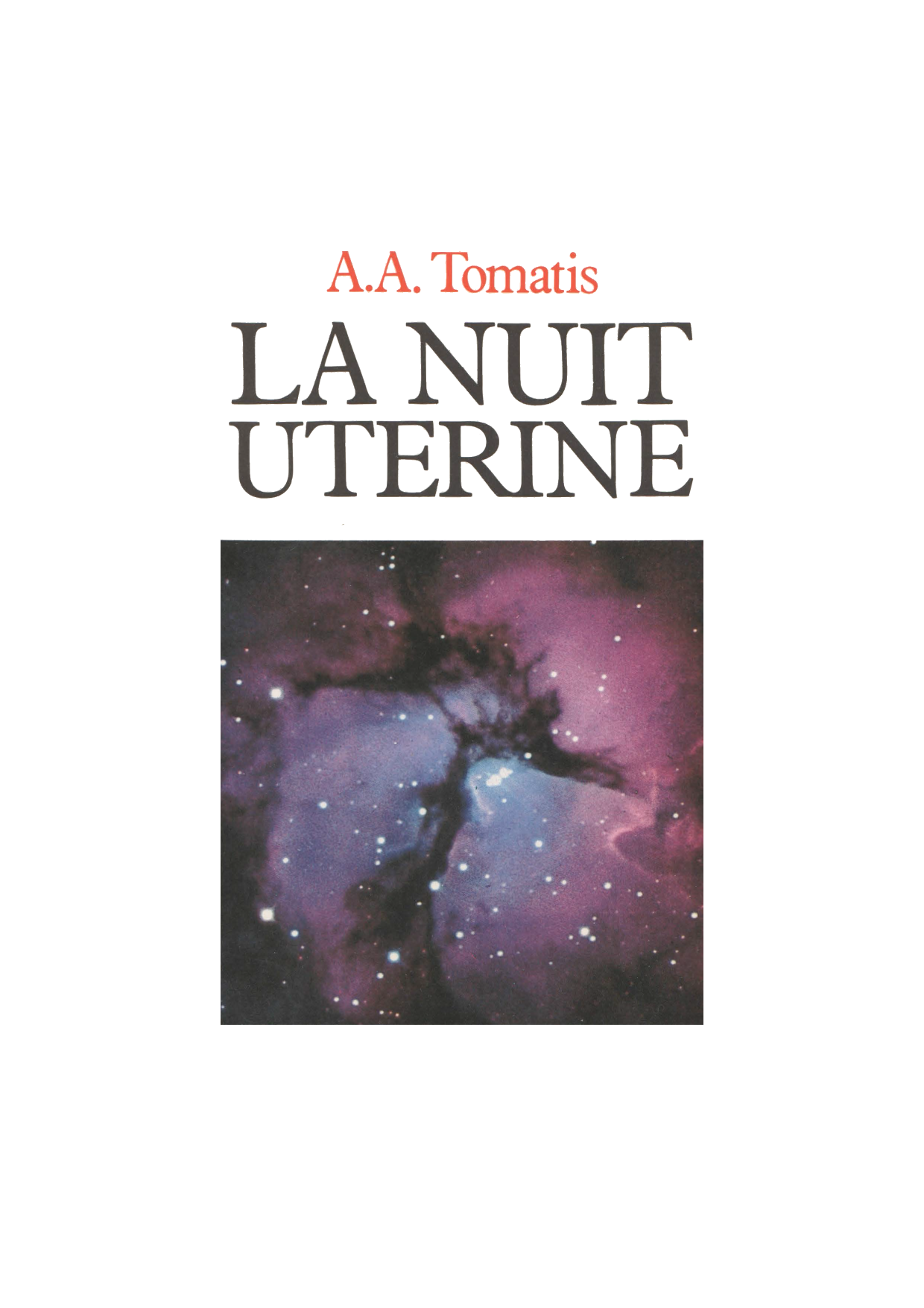
“Everything is memory… The living being feels, retains. The organism never forgets anything.”
— Prof. Robert Debré, in epigraph
Presentation
The idea for La Nuit utérine came to Tomatis after a meeting with a “recalcitrant” father whose daughter, Isabelle (4 years old), suffered from an absence of language. “Certainly not”, the father replied when Tomatis evoked the part played by mother-fœtus communication in the disorders presented by his daughter. This blunt objection shook the author, who decided to write the book that would set down “in black and white” a quarter of a century of research into intra-uterine listening.
The wager was met. From precise clinical cases (Isabelle opens the work), Tomatis traces his way back to the physiological foundations of fœtal hearing: at what gestational age is the inner ear functional? What does it perceive? How are sounds filtered through the amniotic fluids? What place does the mother’s voice occupy, with its inflections, its intonations? And what happens after birth to the child who has not benefited from this full impregnation?
The illustrations by Guy Plomion — painter and illustrator — accompany the reading by giving visual form to realities until then silent. It is one of Tomatis’s few scientific works to assume an almost poetic dimension.
Contents
-
Certainly not — the clinical trigger: Isabelle and her recalcitrant father.
-
The fœtal ear — embryology and physiology of prenatal hearing.
-
Maternal voice, paternal voice — what the amniotic fluids filter, what passes through.
-
Being born into aerial life — the sonic rupture of birth, the role of the primal cry.
-
Reconstituting listening — clinical applications: how the Electronic Ear makes it possible to retraverse, after the fact, these first missed stages.
-
Towards a conscious parenthood — prenatal education, the responsibility of parents.
Place in the work
La Nuit utérine is the clinical preface to what would be, eight years later, Neuf mois au paradis (1989). Where the latter adopts a more accessible and more polemical tone (in response to the fashion that “prenatal stimulation” had then taken on), La Nuit utérine remains the founding exposition, scientifically rigorous, that lays the theoretical foundations. The concepts of fœtal listening, of maternal sonic impregnation, of psycho-acoustic continuity between the prenatal and the postnatal, here receive their definitive form.
In brief
For midwives, paediatricians, perinatal psychologists, obstetricians, expectant parents — and for any adult curious about the psychic genesis of the human being — La Nuit utérine is a reference text. Tomatis offers here a vision in which mother-child communication does not begin at birth but much earlier, through the channel of an ear already active. The practical reach is considerable: to prevent disorders of language and communication by accompanying pregnancy, but also to re-establish, through auditory re-education, what may have been insufficient. Moving, accessible, magnificently illustrated reading.
Available in libraries — BnF, Sudoc.