Écouter l'univers (1996)
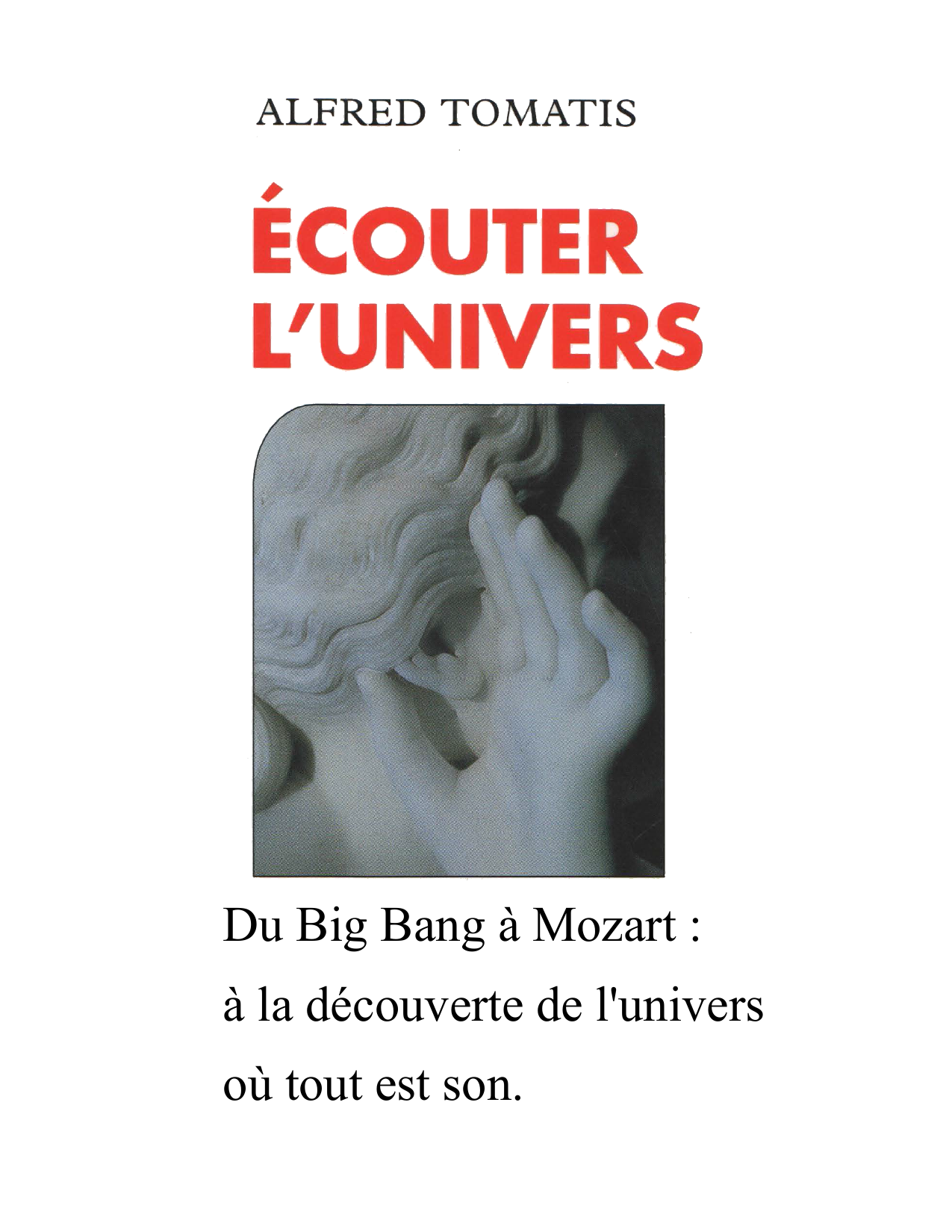
Alfred Tomatis’s final work (published in 1996, five years before his death), which gathers into a vast cosmological synthesis the whole of the intuitions that have guided his life as a researcher. Subtitled From the Big Bang to Mozart: discovering the universe in which everything is sound, the book leaves the strictly clinical terrain to propose a veritable “sonic anthropology” of the universe: from the primordial vibrations of the origin to the most subtle harmonies of music, everything that exists is, according to the author, a manifestation of a universal vibration.
“May this cosmic symphony […]”
— Dedication to Olivier Piaget
Presentation
At 76 years of age, Alfred Tomatis’s medical, scientific and clinical œuvre is constituted. Fifteen books published, hundreds of articles, a discipline founded (audio-psycho-phonology), an international network that has spread from Paris to Tokyo by way of Madrid, Mexico, Toronto and Johannesburg. The time has come, for this physician turned philosopher, to deliver the great synthesis — the one that replaces the human ear in the cosmic order, in a perspective that combines physics, metaphysics and spirituality.
The book opens on acoustics — a discipline of ill-defined contours, of which Tomatis stresses from the very introduction that it has difficulty “holding the rank that ought to be its own among the exact sciences”. He takes up its foundations: mechanical waves, propagation media, harmonics, resonances. But he gradually broadens them, until they encompass the whole of physical reality: light itself is vibration, particles are vibration, the entire universe — from the original Big Bang — is vibration. And the human ear, in this sonic cosmology, is the organ par excellence by which the human being can “listen to” the universe and take their place within it.
The work assumes a spiritual tonality that distinguishes it from its predecessors. Tomatis enters into dialogue with the great mystical traditions, summons the Church Fathers, the Qur’an, the Vedas; he mobilises indistinctly Pythagoras, Saint Augustine, Mozart and contemporary science. This “New Age” tonality — to take up the expression used by some commentators — is fully assumed by the author: “one must then recall the old supplication so often renewed: ‘Lord, open my ear.’” (conclusion).
Contents
-
Introduction — acoustics as a neglected discipline.
-
The great original vibration — from the Big Bang to the first sonic structures of the universe.
-
The universe is music — harmonics, resonances, cosmic consonances.
-
The human ear, cosmic antenna — physiology of listening re-read in the light of cosmology.
-
From listening to conscious listening — pedagogy of listening, the Tomatis method.
-
Spiritual listening — mystical traditions of listening (Christian, Jewish, Sufi, Hindu).
-
Conclusion — “Lord, open my ear.”
Place in the work
Écouter l’univers is Alfred Tomatis’s intellectual testament. It deliberately exceeds the medico-scientific framework of the preceding works to propose an integrated vision — anthropological, cosmological and spiritual — of listening. The book extends the intuitions present from L’Oreille et la Vie (1977) onwards and amplified in the conclusion of the new edition of 1990 (“every discovery only finds its raison d’être in a context that integrates it within a better understanding of the relations that must exist between the human condition and the infinite greatness of the Creator”). For anyone wishing to understand the complete trajectory of Tomatissian thought, this book is the final stage — the one that opens, rather than closes.
In brief
Demanding reading, sometimes disconcerting for the strictly scientific reader but essential for understanding the philosophical unity of the œuvre. Tomatis unfolds here without restraint the spiritual dimension that he had progressively let surface in his earlier books. To be recommended to anyone interested in integrative thought, in the links between science and spirituality, in the philosophy of perception and, finally, in that great question: does the universe speak? and how is one to listen to it?
Available in libraries — BnF, Sudoc.