Biography
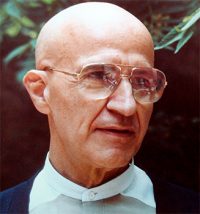
Alfred Tomatis (Nice, 1920 — Carcassonne, 2001) was a French otorhinolaryngologist. He devoted most of his professional life to the study of the relations between the ear, the voice and language, and developed an approach to listening that came to be known as audio-psycho-phonology, or the “Tomatis method”. The inventor of the Electronic Ear and the author of a prolific body of writing, internationally recognised, he remains nonetheless a debated figure whose scientific standing has been the subject of recurrent controversy.
Origins and training
The civil register records Alfred Tomatis’s birth in Nice on 1 January 1920. In his autobiography, however, he qualifies this date: he was in fact born, he writes, a few days earlier, in the last days of December 1919 — his family having declared the 1st of January for reasons, he says, of census convenience. More importantly, he was born severely premature, at six and a half months and weighing less than 1,300 grams. Initially given up for lost, he was, according to his own account, revived by his paternal grandmother. Tomatis would attach decisive importance to these circumstances: he was to see in his prematurity, in his having been cut off too early from intra-uterine life, the very source of his vocation as a researcher and the origin of his lasting interest in life before birth.
He grew up in Old Nice, in a modest household still deeply marked by Italian culture and the Niçois dialect. His father, Humbert Tomatis, originally a manual worker — he was employed as a lead-caster in a Niçois newspaper — saw his exceptional voice noticed and went on to a career as an operatic singer. His Italian mother, originally from Forlì, was only sixteen at his birth. Tomatis’s childhood thus unfolded in the familiar atmosphere of singing and the wings of the theatre — an environment that would durably shape the direction of his research.
A child of fragile health and frequently ill, he had a long-erratic schooling. He himself was to locate the awakening of his vocation in a precise scene: gravely sick, he watched the physicians come and go until one of them, frankly acknowledging his ignorance, simply declared that he would have to search. It is this phrase, Tomatis would say — “I shall have to search” — that decided everything: he would be a doctor, and a man who searches. At the age of eleven, by his father’s decision, he was sent alone to Paris, not as a boarder but as a pupil entirely free and responsible for himself.
He undertook medical studies in a Paris soon to be occupied. The war marked these formative years deeply: mobilised into the medical service while still a junior student, he served for a time as a battalion physician, was assigned to a youth labour camp, and committed himself to the Resistance, in which he acted as a liaison agent for an intelligence network. Alongside medicine, he took several science certificates at the Sorbonne. Admitted to the externship of the Paris hospitals, he trained under several masters, among them the neurologist André Thomas, whose clinical acuity left a lasting mark on him. He obtained his doctorate in medicine in the immediate post-war years and chose otorhinolaryngology as his specialism — a choice he explicitly linked to the desire to help his father’s singer friends, who faced vocal difficulties the medicine of the time was hard pressed to resolve.
The founding discovery: the ear governs the voice
In the years following the war, Tomatis found himself in contact with two very different populations. On the one hand, he carried out audiometric examinations on workers exposed, in the arsenals, to the roar of engines — among whom he observed the lesions of so-called occupational deafness. On the other, through his familiarity with the world of opera, he received singers in vocal difficulty.
The juxtaposition of these two series of observations gave rise to his central insight. Faced with baritones who sang out of tune without classical treatments — focused on the larynx — yielding any improvement, Tomatis had the idea of subjecting them to the same auditory tests as the workers. He found that their hearing presented weaknesses comparable to those of occupational deafness. He drew two linked conclusions: singers, as the first and closest auditors of their own voice, end up altering their own ear; and, above all, it is not the larynx but the ear that commands the accuracy of vocal emission. In 1947 he formulated the proposition that would lie at the root of his entire œuvre — a subject can only reproduce vocally what they are able to hear — and condensed it in a formula that has remained famous: “we sing with our ear”.
To support this idea, Tomatis turned his attention to the case of the tenor Enrico Caruso. Studying his recordings in chronological order, he located the flowering of the Carusian voice after 1902 and tied it to a surgical operation performed that year on the right side of the singer’s face. According to his hypothesis, this operation had brought about a partial deafness which, by filtering out sounds of poor quality, had paradoxically served the singer — a “happy deafness”. This reading, which he sought to corroborate by other means, would directly inspire the instrument that became the signature of his method.
The Electronic Ear
If listening commands the voice, Tomatis reasoned, then modifying listening should make it possible to modify the voice. By way of experiment, he had subjects hear, through filters, a reconstituted listening — and observed that, with the headphones on, they sang better; but that the improvement vanished as soon as the headphones were removed. The whole question thus became: how to make this passing effect durable.
From this line of research the Electronic Ear was born. The first devices, developed in the early 1950s, were rudimentary and relied on manual switching. It was in 1954, by introducing electronic gating into the apparatus, that Tomatis gave the instrument its definitive form — and its name. The Electronic Ear aims to solicit and “re-educate” the ear by exposing it to sounds filtered and modulated to precise specifications.
From this period onward, Tomatis’s work attracted the hostility of part of the medical world and of vocal pedagogy. As early as 1952, he was removed from the hospital service in which he was working — not, by his own account, for any professional misconduct, but for having presented his own findings rather than submitting them under his superior’s name, thereby breaking with the conventions of the medical “mandarinate” of the time. This tension with established medicine would never fade.
The Tomatis Effect and academic recognition
The principles Tomatis had identified — sometimes called the “Tomatis laws” — were given experimental demonstration in the late 1950s in collaboration with the physiologist Raoul Husson and the Sorbonne physiology laboratory directed by Professor Monnier. Following these verifications, the set of findings was deposited, under the name Tomatis Effect, with the Académie des sciences and the Académie nationale de médecine in Paris — through the offices, notably, of Husson, Monnier and Moulonguet. There, the proposition was reformulated in terms more rigorous than the colourful wording of its author.
From his research Tomatis derived a distinction that remains at the heart of his thought: that between hearing, a passive function, and listening, the active and voluntary use of the ear, oriented towards communication. It is on listening, and not on hearing alone, that his approach claims to act.
Audio-Psycho-Phonology and its extension
From these principles, Tomatis developed an approach he called audio-psycho-phonology (APP), commonly known as the “Tomatis method”. Initially aimed at singers and disorders of the voice, it was progressively extended to a far broader field: language and learning difficulties, attention disorders, emotional difficulties, the learning of foreign languages, and support for diverse populations.
The method relies on filtered sound and makes a particular place for music — Mozart’s compositions and Gregorian chant occupy a recognisable role within it. Presented as an education or re-education of listening, APP spread internationally over the decades, and centres claiming affiliation with the method were established in many countries.
The written work and his late thought
Tomatis was the author of an abundant written œuvre. His best-known book, L’Oreille et la Vie (1977), weaves autobiographical narrative, the exposition of his research and more personal reflection; it did much to make his ideas known to a wide readership. In the last decades of his life Tomatis devoted increasing attention to psychology and to a more philosophical and spiritual reflection, a trajectory that led him notably to conversion to Catholicism. This introspective dimension constitutes a self-standing facet of his trajectory and warrants treatment on its own terms, distinct from his clinical and technical work.
A contested body of work
The place of Alfred Tomatis in the history of science is the object of divergent assessments, which a reference notice is bound to set out.
On the critical side, academic medicine and audiology remain largely sceptical of the method’s efficacy for many of the indications ascribed to it. The “laws” presented to the academies in the 1950s did not give rise to publications meeting customary scientific standards, and the evidence of efficacy yielded by rigorous studies remains limited or contested; some observers classify the method among pseudosciences. Tomatis’s institutional trajectory was also troubled: the tension with established medicine, perceptible from the 1950s, culminated in his being struck off the French medical register (Ordre des médecins) in 1977. The final decades of his activity were further marked by judicial proceedings, including a suit brought in 1988 by a former patient following sessions she deemed unsuccessful, and a conviction in 1993 for the unauthorised practice of medicine.
On the supportive side, observers emphasise the originality and prescience of his founding insight — the close coupling between the ear, the voice and the nervous system. The method continues to be practised in many centres around the world. Contemporary work on brain plasticity has, moreover, led some authors to re-examine his contribution; the psychiatrist Norman Doidge devotes a substantial passage to Tomatis in The Brain’s Way of Healing, in a markedly more favourable reading.
Between these positions, the present site does not arbitrate: it documents an influential and contested body of work, and invites the reader to consult the sources in order to form their own judgement.
Death and legacy
Alfred Tomatis died in Carcassonne on 25 December 2001; he is buried in the cemetery of La Conte. He had entrusted the continuation of his work to his son Christian Tomatis and to his collaborator Thierry Gaujarengues, founders of the company Tomatis Développement.
After his death, the method has continued to exist through several lineages — companies, professional associations and independent practitioners — offering varied applications and interpretations. Beyond the controversies, the attention Alfred Tomatis brought to listening, distinct from mere hearing, and to the role of sound in development and communication, remains his most enduring contribution.
Sources
Primary source. Alfred Tomatis, L’Oreille et la Vie (1977) — autobiography and exposition of his research. The book remains the principal entry-point for any reader wishing to read Tomatis in his own words, and the site recommends it. Being a narrative in which the author presents his own life, the elements drawn from it — in particular those touching on his origins and on the genesis of the discovery — are to be read as such and call, where possible, for cross-checking.
Secondary sources. Biographical and historical notices published online, encyclopaedic entries, and press material relating to Tomatis’s trajectory.
This notice will be revised and refined as the primary sources preserved in the site’s Archives — SFECMAS bulletins, communications to the academies, correspondence — come to support or correct the account.