For information on occupational deafness
Lecture given by Dr Alfred Tomatis on 8 June 1954 to the Fédération Française des Travailleurs sociaux, and published in the Bulletin S.F.E.C.M.A.S. of July 1954 (pages 119-127). Tomatis, then Deputy Director of the SFECMAS medical research laboratory, sets out in accessible terms the problem of occupational deafness: a description of industrial noise and its intensities (from normal conversation at 30 dB up to jet-engine test benches at 140 dB), the audiometric method, and a schematic description of the four periods through which noise-induced deafness develops. He concludes with a plea for a struggle against noise articulated along two complementary axes: suppression at the source, and systematic screening by means of the factory audiometer he had devised.
For information on occupational deafness
Lecture of 8 June 1954
to the Fédération Française des Travailleurs sociaux
by Dr Tomatis,
Deputy Director of the SFECMAS research laboratory
Position of the problem in France
Occupational deafness is now recognised in its existence; it is not, however, to this day admitted as an occupational disease giving entitlement to compensation under French legislation, although it is so admitted in other countries. This is enough to indicate the interest attaching to broader information, in the world of social work, on the very nature of this condition, on its causes, and on the means at our disposal both to measure and to prevent it.
Measurement of noise and measurement of hearing
To study noise, we have today two instruments at our disposal: the sound-level meter, which measures its overall intensity, and the frequency analyser, which breaks down its spectrum. The decibel — abbreviated dB — is the internationally adopted unit for expressing this sound intensity. It is a logarithmic unit related to a reference threshold conventionally fixed at 10-16 watt per square centimetre, a value that corresponds approximately to the mean threshold of human hearing at the median frequencies.
To measure the hearing of a subject, we have a device called an audiometer, which permits the establishment of a curve indicative of the possibilities of the ear. This curve, which we name the audiogram, defines for each sound frequency the threshold of auditory acuity in decibels.
[Fig. I — Blank audiogram: abscissa graduated in musical frequencies (128, 256, 512, 1,024, 2,048, 2,896, 4,096, 5,792, 8,192, 11,584 c/s), ordinate graduated in hearing losses from 0 to 100 decibels.]
The ideal audiogram appears as a horizontal straight line — a case never, indeed, encountered in practice. On the contrary, and in a very characteristic manner, occupational deafness imprints on the tracing a perfectly recognisable signature: a vertical notch, centred on the frequency 4,096 c/s.
[Fig. II — Initial audiogram of occupational deafness: tracing appreciably horizontal on the low and middle frequencies, abruptly hollowed in a narrow V around 4,096 c/s, the apex of the deficit registering at about 30 decibels.]
Sound intensities encountered in industry
To fix orders of magnitude, here are some current sound intensities, expressed in decibels:
| Noises | Intensity (dB) |
|---|---|
| Normal conversation | 30 to 40 |
| Street | 50 to 70 |
| Underground train entering the station | 85 to 95 |
| Boilermaking workshop | 100 to 110 |
| Riveting workshop | 110 to 120 |
| Jet-engine test benches | up to 140 |
The scale being logarithmic, the energy ratios are vertiginous. If we take as our reference the 100 dB noise of a boilermaking workshop, then:
-
a noise of 110 dB corresponds to a sound energy 10 times greater;
-
a noise of 120 dB corresponds to a sound energy 100 times greater;
-
a noise of 130 dB corresponds to a sound energy 1,000 times greater;
-
a noise of 140 dB corresponds to a sound energy 10,000 times greater.
Some jet engines produce intensities reaching 160 dB; the Americans have reported that in immediate proximity they have been able to observe 180 dB, which represents a sound energy 100,000,000 times greater than that encountered inside a boilermaking workshop.
It is plain that noises of such intensity strongly traumatise the ear of the worker daily exposed to them, and audiometry now enables us to follow with precision the harm they do to the ear — which brings us to occupational deafness itself.
The four periods of occupational deafness
Occupational deafness evolves schematically in four periods, which we shall study in turn.
1) Period of installation of a permanent deficit
This stage, which does not seem to exceed a month, expresses the progressive adaptation of the ear to the daily and prolonged aggression of a noise of unaccustomed intensity.
It is certain that the worker’s first contacts with the deafening noise of their workshop are most painful, and one understands very well how difficult it must be for them to become accustomed to it at the very outset.
From the first exposure to noise, the audiogram reveals, as soon as work is over, the existence of a deficit of about 40 dB on the frequency 4,096 c/s (fig. 2). This deficit is not found in those who have already been working for some time in the same workshop, but it will then appear as a considerable auditory fatigue, more or less prompt to yield to rest.
The second working day will renew this deficit with the same transient character; reproduced each day, it will lead to the development of irreversible cochlear lesions and to a definitive deficit, and on the other hand to an adaptation whereby this mean deficit will be less acquired than determined at the very outset by auditory fatigue — on average 40 dB.
It does not seem that the thresholds indicated for the permanent deficit are reached by the end of the first week; nonetheless it sets in early in predisposed subjects.
2) Period of total latency
The ear has now adapted, with more or less efficacy according to the individual.
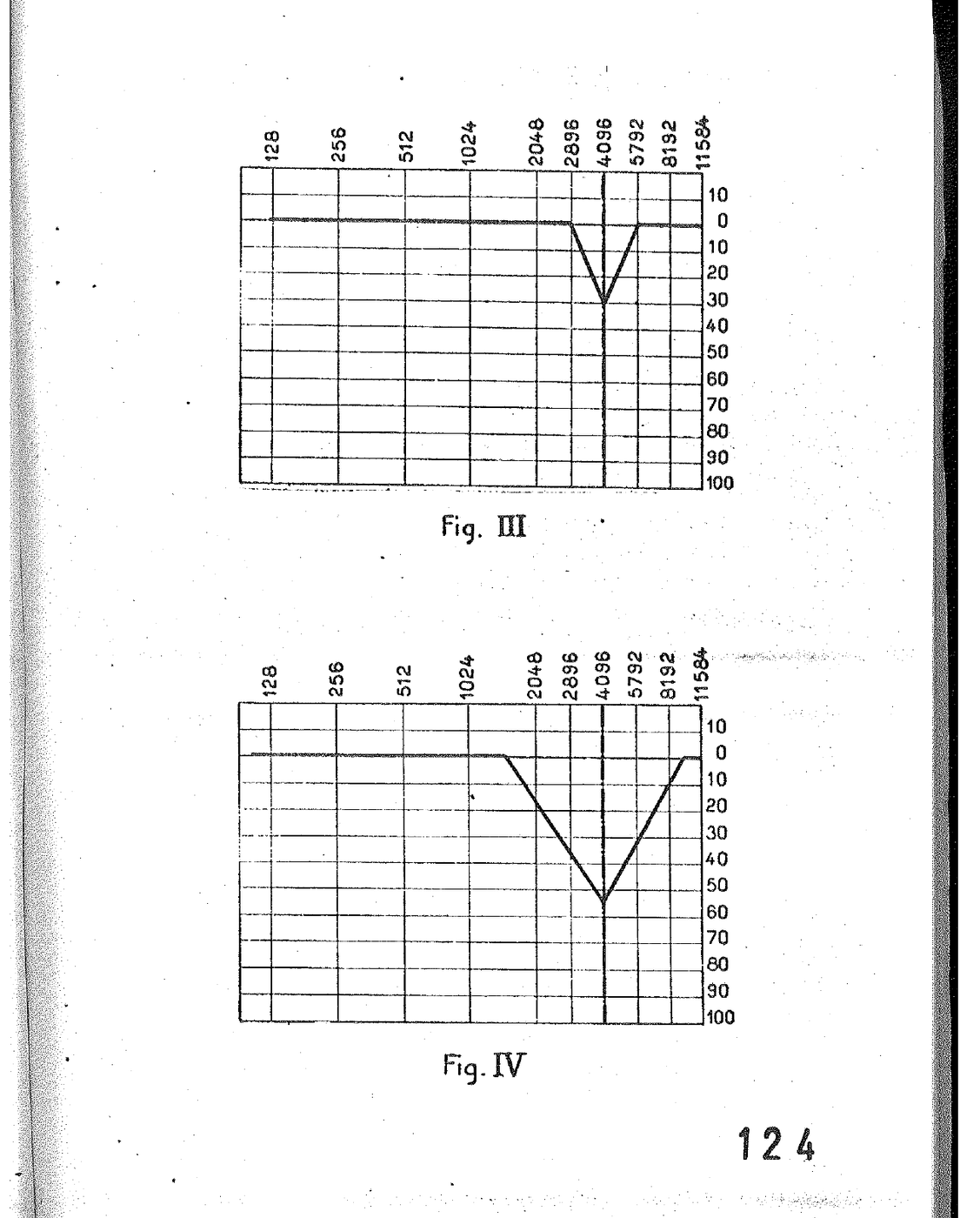
The permanent deficit has just set in: it has not taken a month to raise the hearing threshold of the frequency 4,096 c/s by about 40 dB on average (fig. 3). The progression will be slow to come: 60 dB on average on the tracing, on this point of the audiogram, for a more or less prolonged time without total latency, to such an extent that the whispered voice itself will, for a long time yet, be perceived normally.
But at the level of the frequency 4,096 c/s there exists a scotoma covering 1½ to 2 octaves. It abruptly interrupts the otherwise normal horizontal tracing of the audiogram, hollowing between the frequencies 2,896 and 5,792 c/s a more or less abrupt V-shaped trench, all the deeper as the apex sits on the frequency 4,096 c/s.
The deficit at this frequency is on average 40 dB. It is reduced, in some cases, to 20 or 30 dB. In others, by contrast, it may rise to 70 dB.
[Fig. III — Audiogram: horizontal line on all the middle frequencies, narrow vertical trench at 4,096 c/s, plunging to 30 dB.]
[Fig. IV — Audiogram: gentle downward oblique beginning around 1,024 c/s, continuous descent to about 55 dB at 4,096 c/s, deficit widening to 2 or 3 octaves.]
3) Period of sub-total latency
Deafness is still latent insofar as the subject continues to perceive the voice of conversation normally; but they have ceased to perceive the whispered voice normally, hearing it only at 3 m or closer still.
The audiogram reveals a worsening of the auditory deficit: it has deepened and widened (fig. 4).
At the level of the frequency 4,096 c/s, the loss now reaches at least 45 dB and may, in some cases, rise to 85 dB. In width, it covers 2 to 3 octaves: towards the high frequencies, it has reached or exceeded 8,192 c/s; towards the low frequencies, it advances towards 1,024 c/s.
The duration of this period is a function of the degree of resistance or fragility of individual ears; it is therefore very variable from one subject to another. It may be relatively brief and not exceed 2 to 3 years. It is generally rather prolonged and may continue for 10, 12 and even 15 years.
Many subjects, indeed, stabilise at this stage while remaining exposed to noise for years more. This apparent halt of deafness in its progression underlines, in all likelihood, the perfection of the adaptation of the ears to the noise that continues to assail them daily, but no longer manages to damage them further.
4) Terminal period of manifest deafness
The subject now begins to experience difficulty in following a conversation: an interlocutor must move closer or raise the voice to be heard.
They realise that they are becoming deaf and that their deafness is progressing regularly. They could nevertheless still stabilise it by sheltering their ears from noise, or by definitively renouncing auditions too loud for an ear already very precious to their hearing.
The audiogram (fig. 5) shows the existence of a vast auditory deficit affecting all the high frequencies and reaching or exceeding, towards the low frequencies, 512 c/s. It is interesting to note, in passing, that the first failures in speech intelligibility appear to coincide with a rise of more than 10 dB in the hearing threshold at the frequency 2,896.
On the audiogram, the deficit no longer presents itself in the form of a trench but henceforth as an oblique line which, from the frequency 1,024 or 512 c/s, slopes progressively in a gentle descent towards 4,096 c/s — where it still underlines the elective vulnerability of that frequency, often rising again somewhat towards 8,192 c/s, and where the auditory loss reaches or exceeds 80 dB.
The patient often complains, at this period, of buzzing or whistling in the ears, of a permanent kind, which exaggerates their deafness.
[Fig. V — Audiogram of manifest deafness: tracing in three superimposed curves, beginning horizontally around 0-15 dB on the low frequencies (128, 256, 512), then falling in a continuous slope through 1,024, 2,048 and 2,896 c/s to reach 60 to 70 dB of loss at 4,096 c/s, and holding at that level up to 11,584 c/s.]
Such, in broad outline, are the four phases of occupational deafness. As you see, it is an important problem, since the last period leads to manifest deafness.
Conclusion: combating noise, screening for deafness
Such a finding justifies the efforts being made today in the field of audiology to combat noise and to seek every possible means of protection from it.
For this struggle to be effective, we must have recourse simultaneously to two methods:
-
Suppress the causes of the evil or at least diminish them by soundproofing, to a large extent, the noisy premises. To this end, the spectral analysis of noise will be a precious guide.
-
Systematically screen for declared or incipient occupational deafness and provide it with the necessary therapy.
As regards this latter point — screening — we have endeavoured to overcome a first-order drawback: the time required to establish an audiogram (around 20 minutes). It is evident that its excessive length considerably hinders screening efforts.
This is why we have devised an audiometer of a different type, whose operation remains valid in the presence of ambient noise, even quite loud, and which makes it possible appreciably to reduce the time of audiometric examination.
We have named this device the FACTORY AUDIOMETER, since its purpose is above all the rapid screening of occupational deafness. And we are convinced that, by its simplicity, it will render great services in the struggle against the harms of noise that the circumstances of contemporary life have made indispensable.
Let us hope that social legislation will understand that there is here a problem of the first importance, and that it will act accordingly.
Source: Tomatis A., “Pour information sur la surdité professionnelle”, lecture of 8 June 1954 to the Fédération Française des Travailleurs sociaux, Bulletin S.F.E.C.M.A.S., July 1954, pp. 119-127. The SFECMAS (Société Française d’Étude et de Construction de Matériel Aéronautique Spécial) at that time published a medical-technical bulletin under the direction of Dr J.-R. Rounon. Digitised document from the personal archives of Alfred Tomatis.
Illustrated pages from the original document
Pages of the PDF facsimile containing figures, diagrams or audiograms. Depending on the original page layout, some pages may appear in landscape orientation.
Page 6 of the facsimile