The factory audiometer
An article by Alfred Tomatis published in October 1953 in the Bulletin du Centre d’Études et de Recherches Médicales de la S.F.E.C.M.A.S., in which he describes a simplified audiometer — seven generators at fixed frequencies stepped in octaves — designed for the rapid screening of occupational deafness in noisy industrial settings. A direct application of occupational medicine to audiology: identifying predispositions on hiring, regularly monitoring the auditory system of operators exposed to intense noise (130 to 140 dB at jet-engine test benches), and acting before deafness sets in.
BULLETIN OF THE CENTRE D’ÉTUDES ET DE RECHERCHES MÉDICALES OF THE SFECMAS — October 1953
THE FACTORY AUDIOMETER
OTORHINOLARYNGOLOGY SERVICE
Dr Tomatis
Attaché des Hôpitaux
Deputy Director of the SFECMAS Centre for Consultation and Medical Research
In recent years, audiometry and its techniques have made enormous progress. At present, audiometry is inseparable from otology, of which it has become one of the most precious means of investigation.
Furthermore, organisations devoted to hygiene and social health are giving increasing attention to the problem of combating noise in social life and to the means available for preventing and curing its consequences.
The technical progress of our age, the mechanisation of most of the organs of production, and the very circumstances of life in the twentieth century have made this struggle indispensable.
Large firms have agreed to take the risk of conducting trials in this direction. They have been able to observe that the output of their employees increased in proportions far exceeding the most optimistic forecasts when appropriate measures were taken to restore to the workplace a sound environment such that the auditory system is no longer in a permanent state of defence.
This state induces, as can easily be understood, a heavy nervous expenditure and, consequently, additional fatigue.
But in many cases the elimination of the causes of the evil is not possible, or at least not to a sufficient degree.
For example: at a jet-engine test bench where noise may reach an intensity of 130 or 140 dB, it is practically impossible to bring the sound level down to an intensity acceptable without harm to the ear.
It is therefore necessary to follow closely the evolution of the auditory faculties of individuals working in such an environment.
Certain individuals whose audiogram shows a predisposition to occupational deafness may be directed towards work which spares their auditory system more.
And only audiometry can supply this information. Its role in the struggle against occupational deafness will be twofold:
-
Screening for incipient deafness;
-
Precise situating of the auditory state of an individual already affected, and indication for the specialist of the treatment to be envisaged.
The interest that audiometry holds in this field of social health is immediately apparent.
But to date the establishment of an audiogram remains a rather long operation (20 to 30 minutes). Moreover, it is indispensable to operate under conditions of silence that are not everywhere achievable.
The classic audiometer comprises a series of tones stepped from 125 c/s to 12,000 c/s for air conduction and from 125 c/s to 4,000 c/s for bone conduction.
Each of the tones may be obtained with a sound intensity varying by 5 dB,
from –10 to +100 dB for air conduction;
from –10 to +60 dB for bone conduction.
The examination is carried out by means of headphones and a vibrator. The procedure is to operate successively on each frequency, noting for each the threshold of auditory acuity. Four curves are thus obtained — two for each ear.
This device, indispensable in the specialist’s consulting room, does not seem to us at all suited to the needs of a social screening centre.
This led us to study a device of another type which we have named — thereby specifying its field of use — the “factory audiometer”. This device permits the rapid obtaining of an audiogram, and its operation does not require conditions of silence and soundproofing as extensive as those of the classic audiometer.
It comprises frequency generators supplying acoustic frequencies stepped from octave to octave, and a mixer permitting the simultaneous emission of these various frequencies. An attenuator allows the input current to be dosed.
It is thus possible to determine the overall value of hearing by emitting all the octaves supplied by the generators.
One may also determine the audiometric curve of each ear.
For this, all the frequencies are connected at a determined level — 30 dB, for example.
Then, successively, each of the frequencies is eliminated, beginning with the high frequencies.
Each time a frequency is cut, the individual being examined indicates whether or not they have noticed a modification. Suppose they have recognised a modification on the passage from 8,000 c/s to 4,000 c/s; we then move on to 4,000 c/s and begin the same operation. The individual tells us that they perceive no modification when the frequencies 4,000 and 500 are cut. The immediate conclusion we draw is that, for these frequencies, the threshold of auditory acuity lies between 25 and 30 dB. We shall note 30 dB on an audiogram and proceed in turn until the tone is completely extinguished for the individual. At that moment the audiogram will be entirely plotted.
The device feeds a loudspeaker situated inside a small box pierced with a hole at the front, against which the ear of the subject being examined is applied. In this way, the other ear will be free. One can moreover provide a device closing off the frequencies in order to stop at the other ear. With this device, the audiogram of an individual may be obtained in less than five minutes, and the results are very appreciably the same as with a more complete audiometer.
Moreover, this device has not been designed to replace the classic audiometer.
Its purpose is above all to permit the screening of occupational deafness, to select rapidly, within a group of individuals, those whose auditory behaviour is normal and those for whom precautions are to be taken, or whose state warrants a more thorough examination.
It ought to figure among the instruments of the occupational physician on the same footing as the optometric chart, for example.
From the results obtained with that chart, the physician can deduce the exact state of vision of their patient; they have an overall idea and can then objectively judge whether a visit to a specialist is necessary. The factory audiometer plays the same role in the field of hearing.
Detailed description
Let us now examine in greater detail the structure of this device.
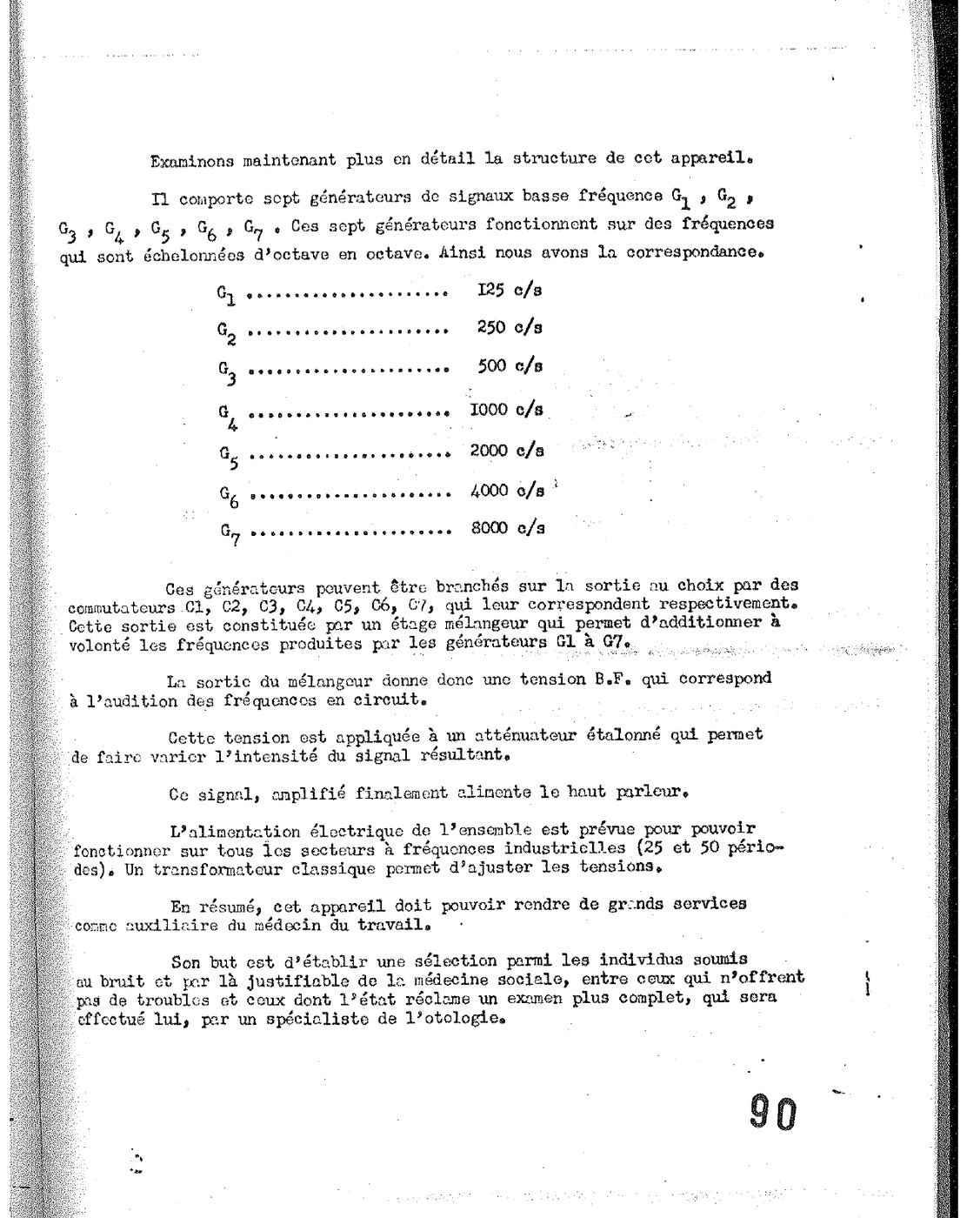
It comprises seven low-frequency signal generators G1, G2, G3, G4, G5, G6, G7. These seven generators operate on frequencies stepped from octave to octave. Thus we have the correspondence:
| G1 | 125 c/s |
| G2 | 250 c/s |
| G3 | 500 c/s |
| G4 | 1,000 c/s |
| G5 | 2,000 c/s |
| G6 | 4,000 c/s |
| G7 | 8,000 c/s |
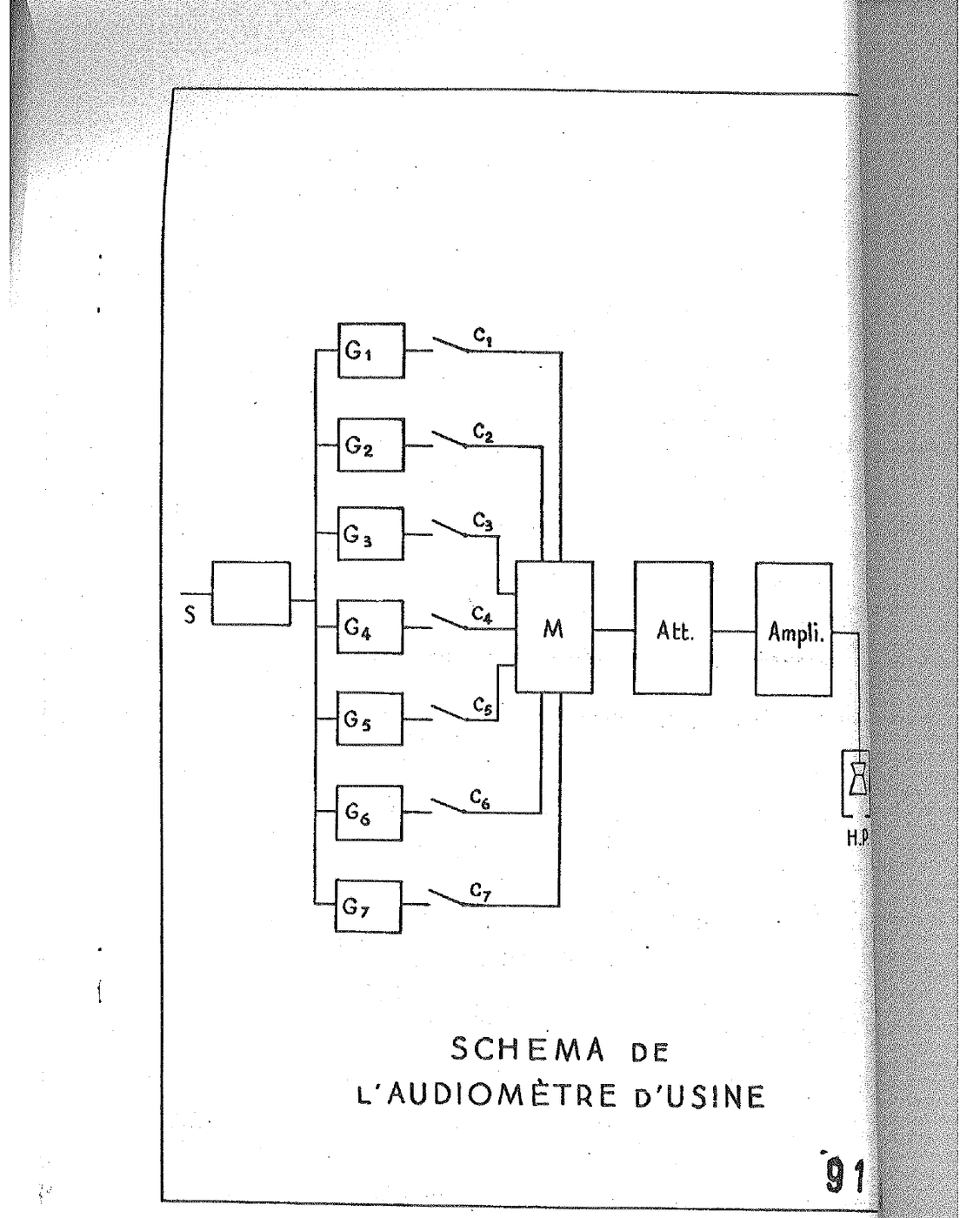
These generators can be connected to the output as desired by switches C1, C2, C3, C4, C5, C6, C7, corresponding to them respectively. This output is constituted by a mixer stage that allows the frequencies produced by generators G1 to G7 to be added at will.
The output of the mixer thus gives an LF voltage corresponding to the audition of the frequencies in circuit.
This voltage is applied to a calibrated attenuator that allows the intensity of the input signal to be varied.
This signal, amplified, finally feeds the loudspeaker.
The electrical supply of the whole has been designed to function on mains at industrial frequencies (25 and 50 cycles). A classic transformer allows the voltages to be adjusted.
In summary, this device should be able to render great services as an auxiliary of the occupational physician.
Its purpose is to establish a selection among individuals subjected to noise — and thereby falling under social medicine — between those who present no disorders and those whose state calls for a more thorough examination, to be carried out by a specialist in otology.
[Fig. 1 — Diagram of the factory audiometer: seven generators G1–G7 (125 to 8,000 c/s) connected to a mixer M by switches C1–C7, output to attenuator (Att.), amplifier (Ampli.) and loudspeaker (H.P.); S = mains input].
Source: Tomatis A., “L’audiomètre d’usine”, Bulletin du Centre d’Études et de Recherches Médicales de la S.F.E.C.M.A.S., October 1953, pp. 87-91. Digitised document from the personal archives of Alfred Tomatis.
Illustrated pages from the original document
Pages of the PDF facsimile containing figures, diagrams or audiograms. Depending on the original page layout, some pages may appear in landscape orientation.
Page 4 of the facsimile
Page 5 of the facsimile