Incidences observed in auricular lesions noted in test-bench personnel and professionals of the voice
The earliest known text by Alfred Tomatis, then Deputy Director of the research laboratory of the Société Française d’Étude et de Construction de Matériel Aéronautique Spécial (S.F.E.C.M.A.S.), published in the internal Bulletin of the Centre d’Études et de Recherches Médicales dated September 1952. Tomatis here reports the central discovery that would underpin his entire œuvre: some workers exposed to the most violent noise (120 to 140 dB) remain astonishingly preserved; and their audiogram — a “reserve curve” rising from the low to the high frequencies — is strictly identical to that of professionals of the voice, singers and musicians. It is from this clinical encounter that the three Tomatis laws would emerge two years later.
Historical note: this eight-page document (paginated 16-23 of the Bulletin) is in all likelihood the earliest scientific publication by Alfred Tomatis. It is also its matrix: “the voice contains only what the ear hears” is here already wholly contained, set out through a remarkable series of fourteen annotated audiograms.
BULLETIN OF THE CENTRE D’ÉTUDES ET DE RECHERCHES MÉDICALES OF THE SFECMAS
September 1952
Dr Tomatis
Deputy Director of the SFECMAS research laboratory
“Incidences observed in auricular lesions noted in test-bench personnel and professionals of the voice”
We have thought it of interest to report here some of the observations we have gathered in recent years, during which we carried out systematic audiometric examinations on several hundred individuals. All our subjects, whether engineers or workers, belonged to highly noisy industries — notably aircraft factories, with their boilermaking shops, their piston-engine test benches and, more particularly with present-day developments, their jet-engine test benches.
At first sight, we expected to discover only deaf subjects, so impossible did it seem to us that an ear could survive in sound environments of such appalling intensity, capable of reaching 120, 130, even 140 dB. Yet we very quickly had to revise our opinion, so numerous were the auditions that had remained intact despite very prolonged stays under such conditions.
We accordingly concluded that the factor of individual susceptibility must really be a substantial contribution, conferring on many individuals a sort of “invulnerability” to noise.
Moreover, among these privileged subjects, some — and we count around fifty out of about three hundred, or 1 in 25 — have an audiometric response curve which, far from drawing the classic 4,000 notch with its spread towards the high and then the low frequencies, reveals a relative hyperacusis in a zone that as a rule extends between 500 c/s and 2,000 c/s, taking the shape — as we have schematically represented (fig. I) — of a curve rising from the low to the high frequencies, with a difference in level varying from 10 to 20 dB.
[Fig. I — Diagram of the characteristic rising curve: audiograms left ear / right ear.]
We report here some chosen examples — one of a worker exposed to noise for four years, the other of a subject exposed for 21 years. On the right ear of each of these individuals, the same audiometric profile is noted in the 500 c/s — 2,000 c/s zone (fig. II).
[Fig. II — Four audiograms: worker exposed for 4 years / subject exposed for 21 years.]
Around the same time, about two years ago, we had occasion to treat two singers, both professionals, whose principal disturbance — by no means a minor inconvenience — lay in the impossibility of singing in tune; the first was convinced of the fact; the second, on the contrary, was unaware of it until two or three days before. Although neither acknowledged any apparent deafness, we nonetheless supposed that they presented a modification in their auditory acuity; this is what the following curves confirmed (fig. III).
[Fig. III — Audiograms of the two professional singers.]
One cannot speak, as can be seen, of hypoacusis, since the conversational zone was preserved, but one very quickly notes an inflection at the level of 1,000 c/s, with a fall in the higher frequencies.
We had, so to speak, only one result to obtain: to raise their curve in the 2,000 c/s zone. We obtained this transiently for the first and permanently for the second. As a result, while the latter no longer sang out of tune, the first began to sing in tune or out of tune according to the modifications, for better or worse, of their hearing.
These last audiometric curves struck us by their resemblance to those of our subjects invulnerable to noise. We then resumed our enquiry in the factory, and were surprised to find that all the subjects, without exception, whose hearing corresponded to an audiometric tracing identical to that just described (fig. I) were musicians, or at least had a musical ear in the broadest sense — that is, loved music, sang in tune, and above all — a very important fact for the pianist and more than a sentimental one — could reproduce an echo-voice, or, on which we particularly insist, could reproduce a musical phrase in tune. So much so, indeed, that very rapidly, by comparing these audiometric curves with subjects from other settings than the factories, we could tell from an individual’s audiometric tracing alone whether or not they were a musician. Thus, one day, we plunged a boilermaker exposed to noise for thirty-five years into considerable anguish by revealing to him the musical possibilities of his ear; he was in fact a tuner in town in his spare hours.
While it is not in doubt that hearing is an indispensable element of self-monitoring in the singer, its characteristics have never, to our knowledge, been defined.
Audiometry seemed likely to bring us some interesting elements, and so we decided systematically to take the audiogram of every musician, and above all of every singer, whom we should have the good or bad fortune to encounter. We have already gathered a quite considerable number, from which one may draw — if not with the rigour of a conclusion — at least some very precious information.
1° — All have an ear that presents the characteristics of the curve first described (fig. I).
2° — All have presented these characteristics on the right ear except for one: a left-hander. We reproduce here his audiogram (fig. IV).
[Fig. IV — Audiogram of the left-handed subject.]
Does this mean that any curve presenting these characteristics designates a musical ear? We should not allow ourselves to admit this in the measure of our present documentation, still too limited but nonetheless positive so far.
We have moreover, as further supporting evidence, the following few facts:
1° — We reproduce here the audiogram (fig. V) of a woman, a former piano concert artist, now a director’s secretary, incapable of externalising three notes without difficulty, although she could mentally retrace any musical trait whatever. This audiogram bears a striking resemblance — to such a point that they can be superimposed — to that of a professional singer who is likewise incapable of correctly and accurately reproducing one of those airs so often sung in the past.
[Fig. V — Former piano concert artist / professional singer.]
2° — The audiogram (fig. VI) belongs to a literature teacher, an enthusiast of music, struck by deafness in captivity, who since the appearance of this infirmity is no longer able to render — even by whistling — a musical phrase of which he retains a complete memory.
[Fig. VI — Literature teacher who became deaf in captivity.]
These first three subjects seem afflicted with a true “expressive amusia”.
3° — The following audiogram was taken from a woman, not a professional at least until then, endowed with a splendid mezzo voice but incapable in her upper middle register of singing in tune (fig. VII). We examined her in March 1952, then after treatment in May 1952, and finally in July 1952. One notes the progressively rising shape of the right ear, as her vocal miseries disappear.
[Fig. VII — Three successive audiograms: March 1952, May 1952, July 1952.]
4° — These two audiograms (fig. VIII) belong to two singers of great power, whose “reserve potentials” in their perception at 2,000 c/s seem very well preserved. Both complain of being unable to “enter their voice” without encountering a discomfort. They merely produce, with the echo-voice, a dazzling phenomenon — fortunately of short duration — yet sufficient to make them “derail” throughout the phrase that follows.
[Fig. VIII — Two singers of great power.]
5° — Finally, experimentally, we have acquired the following certainties:
a) By means of an easily realised arrangement, we enable an artist to hear themselves immediately.
-
First with both ears; nothing is then changed.
-
Then with the right ear: nothing is changed still.
-
Finally the left ear: the voice then suddenly becomes flat, monotone, devoid of quality, devoid of musicality.
b) Our arrangement allows us moreover to obtain at will an over-hearing of 10 to 20 dB by amplification at the level of the hearing pathway from 1,500 to 2,000 c/s. At once the ear, excited in these conditions, makes it possible to rectify the voice and to restore its initial characteristics.
c) Thirdly, we have been able to provide over-hearing to singers above their 1,000 c/s — 2,000 c/s zone.
It goes without saying that an ear is all the harder to disturb as its reserve potential is greater. As an example, here is the following audiogram, belonging to a professional singer, a singing bass, whose over-hearing allowed us to obtain a vocal change only after two minutes of dazzling (fig. IX).
[Fig. IX — Singing bass with high reserve potential.]
By contrast, it is easy to conceive that the progressive reduction of this “reserve potential” can be at the origin of numerous vocal disturbances, identical to those we have observed in experimentation. The auditory trauma generated by the voice manifests itself audiometrically as lesions analogous to those we encounter in factory workers.
One may be convinced of this by examining the two following audiograms:
[Fig. X — Comparison of two audiograms.]
-
The first is that of a singer of great renown who has been singing for about 25 years.
-
The second, that of an engine tuner for 25 years.
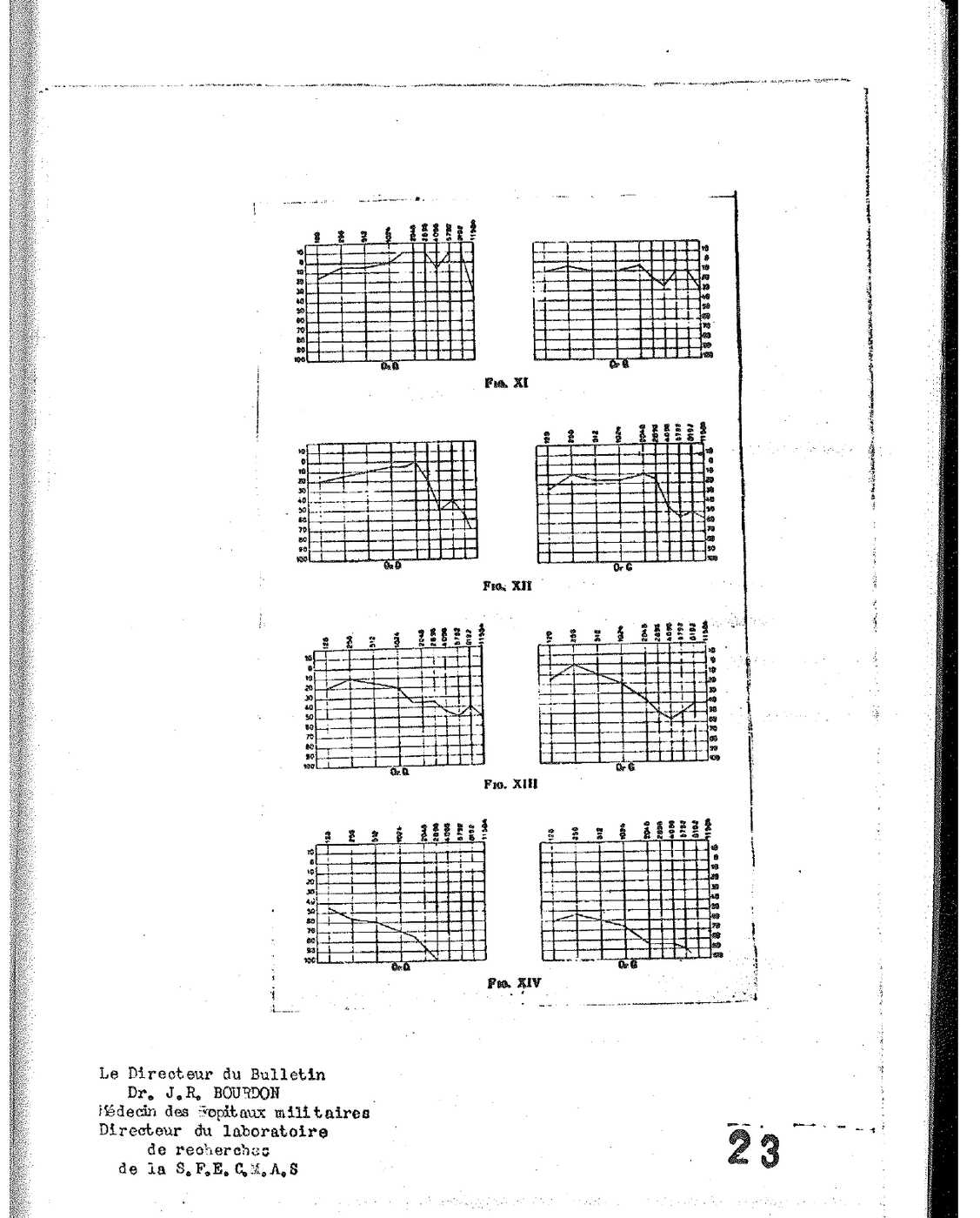
For documentary purposes, and bearing in mind individual susceptibility, we have placed the following audiograms side by side (fig. XI, XII, XIII, XIV):
-
The four on the left belong to factory workers,
-
the four on the right to singers.
They may illustrate, both the one and the other, as can be seen, the four stages of occupational deafness.
[Fig. XI to XIV — Four pairs of audiograms: factory workers (left) / singers (right), illustrating the four stages of occupational deafness.]
The Director of the Bulletin
Dr J. R. ROUNON
Physician of the military hospitals
Director of the SFECMAS research laboratory
Source: Tomatis A., “Incidences observées dans les lésions auriculaires constatées chez le personnel des bancs d’essais et les professionnels de la voix”, Bulletin du Centre d’Études et de Recherches Médicales de la S.F.E.C.M.A.S., September 1952, pp. 16-23. Bulletin directed by Dr J. R. Rounon, physician of the military hospitals. Digitised document from the personal archives of Alfred Tomatis.
S.F.E.C.M.A.S. = Société Française d’Étude et de Construction de Matériel Aéronautique Spécial — a French military aeronautics firm active in the 1950s, where Alfred Tomatis served as Deputy Director of the medical research laboratory and as such carried out systematic audiometric examinations of test-bench personnel.
Illustrated pages from the original document
Pages of the PDF facsimile containing figures, diagrams or audiograms. Depending on the original page layout, some pages may appear in landscape orientation.
Page 8 of the facsimile