Detailed Description of the Posture (Audiogenic Training)
Article by Guy Baleydier*, speech therapist in Montbrison (France),* March 1983*. Practical manual for the application of audiogenic training posture according to the method of Professor Alfred Tomatis.*
Introduction
The experience of audiogenic training, as described in Vers l’Écoute Humaine by Professor Tomatis, comprises two phases:
-
a phase of listening which, in posture, essentially mobilises the head and brings into play, of course, the ear and the nervous system attached to it;
-
a second phase in which the subject, without leaving this particular posture of listening, begins to speak or sing; he then mobilises his whole body.
The present detailed description — practical and anatomical — of the posture will not distinguish these two phases. We shall simply see how, in posture, to use the whole body to attain the level of listening, of true language and of pure singing.
The correct posture
[fig. 1: correct posture vs incorrect — pelvis correctly placed / miséricorde / ribs / lumbar arch]
The subject is seated, feet flat, slightly apart; hands open on the knees; spinal column quite straight.
The seating should preferably be on a hard seat, so as to bring about a counter-reaction of the gluteal muscles which already position the sacrum. To free the articulation of the pelvis, it is often preferable to have a raised seat (stool). On chairs, one must avoid leaning back, so as to acquire the habit of naturally recovering an image of the verticality of the body.
The subject then places his pelvis by effacing the arching of the lumbar curve and “locking” his abdominal musculature.
The role of the sacrum
Let us mention the very important role of the sacrum which, contrary to what has been claimed, is not a fixed bone. It must be anteverted with an infero-anterior rotation so that the vertebrae “stack up”, in such a way that the column takes on, in its verticality, a certain rectitude.
Sacrum means “sacred bone”. Why then is it sacred? Doubtless because it holds a primordial place in postures of humanisation. The Ancients knew this. They installed in churches, under the seats of the stalls, a piece of wood called the “miséricorde”, upon which the monks would rest the sacrum after raising their seat, so as to recite or sing well.
The ligament of Bertin
[fig. 2: role of the ligament of Bertin — pelvic bone / femur / ligament / sacrum]
It is known how difficult it is to verticalise oneself and to adjust one’s body-instrument in order to speak or sing. One of the elements which hinders this process of verticalisation is the ligament of Bertin. This is an enormous ligament — as thick as the thumb — whose mission is to attach the pelvis to the upper extremity of the femur.
The infant who wishes to stand up has much to do with it: as long as he has not succeeded in pulling sufficiently on this ligament, he finds himself with a hollowed back, and his sacrum cannot fall into place to give him his verticality. For the adult, this is also a problem.
The serious and regular practice of the posture, however, allows the lengthening of this ligament of Bertin, and consequently the placement of the pelvis and sacrum.
In addition to the ligament of Bertin, let us note the iliopsoas, stretched between the spinal column (D8 to L3) and the lesser trochanter of the femur.
The posture of the cross
[fig. 3: posture of the cross — clavicle / rib cage / horizontal line]
The subject then straightens his whole spinal column and pulls strongly on the nape backwards, as though tucking his chin in, forming a double chin.
Under the effect of the straightening of the spinal column:
-
the ribs rise, tending to become perpendicular to the axis of the spinal column;
-
the clavicles take on a horizontal position, forming the lateral branches of a cross;
-
the shoulder blades press against the back face of the ribs.
The larynx against the column
[fig. 4: poor singing posture vs good posture — larynx, oesophageal mouth, spinal column, oesophagus, diaphragm, nape pulled backwards, formation of a peau bun]
The larynx then leans back against the spinal column, transmitting the vibration to the cranial vault, then to the whole bony skeleton.
Let us recall that the larynx is a mobile organ: it can be displaced vertically on the one hand, and from front to back on the other. Thus, in a relaxed posture — when one is eating, for instance — the oesophageal mouth finds itself interposed between the larynx, which is in front, and the spinal column, which is behind.
In the listening posture, by the straightening of the column and the pulling back of the nape, the oesophagus being inextensible, the oesophageal mouth is drawn downwards. The larynx then passes above the oesophageal mouth and goes to lean back against the vertebrae. The larynx then functions like the soul of the cello — that small piece of wood which transmits the vibration to the back plate of the instrument. The vibration of the vocal cords can thus be transmitted to the bony skeleton by this contact between the larynx and the spinal column in the lower cervical region, since there is no longer any interposition between the larynx and the spinal column.
Position of the head and of the ear
[fig. 5: correct position of the head in the posture of listening and singing — horizontal plane / opening of the external auditory canal / closed upper eyelid]
[fig. 6: position of the internal structures of the ear — labyrinth / utricle and semicircular canals / saccule]
In this posture, the nape is pulled back as we have said. The head is slightly inclined downwards, forming a slight double chin. More precisely, a horizontal line must pass through the edge of the closed eyelid and through the hole of the right ear. The achievement of this angulation reflects the setting in place of the internal structures of the ear in a position of optimum functioning.
The physiological “lifting”
The face is solicited by a gentle tension with the formation of a peau bun at the top and back of the skull. In fact, all the skin of the skull is drawn upwards and backwards. The points of the ears are also drawn in the direction of this same skin bun. One thereby achieves, by the way, a true physiological “facelift”. Wrinkles and tensions disappear. To the observer, the subject’s face appears rejuvenated, particularly beautiful and harmonious.
The lips of a subject who is listening are always (observe this around you) slightly pushed forward, and in particular the commissures (the corners of the lips) must not be retracted, for this inhibits the functioning of the muscles of the middle ear.
The diaphragm and respiration
[fig. 7: diaphragmatic movements — diaphragm / amplitude of displacement]
For the subject who applies the posture correctly, the clavicles are horizontal, the shoulders pulled back, the thorax very open, the diaphragm becomes a free dome, participating alone in respiration — which becomes exclusively diaphragmatic. But let us explain ourselves.
The thorax is therefore open, and it participates only in posture. It becomes a true undeformable acoustic enclosure. It will no longer be mobilised by respiration. If it lowers during sonic emission, the voice loses its richness.
The ribs, once in place, must therefore no longer move. Only the diaphragmatic vault rises and falls to the rhythm of respiration, in accord with the rhythms transmitted — in total harmony with the cosmos — by the sympathetic system.
The stretching of the column and the coronal point
[fig. 8: listening posture — nape pulled back / pituitary gland / pineal gland / hairline / axis of direction of the peau bun]
The last operation to perform for a “perfect” posture is the stretching of the spinal column. It is pulled upwards — as though one wished to gain a few centimetres — to become a vibrant, living, conscious column!
The highest point of the body is then situated roughly at the origin of the spiral of the hair, at the vertex, at this coronal point which is in the axis of the pineal and pituitary glands. It is here that one must learn to situate one’s listening, at this point of fusion of the two polarities, of the left within the right. Then, consciousness can extend upwards.
Voluntarily, we must make an effort to listen with the right ear by seeking to perceive the high frequencies, by eliminating the low frequencies. Listening will then shift towards the summit of the skull, then above it.
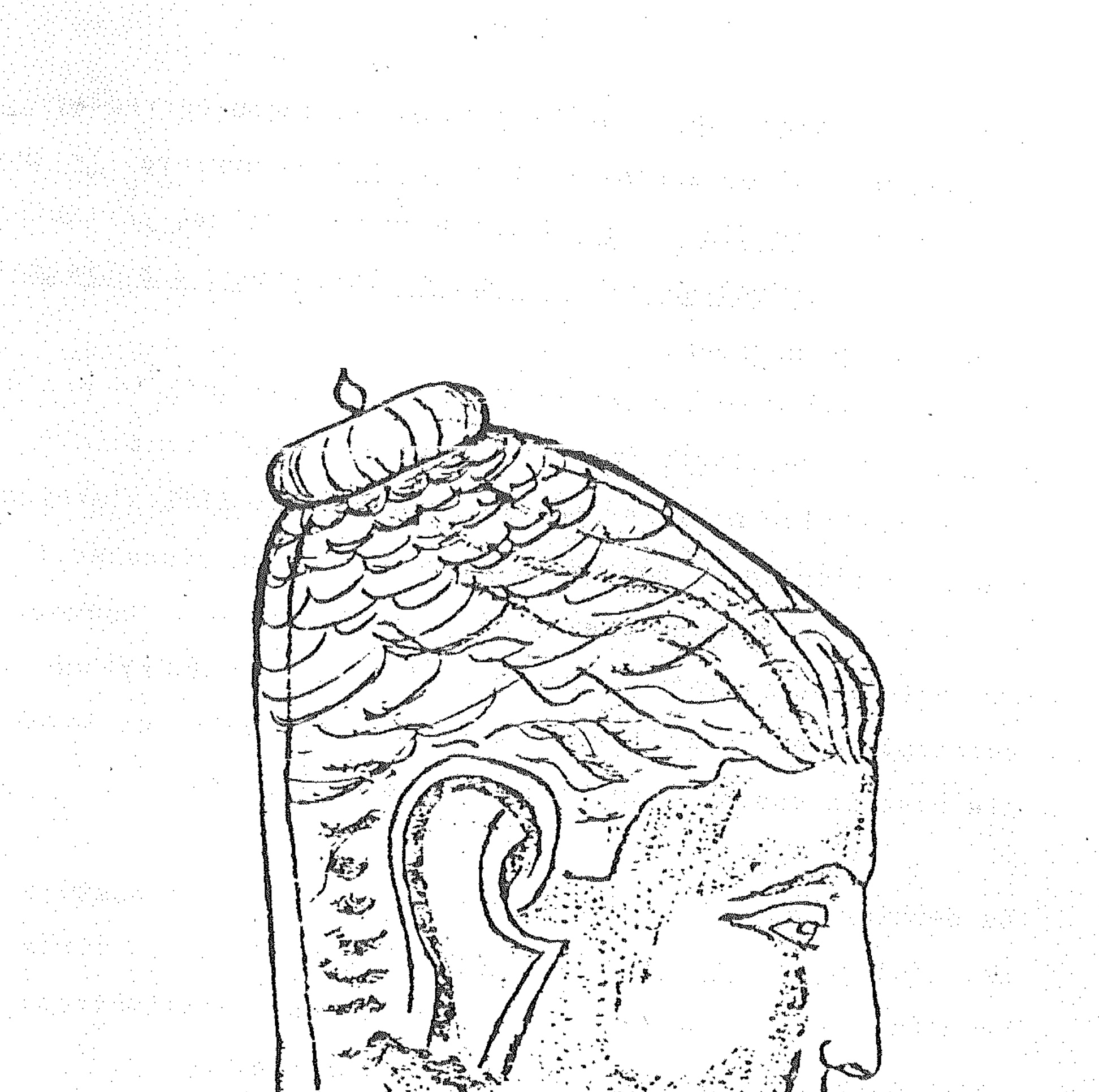
Final plate of the document: the head of the Buddha — peau bun at the summit of the skull, ear drawn upwards, serene face — embodies the optimal listening posture described in this article.
— Guy Baleydier, speech therapist, Montbrison (France), March 1983.