The Tomatis Effect and the Electronic Ear for the Acquisition of Modern Languages
The Tomatis Effect and the Electronic Ear for the Acquisition of Modern Languages — Lecture at UNESCO (11 March 1960)
Lecture given by Dr Alfred Tomatis on 11 March 1960 at the UNESCO Palace, and published as an offprint by the Centre du Langage (10, rue Lyautey, Paris XVIe). Before an international audience, Tomatis presents the theoretical framework underpinning the “AURELLE” Electronic Ear: language as the “ultimate stage of a transcendent adaptation”, the closed audition-phonation loop, the racial auditions and the listening conditionings specific to each language, and the use of an electronic apparatus which allows the recovery, in adulthood, of “the auditory conditions of initial integration, those which permitted us the assimilation of our mother tongue”.
The TOMATIS Effect
and
the Electronic Ear for the Acquisition of Modern Languages
Doctor TOMATIS
Lecture given on 11 March 1960 at the UNESCO Palace
Offprint — Centre du Langage, 10, rue Lyautey, Paris XVIe. Pagination: 200-205.
I. — Language, the ultimate stage of a transcendent adaptation
Language appears, in the last analysis, as the ultimate stage of a transcendent adaptation which has been able to condition, to acoustic ends, a neuromuscular ensemble destined for deglutition and respiration.
It is under the imperative impulse of the sensory awareness of our auditory receptor that there awoke in us the need to exploit the sonic possibilities of this exceptional instrument placed at our disposal: Air.
Information was born of the awareness of this vector, of this sonic vehicle. The enrichment which flows from it leads progressively to the structuring of languages whose extreme variety remains a function of three essential factors:
-
a) the acoustic possibilities of an ambient environment;
-
b) the adaptation of the ear to perceive these sonic phenomena;
-
c) finally the possibilities of reproducing these phenomena with a view to communication.
This circuit, this closed loop, demands of course an overall coordination whose precision of execution could only be elaborated slowly, and arrives at perfection only through an organisation ever more delicate and refined of circuits, of relays, of connections ever more complex and appropriate.
It is thus that so many organs originally destined for different uses have found themselves associated to conjugate their efforts in one and the same functional direction.
According to the richness of the ambient environment, according to the flowering of the neuromuscular ground, according to the suppleness of adaptation, in addition as a function of the neurological inductions and the chain reactions triggered at the different stages of the cerebral tree, as a function of the persistencies, of the memorised peri-axial inductions, of the increasingly precise sensory monitorings, the comparative reproductions were established, discriminations appeared, the muscular synergies of the finest, most discreet, most complex order, which permit the externalisation at will of the fathomless possibilities of Thought, were elaborated — affording it a support of expression, enlarging its field of escape, developing its flowering.
II. — To hear and to reproduce, to listen and to repeat
These actions, their reactions, the counter-reactions that these actions determine, do not fail to encounter in their turn resistances, do not fail to give rise to resonances, to engage interferences.
To hear and reproduce, then to listen and repeat, finally to hear and listen to oneself repeating or reproducing — such are the different stages we seem to climb in the manner of elaboration of our language.
The child benefits from the outset of the millennial acquisitions, refined, adapted to the best of the various organs which must henceforth come into function in his phonation; but he must, from his first efforts, obey the demands of his audio-vocal circuit.
It is here a true closed loop, common to every servo system, conforming to every “feedback” network, governed by the laws and rules of cybernetics.
Language, indeed, in the precise aim of being an information for others, is found to be conditioned by a well-determined mechanism. The first to be informed is not the one one thinks, the listener to be interested in the occurrence, but the very subject who communicates — so much so that every voluntary act of communicating by means of an acoustic phenomenon implies, for its creation, its interpretation, its expression, a rapid, effective, permanent and conscious self-monitoring.
[Diagram — Voluntary act → Informer; self-information monitored by the ear in a return loop.]
III. — The Audio-vocal Effect
Thus, to speak is to hear, but also to speak in a certain manner is to hear and to monitor oneself in a certain manner.
However evident and however satisfying this observation may be on the theoretical plane, it has nonetheless been buttressed by extensive experimentation.
We have demonstrated in the laboratory, for some ten years, that any modification of audition, whether acquired or provoked, brought about, ipso facto, a modification of the voice.
This “Audio-vocal Effect” is characterised moreover by phonatory modifications bearing on timbre, on the organisation of the phonatory apparatus, on the use of the supra- and sub-laryngeal resonance cavities, on the laryngeal tonus, on respiration, on facial expression — modifications which react in chain by reflex ignition, extending step by step to the whole morphological structure of the subject.
It is, without doubt, the demonstration of the capital influence of the auditory receptor in the integration of language, in psychological enrichment, in the mode of expression and its self-monitoring, in the bodily and gestural behaviour, in the engagement and then the elaboration of numerous circuits of psychosomatic induction.
IV. — How does this auditory receptor function?
Made up, as is known, of an ensemble of multiple organs, it comprises three stages whose aim is to capture the sound, to handle it, to transform it, to weigh it, to analyse it and to distribute it, at the level of the keyboard of the sensory neurons, to the various uses from which the definitive image flows by the induction of numerous circuits.
All this auditory mechanism, which calls upon so many successive operations, is not — as one conceives — instantaneous. There is here a more or less rapid, more or less complex accommodation according to the external solicitation of the ambient environment. This accommodation demands an adaptation of the so-called “transmission” stage, that is to say of an osteo-muscular ensemble free in its movements, capable, by greater or lesser muscular tension, of determining the spatial position of the ossicular chain so as to open at will such or such auditory pass band, to enlarge as needed the aperture of the diaphragm.
Thus, rapidly, as a function of the acoustic environment, according to the use one makes of it, the ear will adapt itself from the outset to the best of its interest in integrating to the maximum the surrounding sonic background.
Thanks to the play that puts in presence the choice of a determined pass band and the time of accommodation of the whole apparatus, we shall have a varied gamut of auditory preparations which will differentiate and largely characterise various modes of hearing.
To be sure, the auditory complex always corresponds to a possible conditioning of the stages of the organs of phonation. Were it otherwise, self-monitoring would be impossible, and thereby audio-vocal language non-existent.
One readily conceives the whole interest of the return loop in illuminating the reciprocal repercussions of audition upon the voice, and vice versa of the voice upon audition.
V. — Experimental characterisation of modes of listening
Armed with this experimental discovery, there was nothing left to do but to determine the different ways of hearing: it sufficed to establish, on the one hand, the accommodation curve of the various auditions — each being specific to a given group — and, on the other, knowing the time, to specify the auditory gait which determined this accommodation. This was done in the laboratory.
VI. — The AURELLE Electronic Ear
The AURELLE Electronic Ear puts into practice what ten years of research have allowed to crystallise.
Thanks to its characteristics, it allows the superimposition upon any subject, even the most refractory, of a predetermined audition, thereby obliging him to hear according to a chosen accommodation.
By a play of filters, it offers in the first place the possibility of an auditory diaphragmatic opening upon such or such pass band — a simple fact which already determines a laryngo-resonantial response adapted to the use of the filters imposed. In the second place, it brings out the latency time inherent in the chosen accommodation, which conditions the time of response of the laryngo-resonantial adaptation, the origin of intonation.
The interest aroused by such an apparatus in the learning of modern languages proves to be of capital importance, and renders fit for the integration of foreign languages any subject hitherto impermeable.
It allows the creation of the ambient climate so indispensable to the psychological imbibition of a foreign language.
Moreover, its influence is highly euphorising by:
-
the ease of elocution;
-
the automatic preparation of the organs of phonation, immediately adapted to the use of the chosen language;
-
the integration whose rapidity often proves disconcerting.
In a way, thanks to AURELLE, we recover the auditory conditions of initial integration, those which permitted us the assimilation of our mother tongue.
Dr A. TOMATIS
Source: Tomatis A., L’Effet Tomatis et l’Oreille Électronique pour l’acquisition des Langues Vivantes, lecture given on 11 March 1960 at the UNESCO Palace. Offprint — Centre du Langage, 10, rue Lyautey, Paris XVIe, pp. 200-205. Digitised document from Alfred Tomatis’s personal archives.
Editor’s note: the transcription was established from a typewritten offprint of which certain passages present reading uncertainties (clogged characters, original typing errors). Rare or unusual turns of phrase have been preserved as such whenever the meaning remained clear, in order to preserve the author’s voice.
Figures from the original document
Diagrams and illustrations from the PDF facsimile of the original article.

Figure 1 — facsimile p. 1
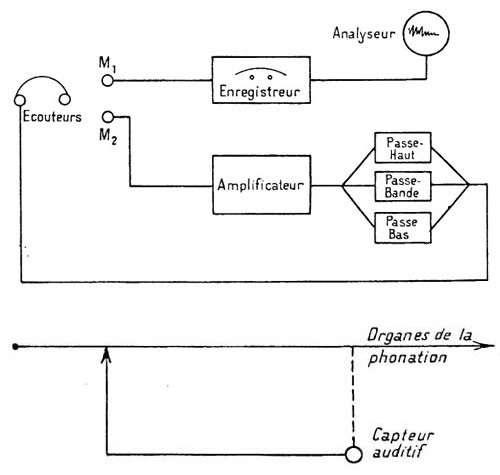
Figure 2 — facsimile p. 2
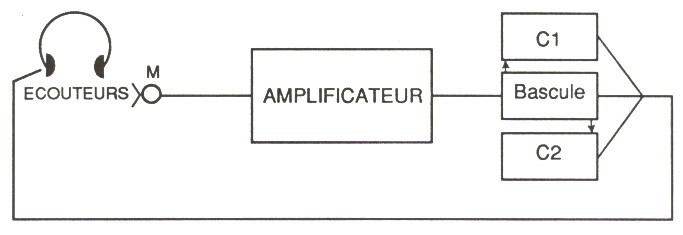
Figure 3 — facsimile p. 3