La Libération d'Œdipe (1972)
Alfred Tomatis’s third major book, published by Éditions ESF in the “Sciences de l’éducation” series directed by Daniel Zimmermann. Subtitled From intra-uterine communication to human language, the work unfolds one of the author’s most audacious theses: it is in uterine life that man’s linguistic destiny — and more broadly his existential destiny — takes root. The resolution of the Oedipus complex finds here, for the first time in the scientific literature, an auditory reading that profoundly renews classical psychoanalysis.
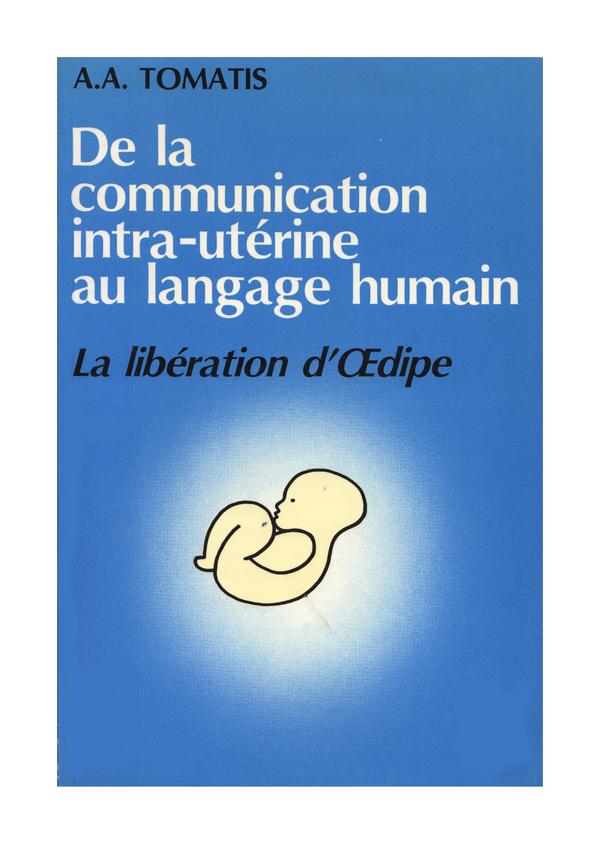
“The whole human journey has here a well-defined meaning, the very one that leads man, from his emergence out of the uterine night, to construct himself through his language and to become what he is according to his linguistic cursus.”
— A.A. Tomatis, Author’s note
Presentation
When Tomatis writes La Libération d’Œdipe, he has just completed the pedagogical trilogy inaugurated with L’Oreille et le Langage (1963) and Éducation et Dyslexie (1972). This work, which he regarded as the crowning of his thought during the 1970s, dares to carry the debate onto the terrain of psychoanalysis — a discipline with which he sustained complex and fertile relations. The central thesis is well known, but it is here deployed in its full breadth: listening begins before birth; the fœtus hears the mother’s voice filtered by the amniotic fluids, and it is this intra-uterine listening that lays the first foundations of the language to come.
The myth of Oedipus is transformed by it. Where Freud reads a drama of desire, Tomatis reads a drama of severed communication: Oedipus is the one who does not hear himself, who does not listen, and who must, in order to become a man, retrace the sonic path leading from the maternal to the paternal voice, from the enveloping low frequencies to the structuring high ones. The Œdipean liberation thus becomes a labour of listening, of which audio-psycho-phonology offers itself as the clinical tool.
The work articulates embryological, neurophysiological, linguistic and psychoanalytic data into a synthesis without equivalent at the time. Fifteen years later, when Tomatis prepared the new edition (1989), he would observe that “nothing is to be changed in the flow of thought” — the work “retains its complete novelty, its educational reach and its therapeutic value”.
Contents
The work unfolds in several major stages:
-
Of intra-uterine communication — how the fœtus listens, what it hears, what it integrates.
-
Birth and the conquest of language — from the primal cry to the first words, the role of the maternal and then the paternal voice.
-
Childhood and lateralisation — how the directing ear is established, how the body scheme is set in place.
-
The Oedipus complex re-read — an auditory reading of the myth: Oedipus deaf to the oracle, Oedipus deaf to his mother, Oedipus deaf to his father.
-
Liberation — the clinical and educational paths by which the ear can be reopened, revived, reintegrated.
Place in the work
Together with L’Oreille et le Langage (1963) and Éducation et Dyslexie (1972), La Libération d’Œdipe forms the trilogy on which the theoretical edifice of audio-psycho-phonology rests. Tomatis here lays the foundations of what he would develop in all of his subsequent works: La Nuit utérine (1981), Neuf mois au paradis (1989), L’Oreille et la Voix (1987). It is the book in which classical psychoanalysis meets, for the first time on an equal footing, auditory neurophysiology.
In brief
La Libération d’Œdipe is the work that swings Tomatissian thought from the pedagogical domain to that of depth psychology. Drawing on some hundred and twenty thousand cases followed in his clinic, the author demonstrates that the quality of intra-uterine — then post-natal — listening very largely determines the quality of the subject’s inscription in language, and therefore in humanity. Demanding but captivating reading, to be recommended to every psychoanalyst, psychologist, paediatrician, midwife and, more generally, to every adult attentive to the mysterious birth of meaning.
Available in libraries — BnF, Sudoc.