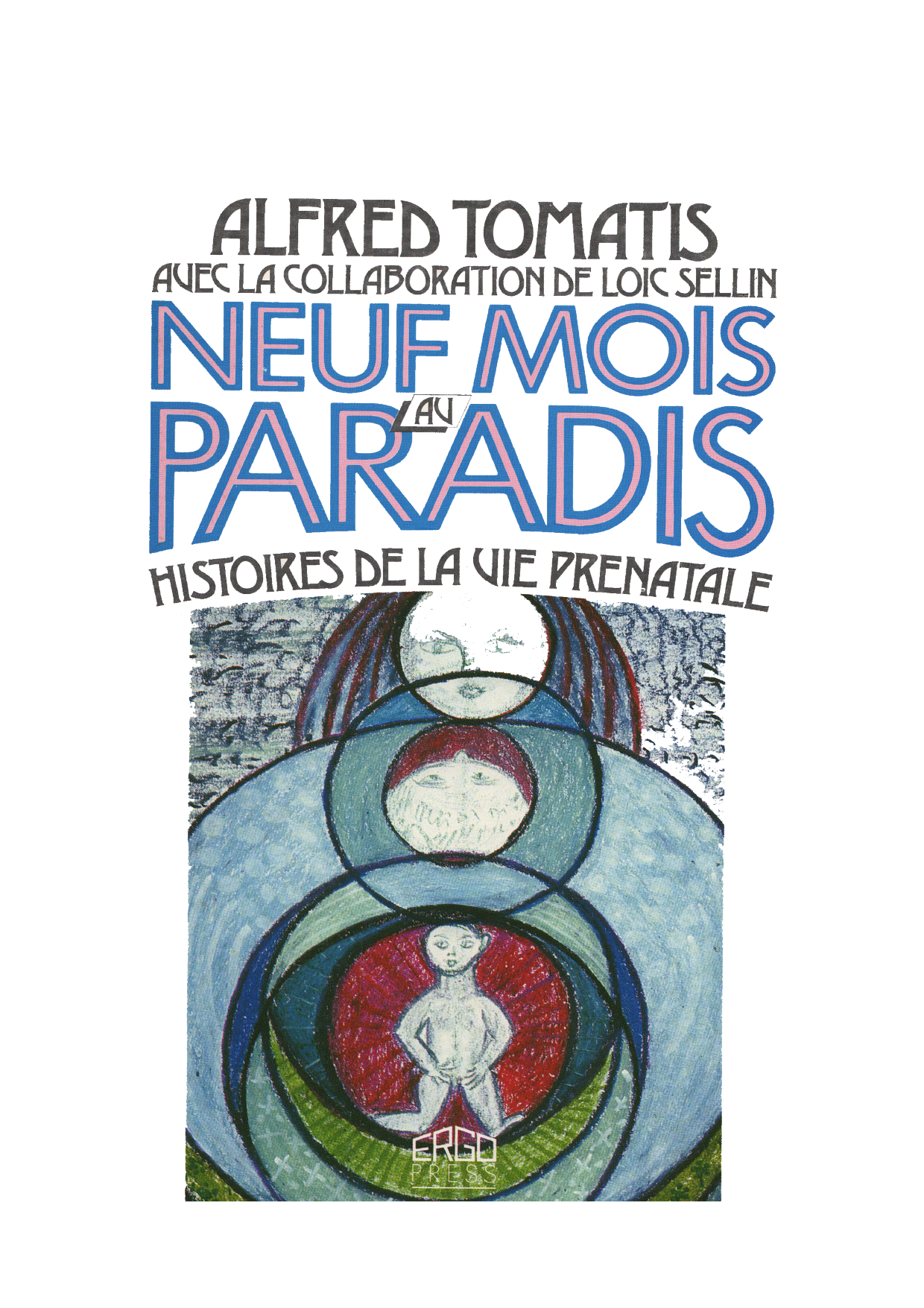
Neuf mois au paradis (1989)
A general-audience best-seller, published by Éditions Ergo Press in 1989, in collaboration with Loïc Sellin. The book brings into popular debate the research that Tomatis had been pursuing for forty years on intra-uterine sonic life. At a time when the fashion for “Mozart babies” was spreading without always knowing quite what it claimed to stimulate, Tomatis sets the record straight: yes, the fœtus listens; yes, it is impregnated by the maternal voice; but no, it is not enough to place a pair of headphones on the rounded belly to manufacture geniuses.
“The fœtus listens; from the first days of its life it has its own cognitive capacities and its psychology. But when I began to take an interest in these phenomena, in the mid-1950s, there was nothing. I was preaching in a desert of indifference and hostility.”
— Chapter 1 — A little night music
Presentation
In 1989, prenatal listening had become a commonplace. The newspapers were multiplying articles on the “motor reactions of the fœtus to Stravinsky”, the Amsterdam university hospital was broadcasting music to premature babies in their incubators to reduce their oxygen consumption, and the “Mozart babies” were filling the columns of magazines. Tomatis, who had been ridiculed forty years earlier when he published his first observations to the Académie de médecine, decided to set things back in order — without triumphalism, but with a new firmness.
Neuf mois au paradis is conceived as a general-audience book, accessible in tone, sometimes polemical, often militant. The short chapters, the lively writing (often in dialogue with Loïc Sellin), the use of precise clinical cases and of examples drawn from the contemporary press, make of it a text that can be passed from hand to hand. It is one of Tomatis’s most widely read books, translated into about a dozen languages.
The argument follows three lines: (1) yes, the fœtus listens, and it does so from much earlier than was thought — the inner ear is functional from the 18th-20th week; (2) the mother’s voice prevails over everything — it is her voice that impregnates the psychoacoustic system of the fœtus, and not any ambient music; (3) the uterine “paradise” continues in the quality of the post-natal dialogue — there is a psycho-acoustic continuity between pregnancy and the first months of life.
Contents
-
A little night music — a survey of research into fœtal hearing in 1989.
-
The fœtal ear, an early organ — embryology of prenatal hearing.
-
The mother’s voice, first sonic landscape — what the fœtus hears and how.
-
Being born, or the acoustic rupture — birth as a radical sonic shift.
-
Tomatissian filtered listening — how re-education makes it possible to retraverse, after the fact, what may have been missing.
-
Clinical cases — autism, language delays, maternal depression, twinning…
-
On the proper use of “Mozart babies” — critique of ill-informed fashions, plea for an enlightened parenthood.
Place in the work
Neuf mois au paradis follows on from La Nuit utérine (1981) by giving it a more accessible, more militant and more polemical tone. It is the book through which many future parents discover Tomatis’s thought. The concepts are identical to those of La Nuit utérine, but the rhetoric has changed: Tomatis explicitly defends his priority against the pseudo-scientific fashions proliferating at the end of the 1980s.
In brief
Indispensable reading for every expectant parent, for midwives, paediatricians, obstetricians, perinatal educators. The book reads in a few evenings and lastingly upsets the conception one has of pregnancy. To be recommended also to every pregnant woman who questions the attention to be given to her own voice, to her emotions, to her silent dialogue with the child she carries.
Available in libraries — BnF, Sudoc.