Audio-vocal conditioning (Académie de Médecine 1960)
Communication by Alfred Tomatis presented to the Académie nationale de médecine by M. Moulonguet and published in the Bulletin de l’Académie Nationale de Médecine (vol. 144, nos. 11 and 12, 1960, pp. 197-200). In four dense pages Tomatis sets out the experimental apparatus he had developed since 1947 — microphones, amplifier, filters, gating — to condition phonation durably through hearing, and its application to the integration of foreign languages in the modern-language laboratories of the Audio-Visual Centre at the École Normale Supérieure of Saint-Cloud.
Audio-vocal conditioning
by M. Alfred Tomatis
(Presentation made by M. Moulonguet)
Printed with the periodical Bulletin de l’Académie Nationale de Médecine — Vol. 144, nos. 11 and 12, 1960, pp. 197-200.
I. — Introduction
As early as 1947, struck by the constant parallelism between the audiometric examination of a subject and the envelope curve of the spectral analysis of their voice, I undertook to study the reactions and the feedback effects of hearing upon vocal emission.
I then used two electronic set-ups:
The first allowed the harmonic decomposition of emitted sounds to be visualised;
The second made it possible to modify at will the hearing of the subject undergoing the experiment.
The subject spoke in front of two microphones M1 and M2.
M1 captured the sound for the benefit of a recorder which then permitted the spectral analysis of the sound;
M2 fed an amplifier whose response characteristics at the level of the earphones could be modified at will by means of a set of filters (high-pass, low-pass, band-pass), thereby allowing the subject’s way of hearing to be altered at will and, in this instance, their manner of self-monitoring.
The truly extraordinary importance of the feedback effects that emerged allowed me to assert a genuine closed-loop circuit of self-information whose monitoring sensor, at the moment of emission at the level of the phonatory organs, was none other than the ear, and that any modification imposed upon this sensor instantaneously brought about a considerable modification of the vocal gesture, easily detected visually, aurally, or in any case physically verifiable on the cathode-ray tube.
Accordingly, as early as 1954, I could state that “the voice of a subject contains only the harmonics that their ear is capable of hearing”.
Subsequently, various experimenters confirmed these data, and M. Raoul Husson, taking up this study again in 1957 at the prompting of Professor Monnier in the Laboratoire de Physiologie des Fonctions at the Sorbonne, grouped this set of audio-phonatory feedback effects under the name “Tomatis Effect”.
II. — Realisation of an audio-vocal conditioning
Being assured, in absolute terms, that a mode of vocal expression specific to a given task — therefore a conditioning of the whole phonatory apparatus manifested as a recognisable vocal gesture — corresponds to a manner of hearing determined by a more or less complex conditioning of the whole auditory apparatus, and being assured moreover that any modification of this manner of hearing generates a modification at the level of the phonatory gesture, I sought to set in motion an audio-vocal conditioning whose importance is considerable from the therapeutic point of view, in dysphonias, in vocal education, and in the very search for a vocal aesthetic.
[Fig. 1 — Diagram of the apparatus: earphones, microphones M1 and M2, recorder, analyser, amplifier fitted with high-pass / low-pass / band-pass filters.]
[Fig. 2 — Audio-phonatory regulation loop: organs of phonation ↔ auditory sensor.]
To trigger a conditioning capable of modifying emission amounts to compelling the ear to hear the emission of a sound in a certain way. In other words, the vocal gesture which we shall call G1, and which results in an emission E1 of poor quality, corresponds — as we now know — to an overall hearing A1. To correct gesture G1 and see it transformed into G2, a vocal gesture capable of emitting sounds E2 of fine quality, is simply to compel the ear to adopt a mode of accommodation that determines the way of hearing sounds.
Hence, in order to efface gesture G1 and to see gesture G2 appear in its stead, it suffices to condition hearing to a new mode of accommodation of the frequencies of sound emission.
To bring about this conditioning, I have for several years used the following arrangement:
A microphone M feeds an amplifier from which two distinct circuits emanate, these two circuits forming two channels that do not operate simultaneously.
[Fig. 3 — Microphone M feeding an amplifier, which supplies two channels C1 and C2 switched by a gating device, returning to the earphones.]
For a given intensity, adjustable at will, channel C1 alone remains open. It allows the subject undergoing the experiment to listen to themselves, as is customary. If, although knowing nothing has been changed, the subject modifies their emission of a sound, then as soon as they add to the ever-present ambient noise an intensity that exceeds a threshold above what they produce, channel C1 closes and only channel C2 opens. This second electronic channel constrains the ear to a different mode of monitoring, which we shall have chosen — that which corresponds notably to the emission of a fine voice. In other words, the opening of channel C2 merely allows the subject to hear, inherent in gesture A2, and to switch automatically to the way A2 of hearing, proper to the sought-for gesture G2.
Once the vocal emission has ended, the intensity reduced accordingly causes the system to switch back the other way, and channel C2 opens while C1 fades away. This rule begins anew each time the subject wishes to speak, and the conditioning takes hold very rapidly. From the first days onwards, after a half-hour session, an after-effect of around half an hour remains. After a fortnight, it becomes permanent.
Moreover, this gating mechanism can quickly become a conscious phenomenon, allowing the chosen mode of hearing to be obtained at will.
With a view subsequently to modifying the rhythm and the intonation of speech, I altered the engagement time of the gating mechanism and, having further determined “racial hearings” — that is, distinct ways of hearing — I applied this technique to the integration of foreign languages.
Indeed, the various ways of hearing are characterised:
a) by pass-bands giving the auditory monitoring apparatus specific response curves;
b) by the time T required to achieve the auditory adaptation which permits the realisation of this curve.
Linguistic integration proves extremely rapid, and its application in the Modern-Language Laboratories at the Audio-Visual Centre of the École Normale Supérieure of Saint-Cloud constitutes its most important experimental proof.
Source: Tomatis A., “Conditionnement audio-vocal” (presentation made by M. Moulonguet), Bulletin de l’Académie Nationale de Médecine, vol. 144, nos. 11 and 12, 1960, pp. 197-200. Offprint printed by Masson et Cie, publishers, Paris (legal deposit 1966, 1st quarter, order no. 4357). Digitised document from the personal archives of Alfred Tomatis.
Figures from the original document
Diagrams and illustrations taken from the PDF facsimile of the original article.

Figure 1 — facsimile p. 1
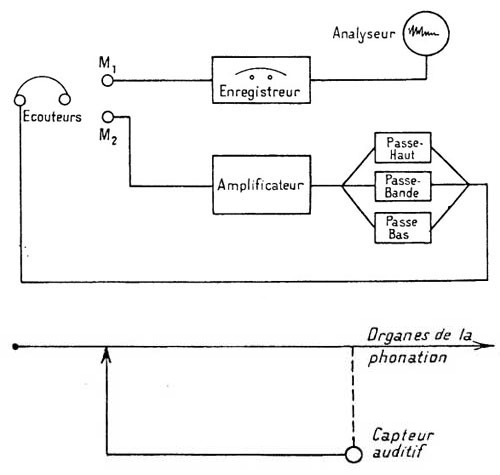
Figure 2 — facsimile p. 2
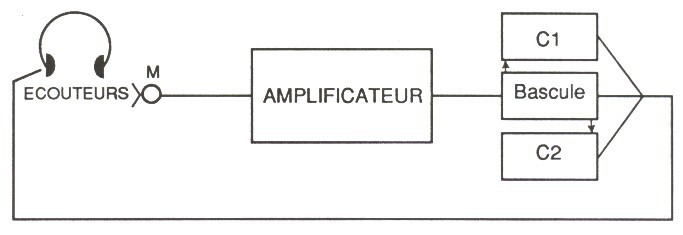
Figure 3 — facsimile p. 3