Audition and phonation
Audition and phonation — Their reaction and counter-reactions (Helsinki, 4th International Congress of Phonetic Sciences, 1961)
Communication by Alfred Tomatis at the 4th International Congress of Phonetic Sciences held in Helsinki in 1961, published in 1962 by Mouton & Co in the Proceedings of the congress (pp. 389-399). Before an audience of phoneticians and linguists, Tomatis formalises the Audio-psycho-phonation triptych: language as a closed circuit of self-information governed by cybernetics, the directing role of a single ear, the mechanism of “physiological delayed feed-back” in stammering, and the strict parallelism between auditory scotomas and vocal scotomas, demonstrated by audiometric dazzling.
Audition and phonation — Their reaction and counter-reactions
by A. TOMATIS
Proceedings of the Fourth International Congress of Phonetic Sciences, Helsinki 1961 — Mouton & Co, 1962, pp. 389-399.
Our communication wishes to place on the agenda audition and phonation, which it claims to approach not as two entities to be studied — so often treated and so deeply studied — but as a whole, as an ensemble in which their action and reactions are interwoven in a solidly framed intimacy.
We would have preferred to grant this short paper the title of “introduction to audio-psycho-phonation”, but the fear of imposing a neologism without prior initiation has led us to incline towards a more familiar but less precise definition. We remain nevertheless convinced that the triptych “Audio-psycho-phonation”, which we long ago adopted, more satisfactorily circumscribes the very object of our work. Furthermore, it defines with exactitude the frontiers of a department which it is proper to annex to the phonetic sciences.
To consider, in one and the same individual, audition and phonation as a whole, to seal their union with a psychological link, is to conceive language under a fairly new aspect.
It is thus that the customary view of language, and notably of oral language, the particular object of the present study, calls upon notions of information, of communication directed to another — indeed an informed party. The latter ripostes in turn with similar capacities, thus motivating the setting in motion of a closed circuit whose extreme poles are the informer and the informed, who, alternating their roles, play at times as emitter, at times as receiver. This manifests itself, on the information plane, by a cybernetic loop of higher complexification, whose simplest diagram is reproduced below.
It brings out the role of the informer, equipped with a cortex and a mouth in function, and of the listener, equipped with the ear in function, his cortex and his mouth, to intervene in the reply in the capacity of the informed party, addressed to the ear of the new informed party, who is none other than our first speaker.
Thus, in a back-and-forth play, a kind of sonic tennis, we can return the acoustic ball with more or less agility, skill, dexterity. This feature, what we know how to emit, what we know how to receive, is the message.
Yet, in information, the first informed party is not already the informer himself. This is the essential point we wish to develop here. To be sure, we shall not stray
[Fig. 1 — Information loop: Informer (Cortex → Mouth) → Ear → Informed Cortex, and symmetrical return in the opposite direction.]
at diagram no. 1, we see that the message, released into space, is directed towards the listening ear, but this message has meaning only because it has been controlled at every moment in its various parameters. It is emitted with an intensity that must be sufficient to reach the ear of the informed party; furthermore, the timbre of voice granted to it must be identical to that of the speaker; the intonation makes apparent as much inflection as the subject seems to desire; the rhythm, becoming more or less slow, more or less jerky, translates the intention of the informer; the coherence of the discourse, lastly, denotes to what extent the language has undergone a control of all these elements.
Thus, the notion to be brought out is that of self-information. It makes apparent the setting into function of self-control in the essential role of imposing a regulation. The speaker thus also obeys the rules imposed by this cybernetic regulation, the study of which reveals how much that is mechanical there is in the physiology of language.
The audio-psycho-phonation circuit decomposes schematically into several sections.
-
a) The first, the highest in the chain, is the one that motivates the spoken act. We shall call it the cortex. It goes without saying that this symbolic appellation is intended only to designate the encephalon in its entirety, without prejudging any localisation. It represents, as a whole, the intelligence, the voluntary act of setting the system in motion.
-
b) The second section is that of phonation, which corresponds to the spoken act. In its mechanism, it brings into play many organs electively destined for digestive or respiratory ends, which it manages to unite thanks to a transcendent adaptation for the purpose of articulated acoustic information.
-
c) The third section is purely physical. It depends on the acoustic qualities of the air that surrounds us and whose infinite modulations we know how to exploit for the purposes of information. It is the phonetic instrument par excellence, and it is in
[Fig. 2 — Self-information loop: Cortex / Phonation Centre → Mouth → Information; in return Ear → Auditory Centre → Self-information.]
the art of using it that man has constituted oral language. Is man not the animal most adapted to the possibilities of acoustic exploitation of the milieu in which he lives?
- d) The fourth section realises the sensor of our cybernetic loop. It is thanks to it that the sonic message released for the address of another is in fact controlled by the speaker. Thanks to it, the informer thus becomes conscious of his role of “kybernetes”, of pilot, in the spoken act; he can thus regulate with precision its various parameters; he attends to the controlled unfolding of the acoustic film that unfolds before him and on which he wishes to impress the flow of his thought.
The directing role of a single ear
This last section appears, as a whole, as the essential organ of self-information. We shall therefore study it alone, given the background on which it regulates the “feed-back” of phonation, totalling on its own multiple functions. It is it that controls intensity, timbre, rhythm, modulation, expression, and so on.
It is to the clinic and the laboratory that recourse must be had to broach these problems. For several years, we have devoted ourselves to studying clinically the role of the ear in the pathology of language, in disorders of phonation, in deficits of vocal emission, work that has enabled us to elaborate the theories supporting hypotheses we have been able to verify in the course of laboratory experiments.
It is not without reason that we alluded, in the previous paragraph, to the role of the ear — and not of the ears — as an element of control parallel to audition. It is true that there exist two auditory sensors parallel in structure, identical in their own mechanisms, but it nevertheless remains true that a single ear serves to control the sound emitted. This single ear is seated on the right in the right-handed, on the left in the left-handed. It is called the directing ear, seat of the “viso”, sound, the sentence, the analysis; it alone verifies the rhythmic value of a sentence; it alone imposes, from the entry of the control loop, its characteristics of modulation.
We shall therefore dwell a little longer on this dominant ear, whose perturbations always entail important disorders of vocal emission.
Its exclusion entails ipso facto an alteration of the voice. The fact is spectacular in the professional singer. Whatever the antiquity and the perfection of his technique, whatever his acquired habits, under the use of the pistons, ease and the vanished quality, accuracy is impossible to know, rhythm alters, loses its quality, rhythm alters and slows considerably without the performer subjected to this test being able to correct such a reaction. If, on the contrary, the other, non-directing ear is eliminated by the same procedure, no modification, no alteration of the emission is noted. Perhaps an improvement, a greater ease, may even be noted.
Thus, in the voice professional, when it is a matter of aiming precisely at the sounds he is capable of emitting, we may note that:
-
on the one hand, the rhythm is modified: some singers go so far as to push the melodic line;
-
on the other hand, the alteration of the timbre denotes a control of poor quality for certain passbands.
The experience is even more striking when carried out on the spoken voice, by dazzling the directing ear of a normal subject, endowed with a voice of good quality. It is again the laboratory that has enabled us to bring to light the perturbations that entail either a disorder of rhythm or a disorder of timbre. Of course, these two categories often interlock and present themselves through all these intermingled images. We propose here to evoke these two groups so as to let glimpse at least their mechanism.
Disorders of rhythm
These appear above all when the directing ear, that is to say the functional sensor, is wholly excluded. Its elimination indeed introduces what we have summarised by the expression “Physiological delayed feed-back”. Wishing thereby to show the role played in the physiology of the sensor in question, we have taken as support the contemporary experiment that Lee and J. Black had discovered, by provoking a delay in speech with mobile-head recorders, an arrangement that allowed them to obtain the same alterations, by simple suppression of the dominant ear, without recourse to the instrumentation of these researchers. Two very simple diagrams will make better understood the mechanism of this delayed feed-back.
The delay, the return time, the lag, to use the usual terms, indeed introduce into the control loop of audition a variable range of disorders that we can use to explain the birth of language disorders in their various forms corresponding to its degree of gravity, from simple stumbling to the most severe stammering. They also translate, in our
[Fig. 3 — Normal hearing-phonation circuit in a right-handed subject: right ear → left auditory centre → phonatory organs.]
[Fig. 4 — Hearing-phonation circuit in a right-handed subject who has lost his directing ear: note the “transcerebral transfer”.]
return loop, imperfections that bring forth incidents ranging from the simple skip to the most characteristic pumping.
Disorders of timbre
These appear as soon as one touches the directing ear in a partial manner — that is, as soon as one suppresses such or such a passband, by any procedure (high-pass or low-pass filter, for instance).
The response is not slow in coming. Immediately, the emission timbre is modified according to the band suppressed in the sensor. The parallelism is so pronounced that it is not too bold to say that the emission is only the reflection of what the auditory sensor hears. Suppress the highs of the receiver, and the voice deepens; grant highs on the contrary, and the voice lights up.
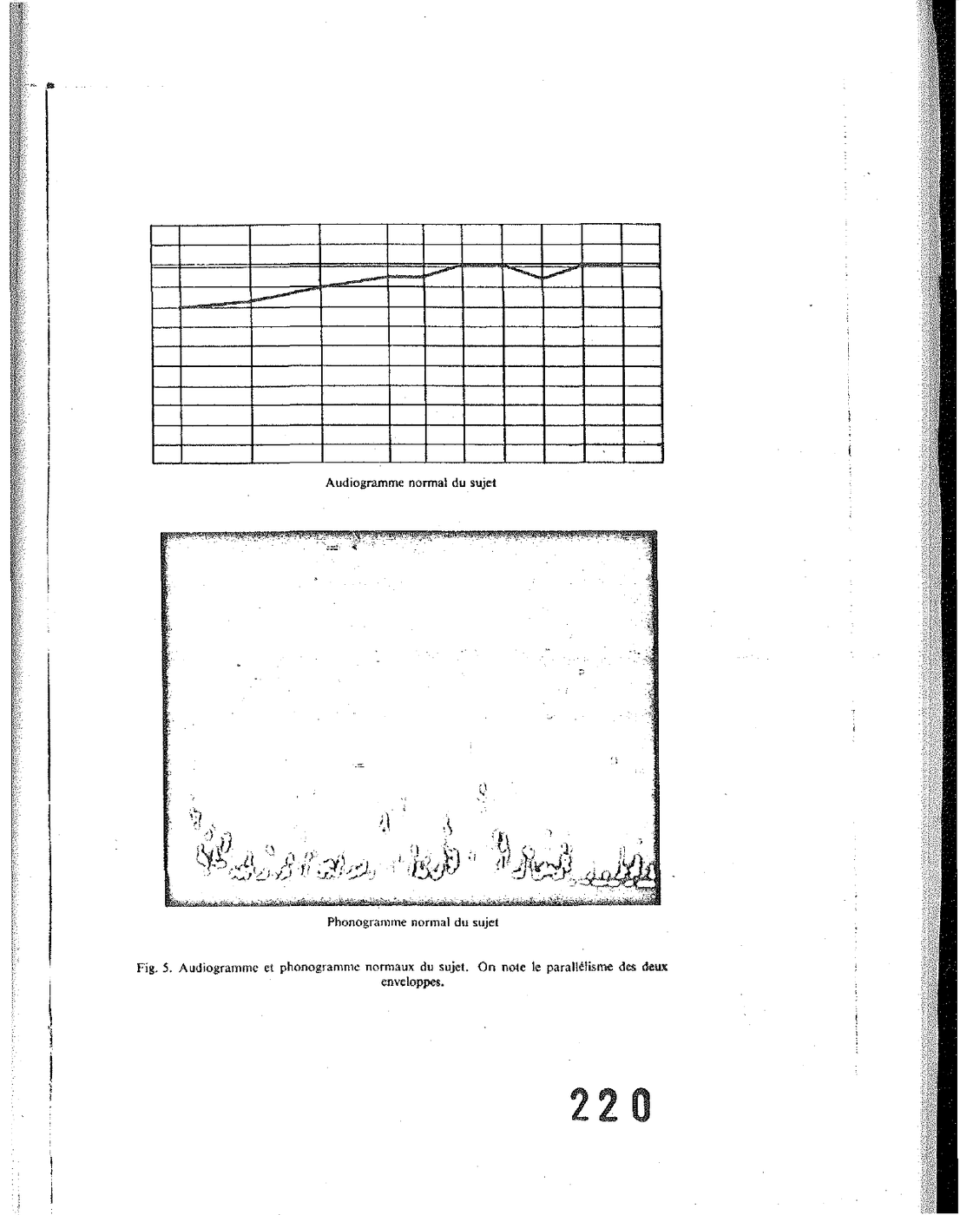
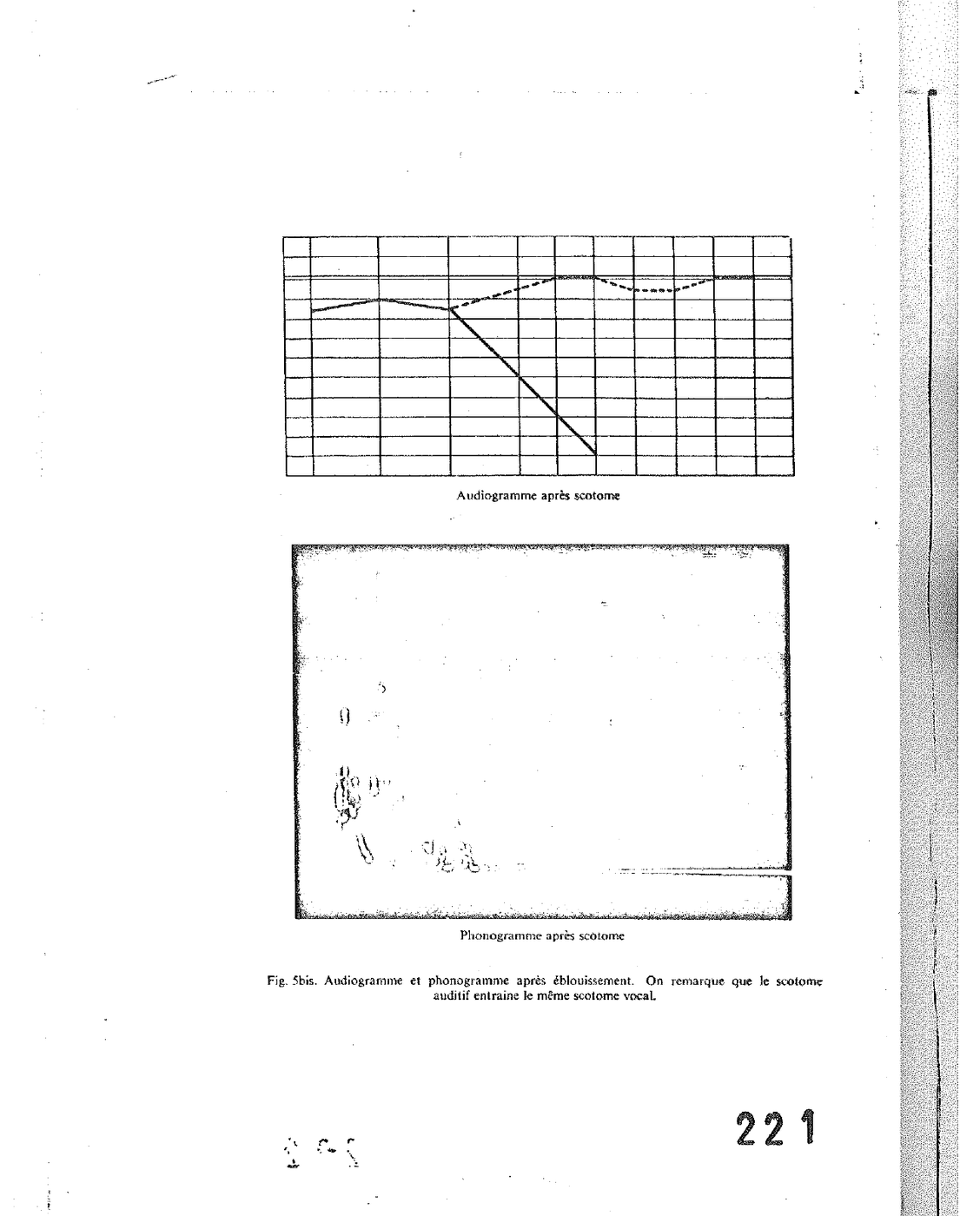
The whole shifts according to the will of the operator. One can illustrate this phenomenon by simultaneously studying the response curve after alteration by filters, and the spectrum of the voice corresponding to its new self-control. One then notes a superimposition of the envelope curve of the sounds emitted. The auditory scotoma is translated by a vocal scotoma, which allows one to extrapolate to the truncated fixation on phonation. Figures 5 and 6 show the effect of truncated audition on phonation.
Faced with such experimental results, there remained only to extrapolate to the clinical and therapeutic plane.
The clinic has revealed to us that:
-
a) disorders of rhythm are essentially linked to the non-use of the directing ear, either because laterality has been thwarted or because it remains poorly defined, as in an “ambiscousie” rendering the determination of the functional sensor impossible;
-
b) disorders of timbre are always associated with a poor use of the directing ear, or with a deficiency of the same.
-
c) one must bring into the same group as this latter disorder the articulatory defects the child acquires, not through a faulty mechanism, as one is often tempted to believe, but through a faulty functioning of the auditory sensor. The phonetic response lets appear distortions, but they are none other than those of the sensor.
The therapy will be simply in practice what the laboratory has enabled us to bring out.
A directing ear that does not know how to come into function: it is sufficient to set it there, and all rhythms are acquired.
A directing ear comes poorly into function but can open its diaphragm correctly: help it and the timbre appears correct, the articulatory defects amend themselves.
It is remarkable to see how much the ear can, after this kind of re-education, modify its way of hearing. Likewise, the acquisition of a good voice, according to these techniques, is translated by a modelling of auditory perception, as testified by the most audiometric modifications.
Such experiments have led us to define the passbands of the various auditory preparations from which one may develop methods of accelerated integration of foreign languages.
Thus, the various applications we have introduced into the therapeutic field over several years have revealed to us the essential role of auditory self-control in the elaboration of language. The efficacy of the techniques used to this end — whether it be to correct bad habits, to re-educate stammerings, to structure a language or to restore the voice to professional singers — constitutes the most manifest experimental proof of this.
We therefore think it would be worthwhile, for the phonetic sciences, to take into account the considerable importance of the auditory factor in problems of phonation.
So, of all phoneticians, of all linguists whose principal concern is to study what comes out of a mouth, we shall ask them to think of what this speaking mouth hears.
Paris
[Fig. 5 — Normal audiogram and phonogram of the subject; note the parallelism of the two envelopes.]
[Fig. 5bis — Audiogram and phonogram after dazzling; note that the auditory scotoma entails the same vocal scotoma.]
[Fig. 6 — Normal sonogram of the subject.]
[Fig. 6bis — Sonogram after scotoma.]
[Fig. 7 — Audiogram before and after re-education.]
Source: Tomatis A., “Audition et phonation — Leur réaction et leurs contre-réactions”, in Proceedings of the Fourth International Congress of Phonetic Sciences, Helsinki 1961, The Hague, Mouton & Co, 1962, pp. 389-399. Offprint, pagination 213-224. Document digitised from the personal archives of Alfred Tomatis.
Editor’s note: the transcription has been established from a copy printed in 1962 in which certain passages present reading uncertainties (caked characters, original typing errors). Rare or unusual turns of phrase have been preserved as such whenever the sense remained clear, in order to preserve the author’s voice.
Illustrated pages of the original document
Pages of the PDF facsimile containing figures, diagrams or audiograms. According to the original layout, some pages may appear in landscape orientation.
Page 8 of the facsimile
Page 9 of the facsimile