New means of psychological conditioning of athletes
New means of psychological conditioning of athletes (INSEP 1974)
Lecture by Prof. Alfred Tomatis given on 17 April 1974 at the Institut National des Sports (INS) in Paris*, before the National Directors of the various sporting disciplines. Lecture given at the request of the Under-Secretariat of State for Sport, organised by the Delegate of the Comité National de la Recherche Scientifique (CNRS).*
New means of psychological conditioning of athletes: how can the ear — and most particularly the musculature of the middle ear — become a determining factor of training, alongside muscle, breath and technique?
Introduction
I am going to speak to you of techniques making it possible to enhance the physiological and psychological conditions of athletes.
I do so all the more willingly — and this will be all the easier for me — as it is a matter of a muscular training. You are particularly informed of these problems; you will therefore follow my paper all the better, since it is a matter of becoming, at a given moment, in a sense master of the musculature of the ear, to the point of being an athlete of it.
The ear indeed has two small muscles ever present:
-
the muscle of the hammer (malleus), whose function is to tighten the eardrum;
-
the muscle of the stirrup (stapes), which must regulate the pressures of the inner ear — which is a liquid vesicle.
The advantages to be drawn by the one who has the good fortune to become master of this musculature are countless. These muscles concern:
-
laterality (and dyslateralisation);
-
memory;
-
concentration;
-
attention;
-
self-control;
-
fatigability;
-
depressive tendencies;
-
relational difficulties with the other — within one and the same team.
Following fifteen years of research and also of practical applications on thousands of cases, we may today affirm that our audio-psycho-phonological techniques permit us — by a series of original tests — to record not only the laterality of a subject but also to obtain curves giving us precious indications on his psyche.
And more still: by sonic injections, we can modify these curves:
-
by lateralising the body to the maximum, allowing him to reach more quickly the technicity and efficacy the athlete needs;
-
in parallel, triggering a neuronic recharge producing a reserve of energy, greater nervous concentration, and increased capacity for directivity.
I. The body image
The body image, in the athlete, is what allows him to have the notion of an instrument placed at his disposal — an instrument that is the body itself, and that allows him to play.
Each individual, at a given moment, has the notion of existing through his body. This image is built from what works best: it may be the head, it may also be the feet. In the footballer, for example, the body image privileges the lower limbs more than in the intellectual who remains all day shut in his study. In the archer, it is at another level that the greatest neuronic mastery is situated.
To a certain extent, the footballer’s body image integrates the ball; that of the archer integrates the bow. There is truly interaction between mind and body.
It happens that whenever a subject is obliged to enter the image of himself, he can take only the existing trajectories, which are those of his nerves. It is the nervous system that gives sensibility to the bony apparatus, to the muscular bundle that will be called upon to practise a sport. Thus the well-exercised player fully inhabits his body; by his will, he can juggle to the extreme precision of the play of all his limbs.
Very ancient theories had recorded these processes. For example, Zen for archery: the archer ends up being the arrow itself; his body image is then so elaborate, so complete, that he comes to integrate the bow, the arrow and even the target. It is the same in shooting with firearms, when one reaches the level of “instinctive shooting”.
But without going as far as Zen theories — when you are in a car, your limits extend to the car’s footprint on the road; your wheels are integrated, the steering wheel is part of you. Notice moreover with what skill one can go forward and reverse, when at first sight that seems almost impossible. It is because we have integrated, in our image, the image of the car. If we change cars, it is more difficult: we must accustom ourselves anew.
This ideal integration, we now have the means of creating, of facilitating, of developing.
II. Lateralisation
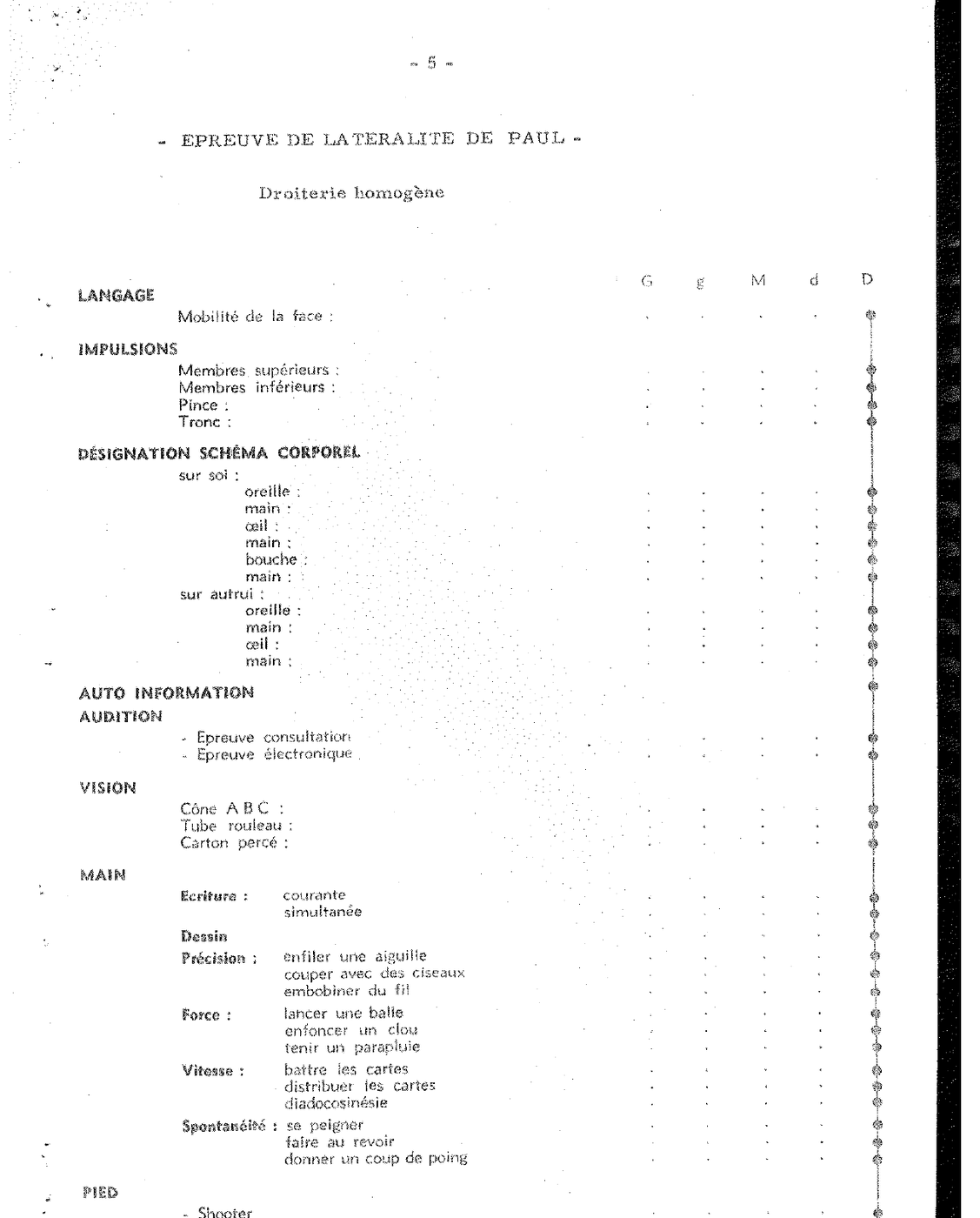
We first verify, by laterality tests, whether the individual has good mastery of all his coordinations. The tests bear on:
-
language: mobility of the face;
-
impulses: upper limbs, lower limbs, pincer, trunk;
-
designation of the body schema: on oneself (ear, nose, eye, hand, mouth), on another (ear, hand, eye, hand);
-
self-information: audition (consultation test, electronic test), vision (cone ABC, tube-roller, pierced cardboard);
-
activity of the hand: ordinary and simultaneous writing, drawing, precision (threading a needle, cutting with scissors, winding thread), force (throwing a ball, hammering a nail, holding an umbrella), speed (shuffling cards, dealing cards, diadochokinesis), spontaneity (combing oneself, waving goodbye, throwing a punch);
-
activity of the foot: shooting, tracing a square.
Some typical profiles
Homogeneous right-handedness (“Paul”) — all the incoming information is applied on the right side. A very rare case. Someone who has reached this homogeneous right-handedness is already a very exceptional being. If a subject reaches this level, one is sure that he has total mastery of himself, of his instrument-body: mastery of his activity, of his concentration, of his memory and of his ways of aiming with his listening — and so, by that, almost perfect coordination of all his movements.
Homogeneous left-handedness (“Alain”) — the symmetrical opposite. Better to be homogeneously left-handed than nothing: it is the antagonist of the homogeneous right-hander, with a different psyche. The subject takes the reverse of what others do — not so much because he has become an opponent, but because he has become out of phase with what the right side does, owing to the enormous shift between right and left information (the left-hander uses much longer nerves).
Psycho-sensory dyslaterality (“Georges”, “André”) — motricity is left-handed but sensoriality (vision, audition, language) is spiralling, zigzagging. He is an extremely undone being in everything — a subject who presents a psycho-sensory dyslaterality with great difficulties manifesting themselves at all levels: schooling, memorisation, concentration, bodily skill. Whatever his underlying potentiality, he is always disadvantaged: these inversions lengthen all his neuronic circuits and oblige him to a considerable expenditure of energy at the cortex level.
Audio-vocal dyslaterality (“Gilles”, “René”) — motricity is left-handed but hearing and language are badly positioned. Everything is dyslateralised on the language plane, the language on the left passing to the right, and this dyslaterality extends also to audition.
Champions and homogenisation
Among the champions we have already had occasion to examine, we have seen curves not far from those of the dyslaterals. Given that they were champions reaching international performances, I was able to say without being mistaken that by homogenising them, their performances were going to burst out immediately — in terms of velocity, rapidity, precision, gesture. And that is what happened.
As soon as we allowed these young people to integrate rapidly an underlying homogeneity, they were able to draw the maximum from their potentialities — through becoming aware at different levels.
Let us be clear on the word “laterality”. It has become a term everyone uses. Many imagine that everything is said when one has affirmed that a subject who writes with the right or left hand is lateralised to the right or left. It is much more complex: in the fact of being right- or left-handed, there is a whole dynamic, sensory phenomena, going from simple automatisms to the perception of movements, from simple perception to consciousness of what will inhabit, at a given moment, a sensory organ.
III. The action of sounds
The ear, organ of nervous recharge
The ear is not only a sensory organ: it is also — and perhaps above all — an organ of cortical recharge. High sounds in particular, distributed at a certain rhythm and at the appropriate level of the cochlea (where the hair cells of Corti are most numerous), provide a considerable charge to the cortex. This charge can be verified by electroencephalogram and by measurement of vigilance levels that increase in parallel.
The ear also ensures, by its vestibular part, equilibration and verticality, as well as general tonus, kinetics, and body image. All the muscles of the body without exception are under the direct or indirect control of the vestibular nerve.
How to act on the ear
To act on the ear — and thus on the whole system — we use a device called the Electronic Ear. It is an electronic set-up comprising a gating between two channels (one favouring the lows, which relaxes the muscles of the middle ear; the other favouring the highs, which puts them in tension). The whole functions as a true gymnastics of the muscles of the hammer and the stirrup.
The athlete is put under headphones; he listens to carefully chosen sounds — filtered maternal voice, Mozartian music, Gregorian chants, filtered sibilants — according to a programme adapted to his laterality profile and his objectives. Each session lasts about 30 minutes; a complete training cycle may comprise from 60 to 100 sessions spread over a few weeks to a few months.
The action of sounds proper
The sounds thus distributed trigger in the athlete:
-
an improvement of the auditory laterality and — consequently — of motor laterality;
-
a reinforcement of posture, of verticality, of body image;
-
a cortical recharge that increases vigilance, concentration and memory, and decreases fatigability;
-
a diminution of stage-fright and of inhibitions linked to emotivity — thanks notably to the anxiety-relieving action of filtered sounds;
-
an improvement of motor coordination, of speed of gesture, of precision.
Auditory training
Auditory training is progressive. One begins with filtered sounds (recreating intra-uterine conditions), passes through sonic birth, then through an active phase in which the subject — under headphones — repeats texts or target sounds, of which he hears simultaneously his own voice re-filtered and lateralised to the right by the Electronic Ear. He thus trains himself to put himself into the audio-vocal posture of the homogeneous right-hander — whatever his initial motor positioning.
Charging sounds
Charging sounds are sounds rich in high frequencies (above 2,000 Hz) that bring to the cortex the energy necessary for all the high functions of the nervous system. These sounds come in particular from:
-
Mozart’s music — which presents an exceptionally rich harmonic spectrum in the high zone;
-
Gregorian chant — which has the particularity of using physiological rhythms (respiratory, cardiac) while being rich in high harmonics;
-
certain nursery rhymes and folk songs according to the subject’s ethnic language.
IV. Debates
Does this method make it possible to manufacture champions?
Answer: one does not manufacture a champion from nothing. But from an athlete already gifted, already trained, one can cause his performances to burst forth by suppressing the blockages that hold him back from his possibilities. The method brings out a potential that already exists but whose expression is hampered by dyslateralities, defects of listening posture, unmetabolised affective charges.
Screening tests
For promising young athletes, the listening and laterality tests we propose are excellent screening tools. They make it possible to identify those who — beyond their physical aptitudes — possess or may acquire the psycho-sensory homogeneity that distinguishes future great ones. They also allow training work to be oriented towards the specific weak points of each subject.
Loss of individuality
A fear often returns: by homogenising athletes, do we not risk having them lose their individuality, their singularity — which is often their strength? Answer: no. To homogenise the audio-vocal posture is not to uniformise character, style, manner. On the contrary: by liberating the subject from his blockages, one allows him to express his singularity more fully. The athlete becomes more himself, not less.
Aggressiveness
Competitive sport requires a certain aggressiveness. The Tomatis method does not suppress this aggressiveness: it channels it. By diminishing background anxiety, it allows the athlete to mobilise his aggressiveness in a more efficient, more targeted way, less parasitised by useless tensions. Aggression becomes action.
Ambidexterity
In some sports, ambidexterity is an asset (boxing, fencing, certain team sports). The Tomatis method does not teach ambidexterity as an end in itself, but it prepares for the voluntary and conscious use of the left side after having solidly established right laterality. The athlete thus becomes capable of playing with the left as well, without losing the directivity of the right.
Conclusion
Audio-psycho-phonology opens, in the sporting domain, a field of application that is not limited to “mental preparation” as it is usually understood. It proposes a neuro-physiological refoundation of the athlete’s preparation, on the basis of a direct intervention on the ear and on the cybernetic circuits of posture, laterality and cortical recharge.
What we propose to the national directors is the opportunity to test these techniques in the concrete framework of the preparation of elite athletes — and to measure, in the field, their effects in terms of performance, recovery, confidence, team cohesion.
When trainers have understood that, instead of having their future champions do physical exercises for 14 hours a day, it would be preferable to reserve a little time for the setting up of a high-level system capable of organising and energising bodily investment — then we shall have the right to attend not only remarkable demonstrations of the body playing of its strength and skill, but also a true dialogue of the being with the universe as a whole, through a wholly mastered body.
— Prof. Alfred A. Tomatis. Lecture given on 17 April 1974 at the Institut National des Sports (Paris) at the invitation of the Under-Secretariat of State for Sport and the CNRS.
Illustrated pages of the original document
Pages of the PDF facsimile containing figures, diagrams or audiograms. According to the original layout, some pages may appear in landscape orientation.
Page 6 of the facsimile