L'Oreille et le Langage (1963)
Alfred Tomatis’s founding book. Published by Le Seuil in 1963 in the “Microcosme — Le Rayon de la Science” series, reissued in 1990. It is in these 81 pages that Tomatis sets out, for the first time before a general readership, the scientific and philosophical foundations of his entire œuvre: the Tomatis Effect, the Electronic Ear, the directing ear, audio-psycho-phonology. An intellectual “adventure novel”, as the author himself liked to call it, which opens up the still uncharted territory of the relations between the ear and the whole human being.
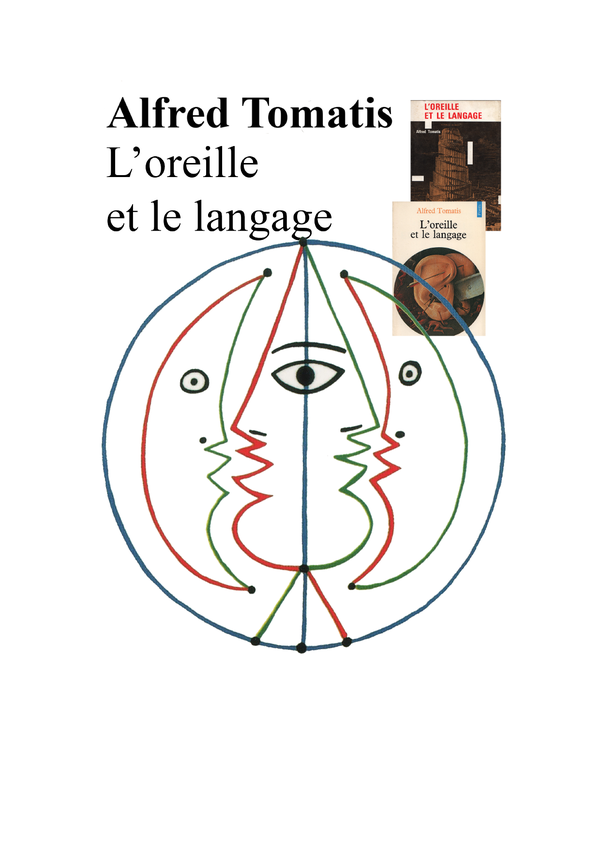
“The speaker is at the same time the first listener of their own voice. We speak, in reality, with our whole body, and more particularly thanks to our ear.”
Presentation
When he published this first work with Le Seuil in 1963, Dr Alfred Tomatis already had some fifteen years of research behind him. An otorhinolaryngologist and the son of a singer, he had discovered, while working at the Aeronautical Arsenals on the occupational deafness of workers exposed to engine noise, an unexpected parallel with the deafness of leading operatic singers. From this observation was born the “Tomatis Effect” — communicated as early as 1957 to the Académie nationale de médecine — which establishes that the larynx emits only the harmonics that the ear is able to hear, and the Electronic Ear, the re-education device that follows from it.
L’Oreille et le Langage is the first book in which these discoveries and their wider implications are gathered into an accessible synthesis. It is also the manifesto of a nascent discipline: audio-psycho-phonology, a science of communication that places the ear at the heart of human functioning.
The work unfolds a striking thesis: the ear is not merely a passive organ of reception. It is the principal controller of the voice, and therefore of language; it is also an organ of cortical recharge, without which the brain falls asleep; and it is, finally, an organ of body image and lateralisation. The whole of the human being — their posture, their voice, their thought, their way of inhabiting space — depends on the quality of their listening.
The tone is that of an explorer: “It is not surprising if this adventurer of the mind’s book is, as he himself says, an adventure novel, and if the discovery he proposes of the links between our ear, our voice and our body proceeds by dramatic twists” (preface).
Contents
After an Introduction that sets out the guiding metaphor (the sound of the voice “floods” the whole body like a cascade), the work develops in several major parts:
-
Language — language and man, language and the philosopher, language and the linguist: a survey of classical conceptions before the arrival of the audio-physiological perspective.
-
The speaking body — the phonatory apparatus and its play, the verbal flow, memorisation and the bodily trace of sound.
-
The ear — gateway and principal controller of the output; the functional dominance of the directing ear; audio-vocal conditioning; audio-phonology, and then audio-psycho-phonology.
-
Laterality, right-handed and left-handed — why, in every civilisation, left-handers are the exception; clinical consequences (stammering, dyslexia).
-
Body image — how language sculpts the body scheme and conversely, how the image of the body shapes the vocal gesture.
-
Conclusion — human thought expresses itself by playing on its body as on an instrument.
Extract
“When you speak, the sound flows from your mouth like water spilling from an overfull basin. It floods your whole body, on which it spreads out. Each syllabic wave pours over you and breaks upon you in an unconscious but certain manner. Your body knows, across the whole of its surface, how to register its progress, thanks to its cutaneous sensitivity whose control functions like a keyboard responsive to acoustic pressures.”
— Introduction
Place in the work
The first of the fifteen or so works that Alfred Tomatis would publish between 1963 and 1996, L’Oreille et le Langage contains in seed form the whole of his subsequent concepts. It would be extended and deepened in particular by Éducation et Dyslexie (ESF, 1971), La Libération d’Œdipe (ESF, 1972), Vers l’écoute humaine (ESF, 1974), L’Oreille et la Vie (Robert Laffont, 1977), L’Oreille et la Voix (Robert Laffont, 1987), to culminate in the great cosmological synthesis of Écouter l’univers (1996). Indispensable reading for anyone wishing to approach Tomatissian thought at its source.
In brief
L’Oreille et le Langage overturns the classical perspective: it is not the larynx but the ear that directs the voice, sculpts language and shapes the image of the body. In 81 dense pages, Tomatis reveals that we speak with our ear and that the quality of our listening conditions that of our thought, our posture, our relations with others. The first founding book of an œuvre spread over more than thirty years, it is the work to read in order to understand the origin of all the Tomatissian techniques — the Tomatis Effect, the Electronic Ear, re-education through filtered sounds — that would later transform the treatment of dyslexia, stammering, the learning of languages and disorders of communication.
Addressed equally to the curious practitioner and to the cultivated reader, this “intellectual adventure novel” reads at a single sitting: the prose is limpid, the concepts embodied, the horizon vast. To be placed in the hands of any parent of a dyslexic child, of any singing teacher, of any open-minded linguist and, more broadly, of anyone interested in what it means to “be human”.
Available in libraries — BnF, Sudoc.