L'Oreille et la Vie (1977)
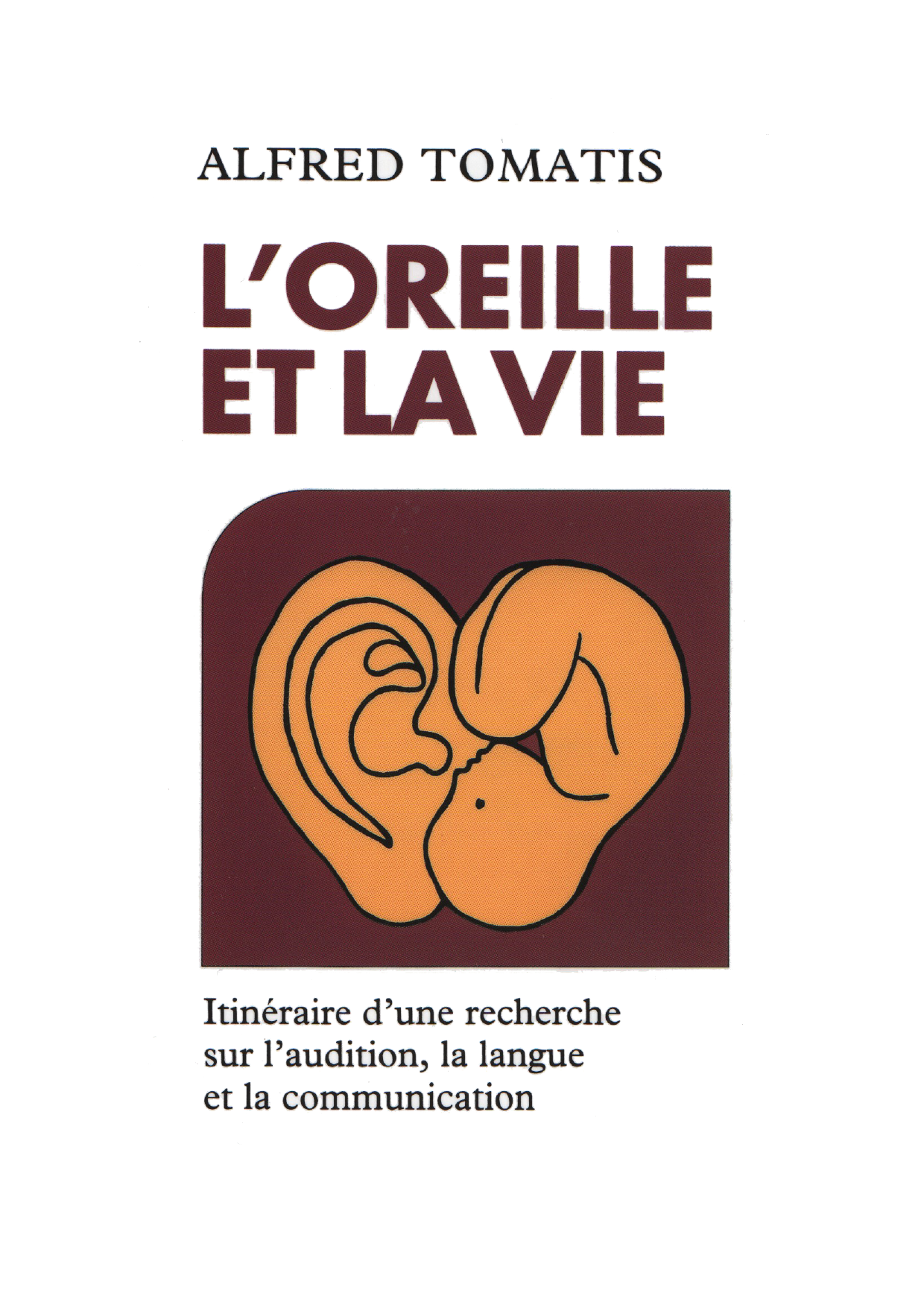
Alfred Tomatis’s first autobiographical book, published by Éditions Robert Laffont (“Réponses” series) in 1977, written in collaboration with the journalist and writer Alain Gerber. Subtitled Itinerary of a research into hearing, language and communication, the work retraces, through a personal and accessible narrative, the scientific and human journey of a researcher who overturned the classical conception of the ear. The general public discovers here, in a limpid style, the intellectual adventure of audio-psycho-phonology.
“— No use bothering with him: he is dead. Such were the first words that my ear heard, even if it did not understand them, when I left my mother’s womb.”
— Chapter I — A pair of yellow shoes
Presentation
When L’Oreille et la Vie appears in 1977, Alfred Tomatis is sixty-six years old, has more than thirty years of practice behind him, hundreds of thousands of patients treated, and an international network of APP centres in full expansion. The time has come for him to recount, no longer from the scientific angle but from the human angle, the path that led him from classical otorhinolaryngology to the founding of a radically new discipline.
The narrative, conducted with the complicity of Alain Gerber — the same Alain Gerber who conducted in SON Magazine the famous 1972-1977 interviews published on this site — alternates biographical anecdotes, clinical descriptions, accessible scientific expositions and philosophical flights. Tomatis’s premature birth, the voice of his father the opera singer, his years at the Aeronautical Arsenals, the meeting with Maria Callas, Romy Schneider, Gérard Depardieu, Henri Hartung — all of it weaves together into a fluid narrative that makes the most abstract concepts tangible.
The work overflows the framework of mere testimony: as Tomatis advances in his narrative, he unveils the inner evolution of a researcher who discovers, step by step, that the science of the ear opens onto a science of being. The final chapter, which would seal the revised edition of 1990, takes on the spiritual dimension explicitly: “Every quest, every research, however scientific it may appear, has value only if it opens onto the divine.”
Contents
The itinerary unfolds through major autobiographical chapters:
-
A pair of yellow shoes — the premature birth, the grandmother who saved him, childhood.
-
The father’s voice — childhood in the world of opera, the revelation of song.
-
Aeronautics and occupational deafness — the first observations that would lead to the Tomatis Effect.
-
Maria Callas and the voices recovered — the re-education of the great singers.
-
The Electronic Ear — the birth and refinement of the apparatus.
-
The listening test, audio-psycho-phonology — the formalisation of a discipline.
-
Towards an anthropology of listening — the ear as a path of being.
Place in the work
L’Oreille et la Vie is the book that made Tomatis known to the French-speaking general public. Where Vers l’écoute humaine (1974) demands of its reader a scientific training, this autobiographical narrative opens the œuvre to any cultivated reader. It would be the gateway, for thousands of future APP practitioners, to the rest of the Tomatissian œuvre. The new edition of 1990 takes up the original text and completes it with a final chapter on the spiritual dimension of the research.
In brief
Indispensable reading for anyone who wishes to discover the man Alfred Tomatis behind the scholar: his origins, his doubts, his struggles, his wonders, his encounters. A sober and powerful narrative at once, to be placed in the hands of anyone curious about the human sciences, of any parent of a child in difficulty of communication, of any singer, of any musician — and more broadly of anyone questioning the secret links that unite the ear to life.
Available in libraries — BnF, Sudoc.