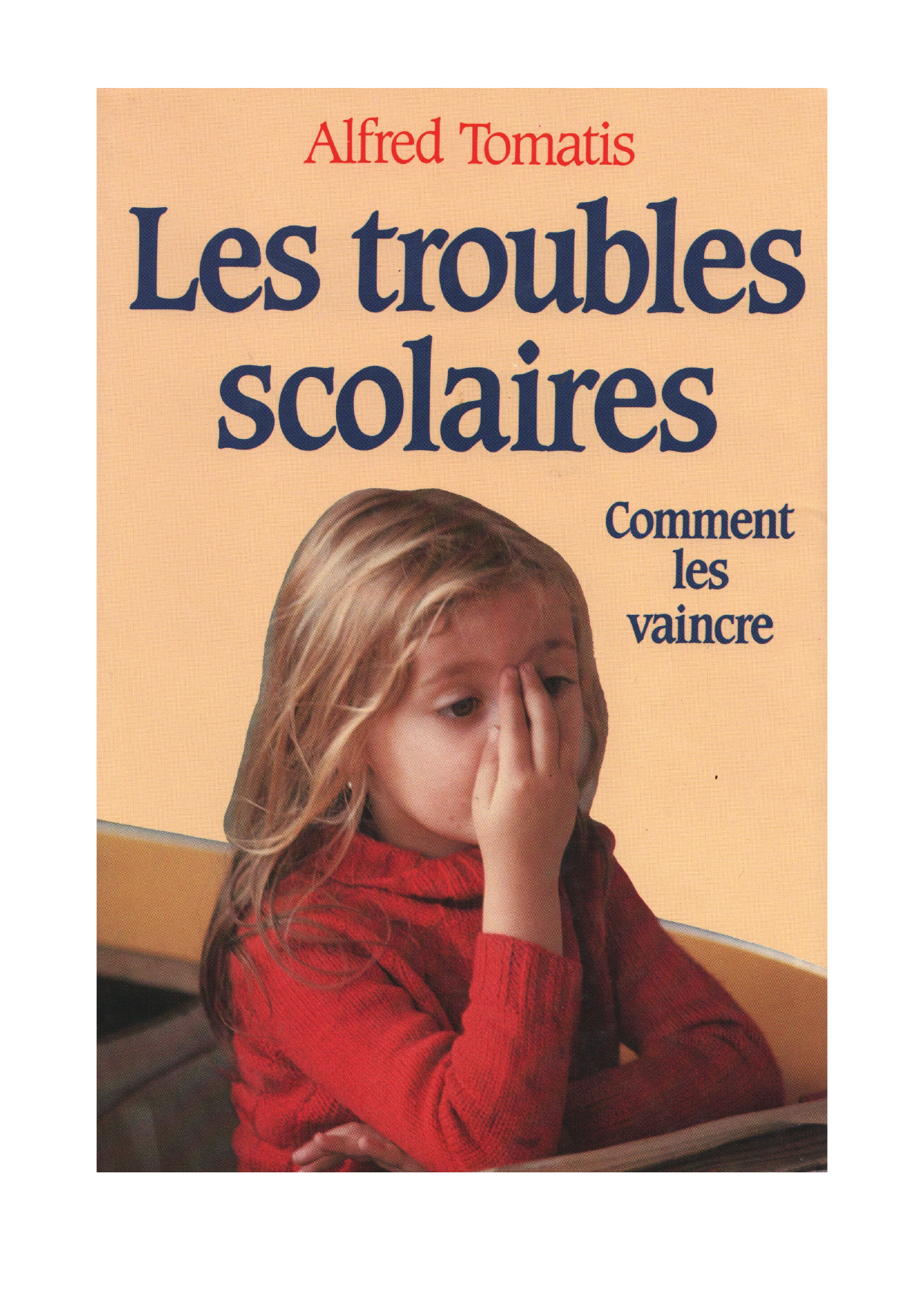
Les Troubles scolaires (1988)
A combative work published by Éditions Ergo Press in 1988, written in collaboration with Loïc Sellin. Tomatis attacks head-on the question of school failure, which he observes affects, in France, more than 60% of pupils in the elementary classes. The thesis is clear: most “dys-” of every kind — dyslexics, dysorthographics, dyscalculics — are above all children who do not listen properly, and auditory re-education makes it possible to put them back on track in more than 90% of cases. A book that opens the eyes of parents, teachers and therapists.
“Today my success rate in the treatment of dyslexia exceeds 90%.”
— Introduction — Checkmate to school failure
Presentation
When Les Troubles scolaires appears in 1988, Tomatis has accumulated nearly forty years of clinical practice on dyslexia. The book opens with a damning observation: the French school is a sealed chamber. “In a class of thirty elementary pupils, ten follow the lesson correctly. Another ten drag themselves along, compensating. The last ten are listed in the category of ‘dys-’ of every kind.” No reform has rolled back this proportion; no committee of experts has been able to reverse it; the explanations put forward (socio-cultural conditions, ill-adapted pedagogies, intellectual level, crisis of civilisation…) “chase their tails”.
The author proposes a different reading, one that goes beyond the framework of horizontal explanations: most school disorders are in reality disorders of listening. The child who does not listen does not learn, or learns badly. He ends up dropping out, and the mechanism of exclusion is set in motion. To this vertical reading Tomatis opposes a therapeutics: auditory re-education through the Electronic Ear, whose protocols, characteristic curves, statistical results and international clinical research (Barbara Wilson at North Shore University Hospital in New York, Byron Rourke at the Windsor hospital in Canada, Tim Gilmor in Toronto…) he describes.
The work also takes an educational stand, denouncing the triumph of the whole-language method and pleading for a return to simple foundations: listening, pronouncing, tracing, reading aloud, memorising. A school that forgets the ear, Tomatis maintains, manufactures dyslexics on a massive scale.
Contents
-
Checkmate to school failure — a survey of the disaster, critique of the dominant explanations.
-
A particular adaptation of an old philosophical problem — the fable of the snail and the labyrinth.
-
The vain discourses on method — whole-language, semi-whole-language, syllabic.
-
The ear, that forgotten gadget — physiology of listening applied to reading and writing.
-
The body that learns — posture, laterality, body scheme and learning.
-
A few ideas to put inside one’s skull to understand the brain — accessible neurophysiology.
-
The Electronic Ear in the service of schoolchildren — clinical studies, results, international research.
Place in the work
Les Troubles scolaires takes up, updating it and making it accessible to the general public, the subject posed sixteen years earlier by Éducation et Dyslexie (1972). It is the pedagogical counterpart of the Tomatissian œuvre, to be set alongside Pourquoi Mozart ? (musical), Nous sommes tous nés polyglottes (linguistic) and Neuf mois au paradis (prenatal) — the whole forming the great general-audience fresco of the years 1988-1991.
In brief
To be placed in the hands of every parent of a child in school difficulty, of every teacher wearied by inconclusive colloquia, of every speech therapist in search of a coherent theoretical framework. Tomatis delivers here, with his customary verve and a very sure diagnostic sense, an analysis that stands out in the French educational landscape — and that remains, forty years on, surprisingly current. The statistics of school failure not having abated, the book retains a salutary provocative force.
Available in libraries — BnF, Sudoc.