Pourquoi Mozart ? (1991)
A general-audience essay published by Éditions Fixot in 1991, in which Alfred Tomatis answers the question he has been asked for thirty years: “Why do you always use Mozart in re-education with the Electronic Ear?” The answer, which unfolds over 117 pages, combines clinical experience, fine acoustic analysis, musical anthropology and an almost amorous encounter with a body of work which, more than any other, possesses according to the author the power to “awaken the ear”.
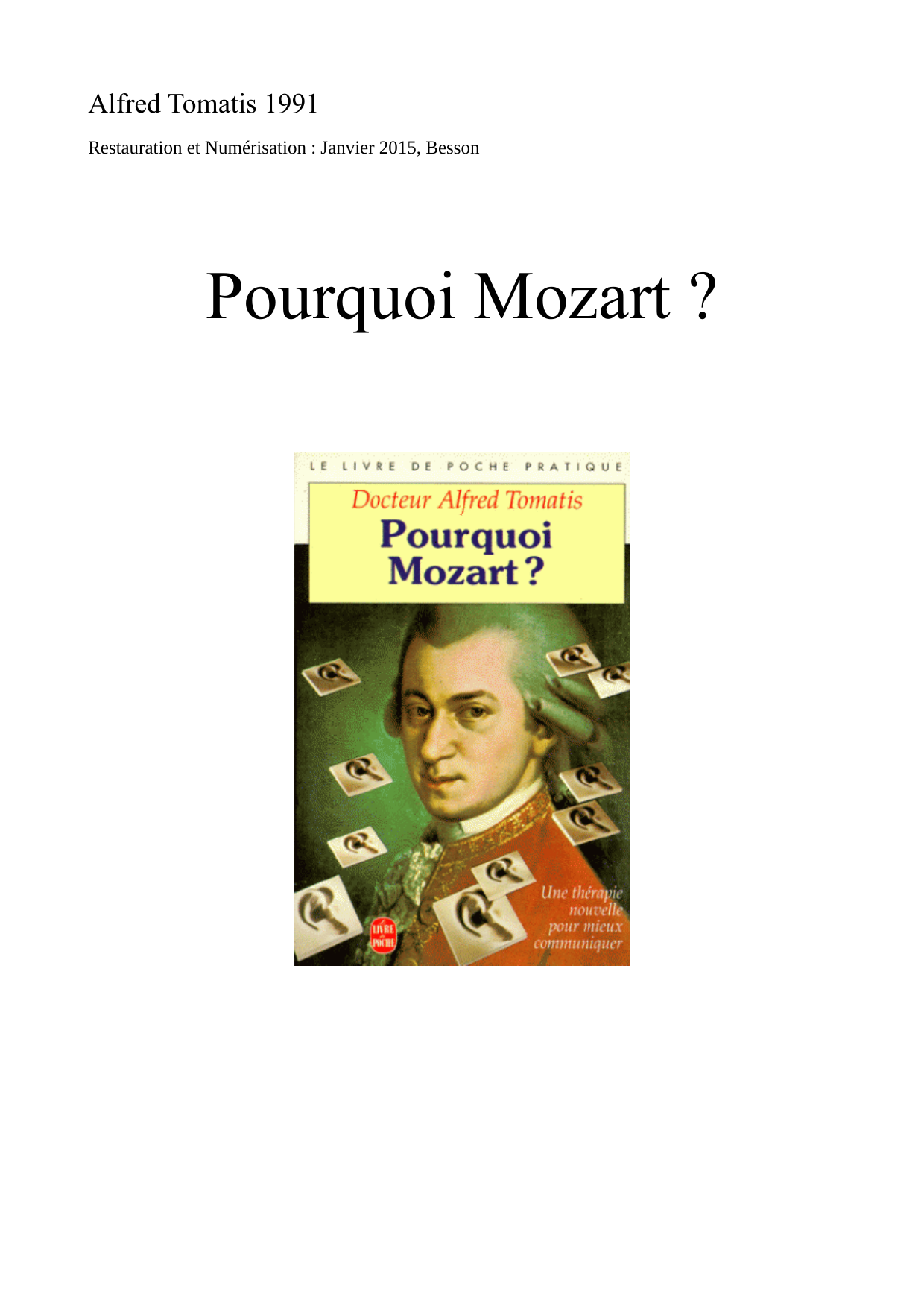
“Why Mozart? I should like to answer simply: ‘Because.’ As a child does.”
— Chapter 1 — Because
Presentation
The subject seems trivial. It is nothing of the kind. Why, among the thousands of composers available — Bach, Beethoven, Schubert, Debussy, Stravinsky, and so many others — did Tomatis choose Mozart as his music of choice for his protocols of filtered listening? Why not Bach, more mathematical? Why not Beethoven, more powerful? Why not a contemporary composer? The answer, Tomatis says, is neither aesthetic nor dogmatic: it is clinically measurable.
The work explores several tracks. Mozart possesses, more than any other, a density of high harmonics that “recharge” the ear. His rhythmic structure is particularly close to the maternal cardiac rhythm felt in uterine life — hence its soothing effect on the new-born and on the regressed adult. His harmonic clarity facilitates phonetic discrimination in dyslexic patients. And his solar psychological tonality — Mozart writes in the major even when he suffers — carries the listener towards an attitude of openness and receptivity.
Tomatis summons spectral analyses, acoustic curves, EEG measurements, but also the paintings produced by his patients under filtered listening — paintings dominated by blue under Mozart, by yellow under Gregorian chant. He thus establishes analogical correspondences between sonic frequencies and chromatic frequencies, between acoustic rhythms and psychic states. The book closes on an eloquent comparison between Mozart and Gregorian (“Mozart divided by two”) which illuminates, by contrast, the specificity of Mozartian listening.
Contents
-
Because — the question, posed and repeated.
-
The ear of Tomatis and the ear of Mozart — an autobiographical journey: birth into opera, clinical musical choices.
-
The secret of the high harmonics — why Mozart “charges” the ear better than others.
-
Fœtal Mozart — the closeness of Mozartian rhythm to the maternal cardiac rhythm.
-
The clinical test — Mozart in APP practice.
-
Mozart and the others — Bach, Beethoven, Verdi, Gregorian chant: comparative spectral analyses.
-
Sounds and colours — paintings produced under listening, blue under Mozart, yellow under Gregorian.
Place in the work
Pourquoi Mozart ? is one of Tomatis’s books that had the greatest media resonance. It contributed to popularising the famous “Mozart effect” which, during the 1990s and 2000s, would take on a life of its own and sometimes a poorly informed one — Tomatis assumes paternity for it without endorsing the commercial drifts. The book stands naturally alongside L’Oreille et la Voix (1987) so far as music is concerned, and prefigures the great cosmological synthesis that would come five years later with Écouter l’univers (1996).
In brief
To be recommended to every musician, to every Mozart lover, to every music therapist, but also to every parent intrigued by the place Tomatis gives this music in his protocols. The book reads like a stroll around an œuvre — Mozart’s — seen through the unique eye of a physician of the ear. It illuminates along the way wider questions: why does this music soothe us, why does that one exhaust us, and what may be expected of a true pedagogy of musical listening.
Available in libraries — BnF, Sudoc.