Sound and Symbolism of Drawing
Sound and Symbolism of Drawing — TOMATIS Network Seminar, Île de Bendor, March 1984
Paper by Alfred A. Tomatis given at the TOMATIS Network Seminar held on 2 and 3 March 1984 on the Île de Bendor (Var, France), at the invitation of the Marseille Language Centre. The theme of the meeting was the Symbolism through drawings made during the Tomatis Method’s course and Creativity in its pictorial realisation. This document of fifty-six pages — including sixteen plates of diagrams — first presents the neurophysiological and symbolic aspects of drawing (vestibular, visual and cochlear integrators; Platonic definition of the object through form/colour/volume/name; object-body dialectic via the pyramidal bundle), then details the archetypal themes of drawings gathered at the five great stages of the treatment under Electronic Ear: Musical Sonic Return (7 themes), intra-uterine Memorisation (10 themes), Sonic Birth (7 themes), Pre-language (5 themes), Language (5 themes). The text preserves the spontaneity of the oral discourse as recorded by the users of the Method present at the seminar.
*SOUND AND SYMBOLISM OF DRAWING
TOMATIS Network Seminar
Île de Bendor, 2 and 3 March 1984
organised by the Marseille Language Centre
Paper by Doctor A. A. TOMATIS*
The Tomatis Method
A man of Science, above all passionate about the Research that leads the Being to evolve, to reveal himself, Doctor A. A. Tomatis is an ENT physician who, after practising as a surgeon, has more and more, in advancing in his approach of Listening to others, taken an interest in the psychological dimension of the patient confiding in him. For over forty years, Tomatis has placed himself in the service of Research and has thus established the bases of a new science: AUDIO-PSYCHO-PHONOLOGY, of which he is the Father.
Audio-Psycho-Phonology has its roots at the very origins of the intra-uterine universe: it is already there that the first meaning of mother-child communication is realised, where the first psychological resonances are encountered. It is there that the evolution of what will be the blossoming of the man it bears within itself begins. In this sonic milieu that is the amniotic fluid in which “man-infans” evolves, he constructs himself and already analyses the emotional vibrations that reach him and with which he becomes imbued. From then on, the roots of Listening and the desire to communicate are elaborated. For this being in the making are set in place:
-
communication through listening and language via a perfectly integrated bodily image,
-
balance and harmony, which so faithfully rejoin creativity, aesthetics and thus become the essential elements of relation.
Audio-Psycho-Phonology, science of communication, has enabled Tomatis to deepen the course of his thought and to advance in his research on the ear and its imbrications with the nervous system through the body-instrument. Thus he has been able to create and develop devices, including the Electronic Ear, which makes it possible to educate or re-educate audition in its dynamic of Listening, with a rigorous method of application.
The course of the Pedagogy of Listening — Tomatis Method
The Tomatis programme, in its different phases, will enable the subject to renew the desire to Listen in an active attitude that will favour a better use of his potentialities at once of creation, of communication, of integration…
This approach is carried out by means of the Tomatis Effect Electronic Ear, following a sonic programming that begins from the first conditionings of life, that is to say in utero.
A first phase consists in bringing the subject to listen to sounds progressively filtered to reach high frequencies. This first part corresponds to the Sonic Return. This preparatory stage allows the subject to find again a protected world in connection with the mother. The intra-uterine Memorisation brings the subject into this past at once distant and close, and has him relive this first relation on the level of the dialogue of an “already-lived”.
After this very important stage, the subject must gradually leave liquid listening to pass to aerial listening through the Sonic Birth phase, which will help him to be reborn in a more harmonious mode. The following stage is that of Pre-language, premise of a dynamic of verticality favouring access to the last phase: Language, opening to Listening and to Communication.
Free of his negative emotions, the subject will be able to use all his potential to attain a better personal balance and to benefit from the processes of energising and creativity called forth by a good Listening Posture, the latter allowing optimum cortical recharge. There then opens to him the possibility of projecting his sensibility, his creativity, his emotional level through form, colour, line, sign — figurative or not, in agreement, were it only in the moment of this expression.
Thanks to the methods of education and re-education he has developed from his works, Tomatis opens a new horizon in the fields of pedagogy, psychology, medicine, linguistics, as well as in those of music, singing, artistic expression…
The TOMATIS Network Seminar took place on 2 and 3 March 1984 on the Île de Bendor and gathered users of the Tomatis Method.
The theme of this meeting organised by the Marseille Language Centre was:
-
Symbolism through the drawings made in the course of the Tomatis Method
-
Creativity in its pictorial realisation.
To illustrate this subject, Doctor A. A. TOMATIS gave a most enriching paper, very appreciated by all, which allows us to shed clear light on what we encounter daily in our practice of the Tomatis Method. Here is its content. We wished to preserve the oral context of Doctor TOMATIS’s remarks in order to restore for many the informal framework and the atmosphere in which this Seminar took place.
I. — Neurophysiological and symbolic aspects of drawing
We are going today to focus our study on drawings. I believe we must rejoice at the choice of the theme of this seminar, for in fact we never have our patients draw enough. Although we have insisted on this necessity for some twenty years, we easily forget the importance of this practice, and have a tendency to let ourselves be carried along by the patient, who is reluctant to draw, who does not like to project himself, to deliver himself. So that we are always obliged to push him to do it. He often prefers to write; but if writing brings an improvement, it is a repetitive improvement: the subject enters into an analytic “purring” history, especially if he has already had an analytic experience; he sticks us in the whole of his discourse. Whereas the drawing allows us to see him project himself and thus make a systematic advance: one rarely draws the same thing twice. The same themes may be found, but they are always more elaborate, so much so that I have come to think of a comparison:
a piece of writing: it is like a fistula that empties itself
a drawing: it is an abscess that has emptied itself and will not renew itself.
In taking up hundreds of drawings, I have tried to make a summary of the different themes and to seek to define what the symbolism of a drawing might mean within the framework of our speciality.
First, what is a symbol? What is a symbol on the neurophysiological plane? How is it to be explained? What does it indicate? What does it mean?
It is difficult to define. I recall that a study of adults’ drawings has already been made, with statistics on the frequency of the number of drawings per stage and the number of themes per phase. We obtained the following figures:
| STAGE | RSM | MF/VM | ASM | PRLG | LG |
|---|---|---|---|---|---|
| % drawings | 18 | 40 | 20 | 12 | 10 |
| No. themes | 7 | 10 | 7 | 5 | 7 |
RSM = Preparatory phase to filtered sounds • MF/VM = intra-uterine phase, in filtered music or filtered maternal voice • ASM = Sonic birth • PRLG = Pre-language • LG = Language
In the linguistic phase, the drawing “dries up”: when the subject speaks, he no longer needs to draw. When he can begin to verbalise, it is because everything is going well.
When we examine these drawings as a whole, we see that we are in the presence of a thematic that plays for each stage. There exist kinds of themes that will always be the same and that will be reproduced in everyone. In other words, in terms of this set, we know roughly at what period of the treatment under Electronic Ear we are. Better still, the subject, in drawing, indicates to us whether we are to pass to the next stage. Hence the interest of the drawing, since it is the drawing, in fact, that guides auditory pedagogy.
How did we come to see that it guided this audio-vocal education? Well, in the old days, when people began their sessions, we made them draw, but we imposed on them a certain schema, thinking that one had to do a few RSM sessions, a certain number of VM, a few AS sessions… On this strategy, we collected drawings until the moment when we wondered whether we were not in reality imposing a determined course, whether we were not, in particular, provoking a premature birth, as if we were almost systematically applying forceps, for instance. So that, subsequently, we waited, according to the drawings, for the subject’s call to the next stage. Now, it turned out that we found the same drawings we had gathered during the imposed treatments. This led us to know that from time to time a subject preferred to remain a long time in maternal voice, in filtered sounds, rather than being obliged to enter a dynamic of birth, for example. But the drawings remain the same according to the stages, so that we were able to determine that if there was a call to birth for example, through a well-defined thematic, we were led to programme sonic birth. It is therefore the subject who asks to be born, and not we who impose birth. But, I repeat, the drawings remain the same on the thematic plane.
Survey of the literature on drawings
To try to understand what was happening, I tried to plunge myself into the study of drawings and to see what had been written on the subject.
First of all, it is interesting to note that there is practically nothing written on adults’ drawings. By contrast, on children’s drawings, there exists an important literature… For those who wish to document themselves, here is a summary of what can be found:
-
1950, NAVILLE: 404 documents, books, articles and other on children’s drawings
-
1962/63, STORA René: 400 other documents.
In other words, you have 800 documents in hand that will allow you to read what has been done on children’s drawings.
In going through these writings, you will be quite surprised to observe that they have nothing in common with what we do. And I think the dynamic of drawing we bring may be of great interest both to us and to certain other specialists.
If one examines the phases described by these authors, one sees that there exists an evolutionist theory. It is an era when one thought that the child drew essentially like the primitive, and one made comparisons between children’s drawings and the primitive drawings of Africans, for example. There is a whole school to which belong Kurchtner, the great pedagogue of Munich, Lampert, the anthropologist, and so on. The most notable for us is Luquet, who had the same objectives and established about everything that was done on children’s drawings in France. His work hardly deserves to be skimmed…
There was then an interesting movement: and here, one approaches what Madame Nicoloff does with the handicapped children I saw with her. It is the psychological movement introduced by the works of Wallon.
The neuro-physiological approach
Another approach that interests us particularly is the neuro-physiological approach:
I have schematised an object. I have taken the simplest possible (diagram I). How will one be able to lead this object to the symbol? I have placed opposite it a nervous system. You are all now somewhat used to this kind of approach.
The principal elements are as follows (diagram II):
-
the cortex
-
the thalamus, in depth with the geniculate nuclei, at the level of the pulvinar in the posterior part: the external and the internal
-
the nuclei of the pons
-
the bulbar olive
-
the red nucleus with its two nuclei: the central and the external
-
the nucleus of the cerebellar roof
-
the cerebellum
-
the embolus and the globulus
-
the dentate nucleus.
The vestibular integrator
You will remember that before the third month of intra-uterine life, it is the vestibule that develops most particularly. It is therefore a progression essentially vestibular (diagram III). I briefly recall the connections of the vestibule and their reactions:
The vestibule introduces from the outset the four bulbar nuclei that will command the whole body on the muscular plane. The response is then made by the nuclei of Flesching and Gowers, which project onto the cerebellum. From there, there is a response by the roof nucleus directly to the vestibule: there is therefore feedback information from the body to the vestibular apparatus.
The vestibule is thus informed at every moment of the injection it has itself produced into the body: there is counter-reaction. To refine all these responses, there exists, thanks to the Gowers nucleus, a feedback connection also via the red nucleus in its central part, which returns again into the body via the spinal vestibular bundles — here the rubro-spinals that rejoin the spinal-vestibulars. Another bundle then departs towards the olive to give the same counter-reaction. Without detailing further, I specify however that one of the bundles is crossed, the other not.
In any case, thanks to this double circuit, the vestibule will have a finer action in all its responses. This is prepared very early on the intra-uterine plane. I recall to you that from the first days of conception, the vestibular system installs itself and completes itself in its function before the third month of foetal life. In other words, there is already an elaboration of the body image, a kind of penetration of the vestibule into the bodily system.
The visual integrator
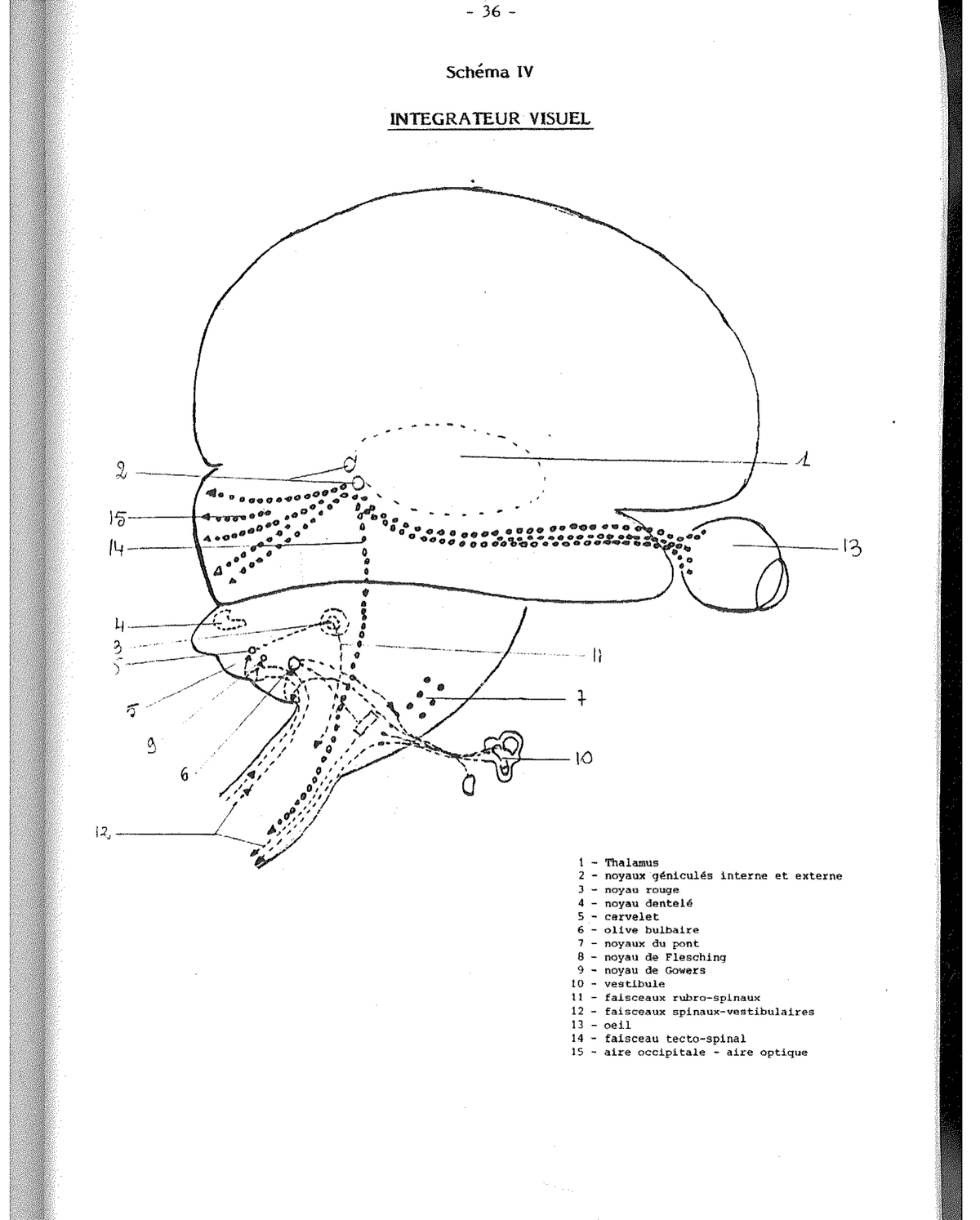
At birth, the eye begins to come into function and to take the vestibule into its service. The visual integrator is set in place, following the vestibular integrator (diagram IV). It starts from the retina, projects onto the part of the pulvinar, the posterior part of the thalamus, and will flood the occipital area. From there departs a tecto-spinal bundle that will rejoin directly the elements of the vestibule to reinforce its action in the regulating commands. But for a certain time, it seems, it is the eye that will put the body at its disposal.
The cochlear integrator
Soon the cochlea appears. The vestibule intervenes more on the motor function of the body, while the cochlea is more specialised in the sensory part (diagram V). There exist two nuclei: central and dorsal. From there depart bundles that also go to the pulvinar in the posterior part, then project onto the temporal area. They go towards the nuclei of the pons through the Turk-Meinert bundle. Then the ponto-cerebellar and then the cerebello-dentate-thalamic, then thalamo-cortical bundles enter into play. One returns here again to the nuclei of the pons, and one then has a closed circuit that is cortico-ponto-cerebello-dentate-thalamo-cortical, and so on. But each time, there is a bundle that projects onto the external rubric nucleus of the red nucleus and rejoins the vestibular fibres. It will therefore associate with the vestibule and form a whole. This process, which engages memorisation, will give a memory of the bodily totality. I recall that memory is not essentially cortical: it is, to be sure, in the whole brain, in the whole nervous system, but through the vestibule, it is in all the muscles and, through the responses that follow, in the whole sensory apparatus.
If one goes much further, there soon appears another sensitivity bundle: the superficial sensitivity bundle — this being added to the protopathic deep automatic sensitivity. The much more elaborate and finer sensitivity will thus give vestibulo-thalamic and thalamo-cortical bundles that will project, themselves, onto the anterior parietal area.
I here present a diagram of the circumvolutions (diagram VI): everything is in place, while there appears at the same time this demand for external sensoriality intended to ensure the associated movement; the pyramidal bundle installs itself with, in particular, everything that will concern language in projection onto the cortical areas: the larynx — the tongue — the muscles of the face — the thumb and index, the hands, the shoulder — very little projection for the body — the hip — the knee, and so on.
There is therefore the motor area, the adequate sensory area and the superficial plane, which is ensured at the same time.
I should like to say a further word in evoking this small bundle that departs from the vestibular nuclei, which rises and is of such importance for us. It is also commanded by the geniculate bundle. It is the pyramidal bundle, which will command, starting from the vestibule, the sixth, the fourth and the third cranial pairs at once, that is to say the eye. In other words, the eye is taken in charge by the cochlea. Whereas it had seized the vestibule in a first time, the inverse now occurs: it is the cochlea that allows access to the higher stages of symbolic integration, that is to say: naming.
The Platonic definition of the object
I have tried to summarise this in another way in order to show clearly the functional cortical process with respect to the object. What is therefore going to happen? I take up the object (diagram I). To define an object, there are several means, and I think the best is to return to the Platonic definition.
I recall that Plato in the Cratylus claims that each object is defined by:
-
a form that one may imitate by drawing
-
a colour that one may imitate by colouring
-
a volume that one may imitate by sculpting
-
a name that one may imitate by naming
Plato also specifies that one must reach a very high level of sensibility to touch all these stages:
-
in the first, one must be a draughtsman
-
in the second, one must be a painter
-
in the third, one must be a sculptor
-
in the fourth, one must be a man of the Logos, a man of law in the Greek sense of the term.
In other words, according to Plato, it would seem that two men of the Logos, endowed with the same sensibility, placed before the same object, would come to determine the same name. For us who speak of passbands, of neurological counter-reactions to the acoustic impedances of places, this seems plausible. While De Saussure, for his part, is hampered before such processes. He does not understand and concludes that naming is essentially a sociological phenomenon: how, indeed, can an animal be called “bœuf” on one side of the border and “ox” on the other side?
Well, it is true that the neurological responses to the impedances of the place not being the same, the deep response is not the same. There exist consonantic mutations, there exist heaps of things on the plane of linguistic transformations that may explain certain phenomena. I think that here Plato was right: there is a kind of counter-reaction of the object on the body, as if, at a given moment, the object detached influxes onto the body.
Since Epicurus, it was thought to be the inverse — that it was the body that launched rays at the object that received them. Now we know that it is light that transports the system, but in reality, with a few details, it is indeed the same play that is at work.
Evolution of the object through the ages
We therefore have an object that is defined as expressed above, and facing it a body that is in the making, from conception to the adult age (diagram VII).
Wallon introduced visual and kinetic data. Indeed, in some handicapped persons, one sees that from time to time the drawing is an impulse: it seems that the child at the start does not master his body; he will act by impulse, bringing into play his vestibular system. Then vision will be added, which will command the vestibule; and then later, the child will manage to go further in another symbolic.
There exists another movement: the psychoanalytic movement followed by Madame Morgenstern, who studied the drawings of children with problems, of psychotic children. Her works were taken up later by Dolto under the impulse of Lafforgue. They deduced a certain therapy from them, stressing the whole dialectical dynamic of Freud, Adler and Jung, which is a conscious-unconscious dynamic.
For the Dolto school, it would seem that the drawing brings as much as the dream — it would be a kind of waking dream that the child makes. In the form of play, one tries not only to induce him to draw but to make a therapy of it, and you will be quite disappointed reading what has been written. Dolto’s book is certainly to be read, for it brings important elements, but the analytic interpretations, notably those of the tree, are very questionable. You know how much we are interested in the drawing of the tree. For Dolto, the tree is the image of the father… You see that we are very far from our conception, which refers to an intra-uterine image. There is therefore something here that seems out of kilter with reality. In the end, it is difficult to speak of symbol, since each wishes to interpret, and I always wonder whether it is not the analyst who projects, and not the patient himself.
The approach of Audio-Psycho-Phonology
Then you have another approach which is that of Audio-Psycho-Phonology. I recall that it is the unfolding of the treatments that is the essential element of this work of interpretation. It is an approach essentially dynamic. It must bring us, I think, a new dimension of symbolic interpretation, essentially through a kind of evolutional neuro-physiological route, and that from conception. There is therefore something here quite different from the usual approaches. The neuro-physiological support we bring is more comforting and in any case more euphoric for the therapist who is going to follow the patient, knowing that, in advancing, he has two things to consider:
-
first, the evolution of the nervous system
-
then, the systematic layers that are touched on the neurological plane.
Before explaining what symbolism may be, I have tried to schematise to the maximum the neurological cross-sections that would seem to correspond to what is happening.
Let us recall therefore, once more, the processes of memorisation, which concern not only the cortical part but also the whole of the nervous system, and consequently the whole of the body in its motor and sensory parts.
Stages of development facing the object
I have tried to differentiate certain stages (diagram VII):
-
one has first the embryo-foetus: we know how important it is
-
one has then the one who does not speak: the child or infans
-
then one has the young child
-
then the adolescent
-
and finally the adult.
The embryo-foetus obeys particularly the vestibule. Already in the mother’s womb, the vestibule comes into function before the third month of intra-uterine life. It will penetrate the whole nervous system and produce at a given moment a deep somesthesia. The whole body image thus begins to be built, and it is thanks to this that the child will be able to take a certain automatic posture that will enable him later to sit up, stand, walk, enter into a dynamic whose effects on the whole of language we know: he will be able to babble, pronounce the first words, the first sentences, then to go to the discourse of the adolescent and the adult, and to accede at the end of the course to the liberation of thought beyond the word.
But very quickly, in the young child after birth, the eye will seize the whole and produce a deep somesthesia that will allow the commanding of the body. A whole visual education then takes place. The whole thing is then to be able to free oneself from it.
There, one sees the object: but this object exists only for the one who sees it. It is difficult to communicate to the other the information just received, since there is not, at a given moment, the possibility of a vehicle on the verbal plane. It is then that the cochlea intervenes, having already prepared its neuronal networks during its pre-natal course. It begins to develop after the vestibule and comes into function from the fourth and a half month of intra-uterine life.
As soon as there is the cochlea, one sees appear a conscious epicritic superficial somesthesia that will seize the deep automatic somesthesia and that will also place the eye under its sway, at the same time as appears the bundle of command: the pyramidal bundle (conductor bundle). All this progresses in a kind of setting in motion characterised by progressive myelinisation. As myelinisation occurs, the brain grows not in number of cells but in volume and in function.
Realisation of stages: drawing, painting, sculpture, language
What therefore happens at the level of the realisation of the different stages in relation to the object? As soon as the eye is completed, as soon as the pyramidal bundle is set in motion thanks to deep and automatic somesthesia, one will be able to begin to draw, then to paint, then to sculpt, and finally to reach language. As soon as the cochlea appears, the whole of the system is realised. Language thus enables us to convey integrated information and to use it beyond all systems.
It is true that one can realise and observe sculptures more or less different, as for languages. When one sees for example an African sculpture or drawing, it is quite different from a Greek sculpture. It is the same for language. We are in the presence of a whole dynamic that is always linked to the vestibulo-cochlear set.
If one looks at what happens at the level of the brain, one sees that there are stages of integration. This integration consists simply at the outset in an engrammation — that is, in a collection of information that may be situated at the level of the vestibular and cochlear nuclei, with a view to beginning to play on the whole bodily set. But there is a burst on the level of the brain when the latter begins to come into function and will allow reproductions to be made:
-
there is a reproduction called iconic: it is a drawing that will have a signification
-
there is a reproduction much closer to something abstract, which is the sign: it will be the letter
-
then there is everything that is art or artistic reproduction.
All this progresses with age.
The child draws a tree: he claims it is a tree; if it is a house, he says it is a house. There is of course reason to consider the whole underlying symbolism.
Later, the child enters the learning process. If you take a Chinese, for example, you will see that to speak of a “man” he draws a little figure. If he wants to speak of the “housewife”, he draws a subject with a broom in hand, and so on. There is therefore a whole iconic history of representation.
Then the letter appears to introduce the same signification but bringing a much greater improvement and bringing into play at once the vestibule, the cochlea and the eye.
Then there is art, which may be much more elaborate and which risks from time to time losing its symbolism.
The whole set of these reproductions consists in the end in reaching a realism that may go as far as abstraction. An abstract line may have an extremely profound realism: if you take a line by Hartung when he wants to draw a cosmic dimension for example, it has as much value as the one who amuses himself by drawing clouds in the sky or dotted lines to represent the path of a star in the sky. In other words, abstraction is not yet a symbol. Abstraction is an elective choice on one of the lines of a realism that is still evocative, but it is not yet true symbol.
What is the symbol?
When one has the good fortune to have drawn something through this whole course of life, to have integrated it and to find again at the same time the parallel of the lived experience with the object of this realisation, one accedes to a symbolic image. The evocation of the “lived with” the object is symbolism.
To sum up, I have represented the various elements in a single diagram (diagram VII). You thus have:
-
the object with its forms, its colour, its volume
-
the body that may find itself facing this object with development in time
-
in terms of time, the intervention of the vestibule with a counter-reaction of the eye that gives a deep somesthesia
-
the intervention of the cochlea with a counter-reaction of the superficial somesthesias.
There is a whole play that will bring about, thanks to the pyramidal bundle, a command for drawing, for colour, for sculpture; the cochlea will bring the summit of naming through language.
Plato’s criteria are therefore inscribed as a kind of progressive genetics of the child facing the object.
The object seen by the photographic apparatus vs. the symbolic object
I take up again the notion of what the symbol is. I again consider an object. This object will have a kind of dialectic with the body. This dialectic will remain almost vestibular. It is a structuring dynamic, but it is unilateral. It is the influence of the object on the body, and there the body operates somewhat like a photographic apparatus: the object imposes itself in what it is.
The child sees an object and reproduces it, full stop: that is what a photographic apparatus does. Then there is a dialogue with the object. This dialogue gives a second dynamic, which is a parallel structuring dynamic, each of the elements having an influence on the other. It is the body that interposes itself in its lived experience with the object, and there it is a matter of symbolic evocation.
In the framework of the object reproduced by the photographic apparatus, we find ourselves in a domain essentially vestibular, that is to say much more automatic. By contrast, in the case of the dialectic between object and body, it is the cochlea that intervenes at a higher level. Here, a deeper dynamic institutes itself, and the body plays in terms of:
-
its lived experience
-
the moment of the lived experience
-
the object
Examples of symbolic evocation
I give you a few examples (diagrams VIII and IX). I take a tree. You remember the importance of the tree for us. The tree may be reproduced in an essentially vestibular way: you have before you a fine tree and you draw it: you are thus a good photographic apparatus.
Now, let us consider the embryo-foetal progression, with all the similitudes that lead one to believe it is a tree: there is the placenta, the umbilical cord, the crown representing the foetus. This crown will gradually blossom. The maximum blossoming corresponds to the relation with the cosmos, and at that moment, it is the symbolism of the cross that appears. The verticality of the umbilical cord and the parallel to the ground mark the importance of the span of the system. The cross, in fact, is a tree burst to the maximum whose crown would be the universe itself. There is one symbolism.
Another example, another symbolism: the cavity. If I remain vestibular — that is, a photographic apparatus — I see a cavity: I therefore draw a cavity. If now I integrate in terms of the body image, I shall see a sphere. The foetus touches at every moment the uterine wall, and the child, later, will draw a sphere. This sphere corresponds to the uterus or to the head. We shall see later that the head of the mother and the uterus will be superimposed. This head may have two eyes, a mouth, and one will find the house with two windows and the door. The whole will be closed at the outset, then will open onto the outside world. Then it may be represented by a fortress in terms of the mother’s attitude: it may be a church that sings; one will find again this same mother that speaks. One may also encounter the symbolism of the earth up to a cosmos that vibrates…
On the other side, there is the sphere and the cavern that resonate, and you find again the maternal voice and the voice in general. In other words, I can amuse myself by taking one of the elements that are there and redoing the whole process.
I know that if I see a house, I shall be able to retrace the whole symbolism, and I shall almost be able to know the lived moment, the transformation of the lived experience.
As long as I am at the stage of the cavity, I am at the embryo-foetal stage. Then I shall begin to find the head at birth in the form of a house. There, it is still the child who does not speak: as long as the house is dark, there is no communication with language; as soon as it lights up, the image of light appears, the image other than the mother, and so on. One sees arriving the dynamics of maternal tension, a kind of burst image of the mother’s drives with the symbolism of the Father and of the cosmic image.
There exists a second phenomenon, which is that of the cavern. This recalls Plato’s myth of the cavern, with the same systems. In other words, there is either a materialised or animal reflection, or a reflexive dynamic.
Another example: light. You have seen that drawings “light up” from time to time. Well, light gives the inverse of all that is dark, or the inverse of all that is water: it is the phenomenon of birth. A house that begins to be lit: it is the appearance of language, it is another than the mother that emerges, it is the father. The father is the one who speaks, whence language. There then are all the symbolic links.
There is also the solar image, the solar trajectory, and one finds the paternal image in the sun. There is on the other hand the inverse of the cavity with water, again an expression of birth, and it is the rainbow. It is the myth of Moses, who emerges from the water. At a given moment, light brightens as soon as the child wishes to enter the process of birth: one will see a cavern with a very beautiful yellow patch, that is all; or else a lamp, a sun, nothing more.
I have taken another symbolic image: verticality. It is difficult to define. The child will draw a vertical if he has nothing other than a vestibule. For us, on the contrary, one will then see energies: ascending energy or cosmic bombardment. The greater the sensibility, the more one reaches complex elaborations. One will find the sensibility to the chakras that the Indians have so defined. They are found in the drawings.
The phallus, the tree, the umbilical cord
Let us now study what happens during the audio-vocal education sessions. I have tried to present to you, by a few schematic lines, how we came to the symbolism of drawing. I recall to you that years ago, I found myself before a child who had drawn me a beautiful phallus: she must have been two or three years old perhaps. She was a little girl who did not wish to speak, a slight autistic, who had begun to babble rapidly and who had the right, like all the children, to enter when she wanted into my consulting room. I was doing correspondence; she then installed herself near me and asked me to draw. I then gave her a pencil, and she drew, with the virtuosity of an artist, a fantastic phallus. I knew she would soon ask me to appreciate what she was drawing. So she said: “is it beautiful?” I answered her, “yes, yes!” I wondered, at bottom, what she could be thinking while drawing this.
According to Freud, she had surely seen a phallus. That seemed a little early to me. If I referred to Jung, she had found again a phallus in the archetypes. That did not satisfy me any further. I then wondered whether we were not all of us plunged in more or less aberrant interpretations centred on the phallus. After all, this child, so close to birth and so close to the birth of language that was not structuring itself, did she not have another vision of the thing? At that time, I was working a great deal on the dynamic of intra-uterine life, and I thought it was perhaps a vision of the uterus. The schema she had made was very elaborate. She had thus drawn a phallic element with the glans at the top, and in fact, I wondered whether it was not the umbilical cord with its placental implantation and, above, an outline of the image she could have of her body during foetal life, at the moment when the vestibule begins to elaborate itself. The best proof is that some time later, the drawing took on another aspect, with augmentation of the crown. It is we who, by abuse of language, are going to call it a tree.
This approach seems interesting to me, all the more so since in all corners of the world, even where there are no trees, children draw the same things. In the middle of the desert, they draw the same schemas. The notion of this tree is therefore engrammed well before birth, well before the relation with the outside world. It is because we have lived in a uterus, it is because all men have passed through this channel that they draw the same things, whether they be Eskimos in Alaska or Bedouins in the desert. One finds the same drawings, although there are no trees in this nature.
If one pursues, one realises that the tree will evolve as the sessions under Electronic Ear progress (diagram X). The image becomes more precise and more and more elaborate. One may have the image of the embryo with its head and its tail, its umbilical cord which sinks more or less under the crown, and so on… One may find oneself before a dialectic between the thickness of the cord and its position with respect to the crown — marking the mother’s pressure on the foetus — the upper ascending part, and if the roots are too strong there may be too great an attachment to the mother. If there is a strangulation in the drawing, one may think that there exists a non-desire to pass from the mother to the embryo. When we are in the presence of children in distress, we often know the formula whereby the mother no longer gives anything. There then exists a kind of non-desire to live in the child, but which has often been integrated by him as a non-desire of the mother to communicate with him, a non-desire of love from the mother to the child.
Let us now examine the progression of the tree. We first see something elaborating itself like a little mushroom that will grow with roots. There is here a kind of attempt at cutting at the level of the umbilical cord; I remind you that the umbilical cord is not innervated but very vascularised. The innervation stops at the umbilicus. When there is interpenetration, that corresponds to an affective problem in depth.
The elaboration of the body schema occurs progressively. The whole appears to individualise itself, and there is the appearance of a more spread-out crown indicating an increase in energy, as if the nervous system were structuring itself, as well as the appearance on the lateral lines (you remember the fishes) of the first sensory touches of the conscious superficial apparatus. For us adults, the integration is made as fruits. But it is not that.
I tell you this because in leaving Paris last week, I examined a child who drew a very fine tree. He is a little Iranian, gifted, adopted, who has colossal problems with his somewhat weak parents, although the father is a chief of police. One would think one was dealing with an authoritarian man, and yet the child commands everyone. It is true that he has an IQ of at least 150. He offered me this tree, putting in it large circles. I asked him what they were, and I expected him to tell me: “apples!” You see the psychic pressure of the adult thinking that there is integration of both a tree and fruits. He answered me: “those are holes in the sky…” It is fantastic! Truly it is he who is right. It is the first sensation of touch, lived at a given moment in a body that is being formed. It is really already kinds of eyes that look, as in Argus who had a hundred eyes. It is the first sensoriality of his skin that is realising itself, and he gave me the symbolic answer of something profound.
The evolution of the house and the flowers
In terms of the tree, there is first a round image: one finds again the starting sphere; this round image is from time to time hollowed. There is then the appearance inside of the hooking of the egg, often in the wall, and at the same time, almost always there is the appearance of the vestibule and of the cutaneous sensation. This is organised to become either a head or a house (diagram XI): it is the head of the mother with the eyes and the mouth, or the house itself, linked to the foetal appearance. One sees very rapidly a sun appear, the already more structured image of a house no longer closed but already letting glimpse the light. However, this light is not seen because there are clouds. Here everything is open: the windows are open, the way out is possible, the flowers appear.
For a long time, I did not know what the flowers represented. It has been twenty years that I have “racked” my brains to know why there are always flowers. Then one fine day, a child had the good fortune for me to draw both the flower and the evocation: they were hands. You will see that the flowers often have five petals, and it is indeed the representation of the hand that allows the foetus to touch first his body and to be able gradually to feel the bodily shell that surrounds him.
II. — The drawings, their themes through the stages of the approach under Electronic Ear
We are going to go a little further in this study and take up the starting themes. There are thematics, symbolic evocations, always the same, numbering:
-
7 for the Musical Sonic Return
-
10 for intra-uterine listening
-
7 for the call to birth
-
5 for pre-language
-
5 for language
Very schematically, I am going to try to represent these passages to you. They are always the same. This will help you to detect them very rapidly when you have to study a drawing.
Musical Sonic Return (RSM) — 7 themes
In the first sessions under Electronic Ear, people draw banal things, but very often we find (diagram XII):
-
a face and especially the eye (XII-a) — it is the eye that appears systematically; the subject is therefore in the phase of vision. It is the most frequent schema.
-
the house in a small corner of the sheet (XII-b)
-
geometric images (XII-c) — each time the subject must project something and is afraid of being seized by his projection, afraid of his interpretation, afraid of himself, he always secures himself by making geometric drawings. You will moreover encounter from time to time during the other stages a few geometric figures appearing, notably when there is a dead time and the subject needs to be secured to go further.
-
a progressive call towards the cavity (XII-e)
-
the boat (XII-f) — one might expect that this means the way out, but now, on the contrary, I think it is the way in. One finds a theme of water where there is the boat. You know that the boat should be a theme of birth according to the psycho-analytic interpretation. It is thought to be the first vision of the child on coming out of his mother: he sees the mouth, the nostrils and the medial septum; it is an interpretation of Dolto’s, I believe it is true…
-
an ambivalent drawing (XII-g): two trees, I do not yet know why, but one encounters them.
There then are the seven thematics found in hundreds of RSM drawings made in terms of the genius of each, of his pen-stroke, of his possibilities. These same themes will in fact be symbolic evocations.
intra-uterine Memorisation (MF / filtered VM) — 10 themes
As soon as we enter the phase of intra-uterine memorisation (diagram XIII), the major themes that appear are ten in number:
-
foetal images or cavities often with red edges (XIII-a)
-
umbilical cords (XIII-b) — the child often uses red. One also often has foetal images incorporated in cavities.
-
the boat again (XIII-c) with all the dynamic of water you already know: the submarine, the subject in the water — it is flagrant.
-
the “symbolism of the mother”: it is the house (XIII-d-1, XIII-d-2). Depending on the houses, they may be well closed, with a door tightly shut. If one asks an adult who comes to see us to make a house, and he draws such a closed house, one knows at what stage he is.
-
the notion of the tree (XIII-e-1 to e-4) may appear with very interesting thematics, in VM: either it is a tree still very integrated with the mother, or one feels there a strength already manifesting itself. It is already a bodily division: they are the neurons that grow as if there were a kind of becoming aware of the nervous system in depth. One may also see a tree in which one notes a truncated future. It is therefore dramatic, for it is a child who will remain in relation with his mother all the time. Another case where there is no becoming: even the trunk is found cut. When we have such schemas, we are worried for the subject, and all our work consists in re-energising him. It is the type of the suicidal.
-
a geometric figure of securing (XIII-f): a subject having “let go” such a drawing will at a given moment secure himself by drawing a geometric figure; it is the schema of securing — it is commonplace.
-
the total invasion of the sheet with the appearance of colour (XIII-g) already more sustained. You always have cavities with a median space and colouring all around.
-
a very large drawing with red colouring (XIII-h). As soon as there is red, aggressiveness manifests itself. These drawings are not rare. One sees the subject entering images that have been lived on a conflictual plane inside the uterine cavern. There is the appearance of blood.
-
faces (XIII-i)
-
“various” (XIII-j) — ninth and tenth thematic. One may see anything, but the background is coloured; the white disappears more and more. They are archaic foetal manifestations with rounded forms.
If the lived experience is happy, one sees soft colours; the drawings are very luminous. If black is dominant and if the drawing is then crossed out, one knows that the subject does not like what he has done. Very often patients realise very fine drawings and they tear them up. One must be there to prevent them, or else they destroy them and they begin to move: it is the sign that there is an enormous anguish. The subject has emitted something too strong, too painful, and he retracts.
Sonic Birth (AS) — 7 themes
In the dynamic of birth (diagram XIV), there are the following themes:
-
the first, the strongest, is the rainbow (XIV-a). It is a drawing of birth. You remember that the rainbow in Scripture is truly birth. Noah comes out at a moment with his rainbow: it is the coming out. It is in fact the diffraction of light.
-
the open house (XIV-b). It is no longer closed; everything is open; the day is seen in it, and the road shows that the door is open.
-
the battles, the cannon shots, the explosion of the volcano (XIV-c): it is the desire to come out.
-
the path that goes up or down (XIV-d) with the trees on the side that show the direction of the ascent or descent.
-
two hills, a sun in the background or in the middle and a tree (XIV-e): in fact, it is the chest of the mother, of a body seen horizontally; it is the umbilical cord and the foetus. It is truly birth.
-
the bridge (XIV-f) — another thematic I have added and that I have not quantified: when the child wishes to enter into dialogue with the other than the mother, he takes the bridge. One comes out of the mother to go towards the father by passing over the bridge.
-
the long threads, the great vermicelli (XIV-g) — during the AS, we also see drawings that are very often kinds of long threads, great vermicelli; in fact, it is a kind of umbilical cord enlarged to the maximum. You will note how many adults draw this, brilliantly moreover, because it is not easy.
-
the boat with clouds and a sun that appears (XIV-h).
There then are the thematics of sonic birth.
Pre-language — 5 themes
I have tried to simplify the thematic of this stage in a single structure, which is that of the tree (diagram XV). It is therefore often encountered. There are trees with a straight trunk or a more complex trunk when energy is very strong (XV-a). There is a first image, then a second more elaborate; then one sees appear “the holes in the sky”, the evocation of which you remember. It is the first manifestation of superficial cutaneous sensitivity, hence the spino-thalamic and thalamo-cortical bundle that will show us the counter-reaction through the pyramidal bundle. Considerable energies may express themselves; the roots are more or less thick, and from time to time one may see a contour simply signalled by a dotted line or the appearance of leaves. Specialists on the drawing of the tree, like Stora, have much difficulty interpreting this element: she says that this has a more or less pathological value. I do not think so. It is the moment when the subject has a very developed cutaneous sensitivity; it is the moment when his touch becomes extraordinary; he passes to the bursting of himself, to a practically cosmic dimension, to an enormous perception; and the leaves, in my view, should not be interpreted as an obsessional phenomenon. It is a coming into contact with the environment, with nature. It replaces the “small holes in the sky”, which are the fruits. You will see that the fruits are always on one, two or three lines. In fact, they are the relics of the lateral lines of the fish. They are also places of great cutaneous sensitivity at the level of the skin. There is nothing on the back, but there exist very sensitive points on the anterior face of the body, distributed on “lines of force”.
-
in the pre-language phase, there is also an ascending desire — very often the image of a spring, of wanting to become, appears (XV-b).
-
when the subject has delivered himself through different sorts of drawings, you will see him once again pass through a phase of geometric representations (XV-c). This is meaningful: it is a moment when the subject catches his breath after having delivered himself too strongly: he is perhaps afraid and seeks to stabilise himself, to secure himself. He could very well make tons of numbers. It would be worrying if he remained always at this stage. We let him evolve.
-
in the pre-language phase, one may also encounter drawings representing something calmed: the sun everywhere, the sea… and a dynamic represented by a flying object (XV-d); I think from the interpretation point of view, one can say that the subject is ready to enter into language.
-
another theme may indicate that the pre-language stage was poorly lived… You know that language will oblige us to grow. The child then signals to us his nightmares, his troubles. A child does not wish to grow up. He is caught by language because he cannot do otherwise; and if he speaks, he grows up. He will refuse this. He will have enormous nightmares with monsters that want to devour him, a man who wants to kill him… In the drawings, one finds the same symbolism. Thus you see from time to time a child who has his neck cut or something dangerous (XV-e-1, XV-e-2). Very often, someone is taken by the throat: the image of the father who takes the child by the throat: it is language (XV-e-3).
One sees how many people who do not know how to speak, who speak with a throat voice, are stuck: they are caught by language. The word has on such subjects a very strong impact. Each time, it takes them by the neck… Now, someone who is master of the word can throw each of the syllables out of him like playing cards on a table. He uses words to say what he thinks. While these images show that the subject thinks in terms of the word that has been said to him. It is very different. There then are the themes of the pre-linguistic phase, which are five in number.
Language — 5 themes
As soon as we reach language (diagram XVI), we find something more elaborate, but it is the same themes that reappear.
-
a tree, strong, robust, with almost no roots although they are present (XVI-a). The crown is very spread out, very open.
-
very often too, it is a vase (XVI-b). One goes more and more towards a dynamic of energy.
-
this image, which is the largest, most spread-out dimension of the mother, but the mother pushed to the maximum: the church (XVI-c). We are all part of the assembly of Men, which is what the word “church” means, and one sees the symbolism of this very well.
The bell-tower of the church is often interpreted as a phallic image. I personally think that the bell-tower is an umbilical cord that goes not towards the mother but towards the sky, a kind of call upward. And there, I think we are in the presence of an ascending dynamic that means that conscious man is no longer hooked to the mother but hooked directly to his Creator — that is quite another thing…
What is interesting when one looks at how a church is built is to think that the peristyle may be symbolically the representation of a uterine image. In ancient churches, there was the entrance, the peristyle reserved for the non-baptised, then the church with its corpus — it is a Christic corpus. This corresponds to the entrance, the vaginal part and the uterine part with the image of the inner corpus, of the body, and there is the tabernacle.
Another interesting trait: it is said that the bell-tower must be outside, like the umbilical cord, and that it can only penetrate inside the church through sound: the bell-tower begins to resonate and makes the church resonate, but it is not connected with it.
It is a symbolic image of a high degree, and which can easily replace the phallic image proposed by certain analysts. In fact, the bell-tower is something that supplies in sound and gives back to sound its dynamic value.
-
In this stage of language, one may encounter lines of force (XVI-d): the more a language is elaborated, the more the tree takes on a vertical aspect with a crown that goes towards the sky: it is the cross. Sometimes the tree is broken, and if you look carefully, for Hebraists, it is a noun ן, the letter in Hebrew that signifies “universal man”; it is also “the one who says no”. It means no, but if one places noun mem ם, one has the representation of universal man entering matter, and it is naming, whence the name with an “n”.
-
During this stage, there are also often the representation of images such as the mother, or someone going through a maze, passing through hills (the mother) and the solar image (XVI-e). At the outset, as long as the sun is low, it is the head of the mother; then, when it detaches itself in the sky, it is the image of the father that appears, and from then on, one can say that the subject goes towards language, towards communication with the other (XVI-f).
-
In the terminal phase of auditory pedagogy, one may encounter a calm sea, a sky with the sun, or someone going towards the sky leaving the sea and the earth; one always sees the two breasts of the mother, the bird and, from time to time, a butterfly and the solar image (XVI-g).
There then are the principal themes of the drawings encountered during the course through the different auditory approaches. I have presented the themes to you in order of importance. Now, and we are all here to do it, statistical calculation of each of the themes in each of the stages should be carried out. It is on this proposition that I shall end this paper.
DIAGRAMS
Diagram I — An object: the starting point of the object/body dialectic.
Diagram II — Elements of the nervous system necessary for the vestibular, visual and cochlear integrators (thalamus, geniculate nuclei, red nucleus, dentate nucleus, cerebellum, bulbar olive, nuclei of the pons, nuclei of Flesching and Gowers).
Diagram III — Vestibular integrator: rubro-spinal and spinal-vestibular bundles, counter-reaction from body to vestibule.
Diagram IV — Visual integrator: tecto-spinal bundle, projection onto the occipital-optic area. The eye takes the vestibule into its service at birth.
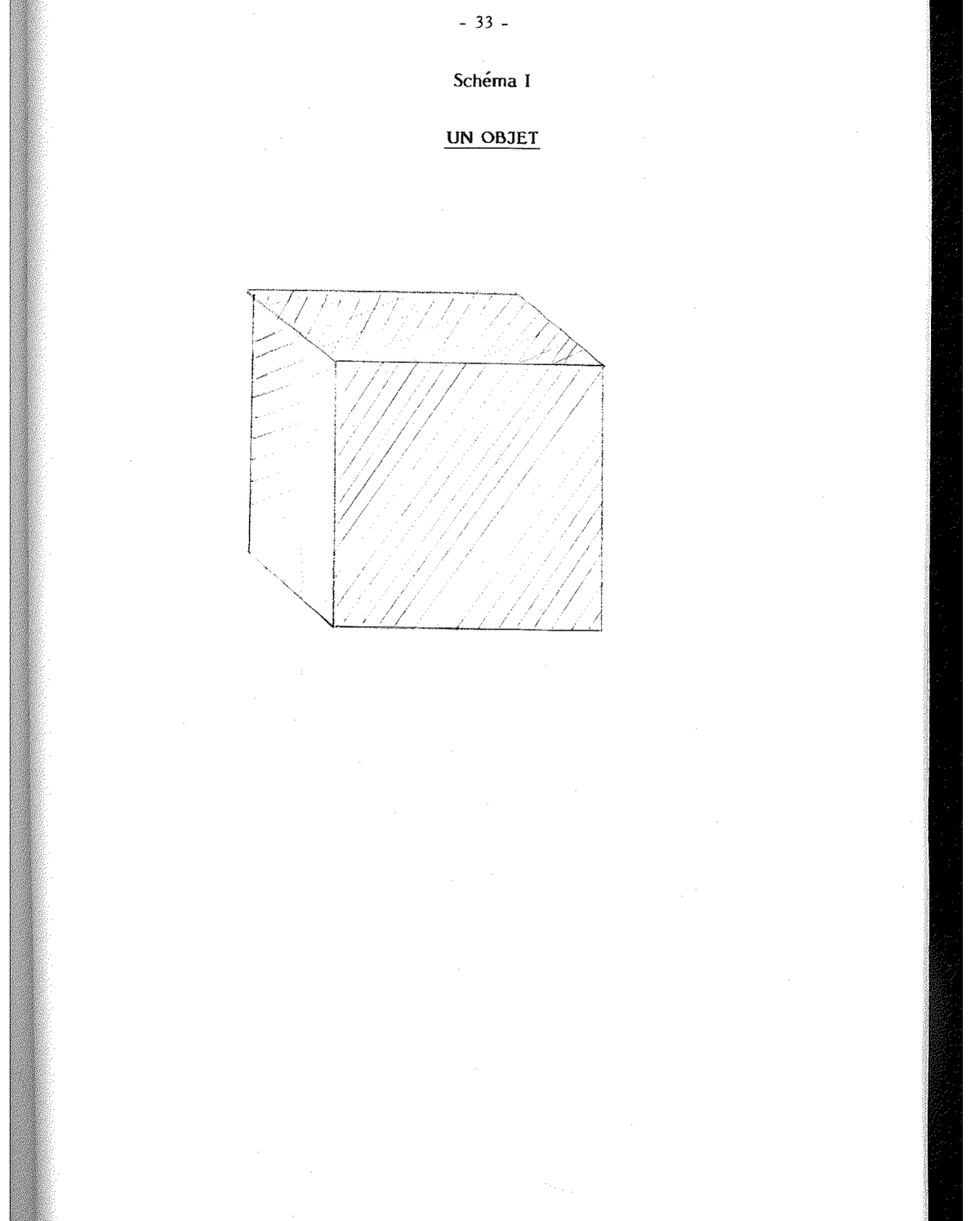
Diagram V — Cochlear integrator: cortico-ponto-cerebello-dentate-thalamo-cortical circuit, bundles of Turk-Meinert, ponto-cerebellar, cerebello-dentate-thalamic.
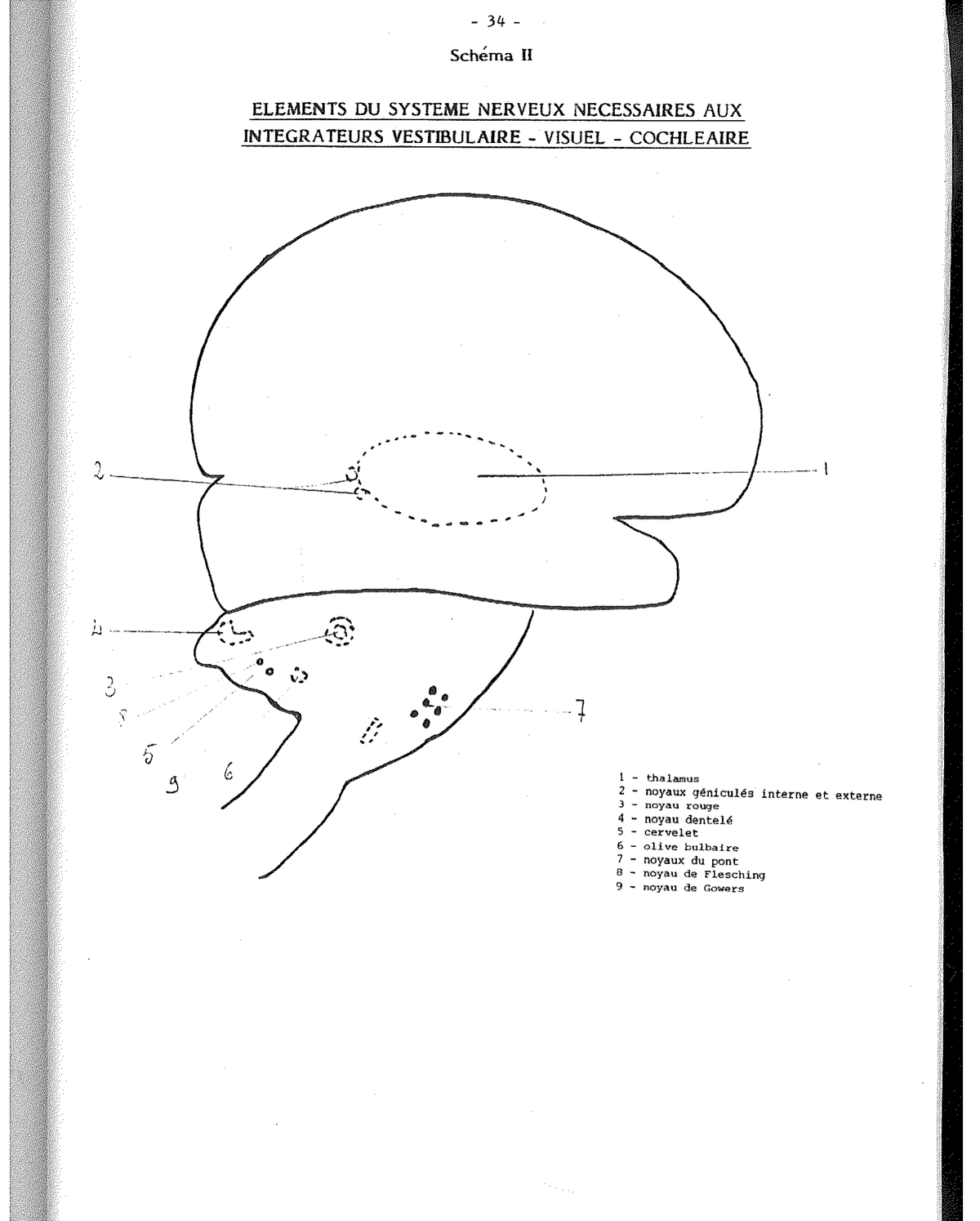
Diagram VI — Complete cochlear integrator: circumvolutions, fissures of Rolando and Sylvius, projection of the pyramidal bundle, sensitive fibres on the cortical areas.
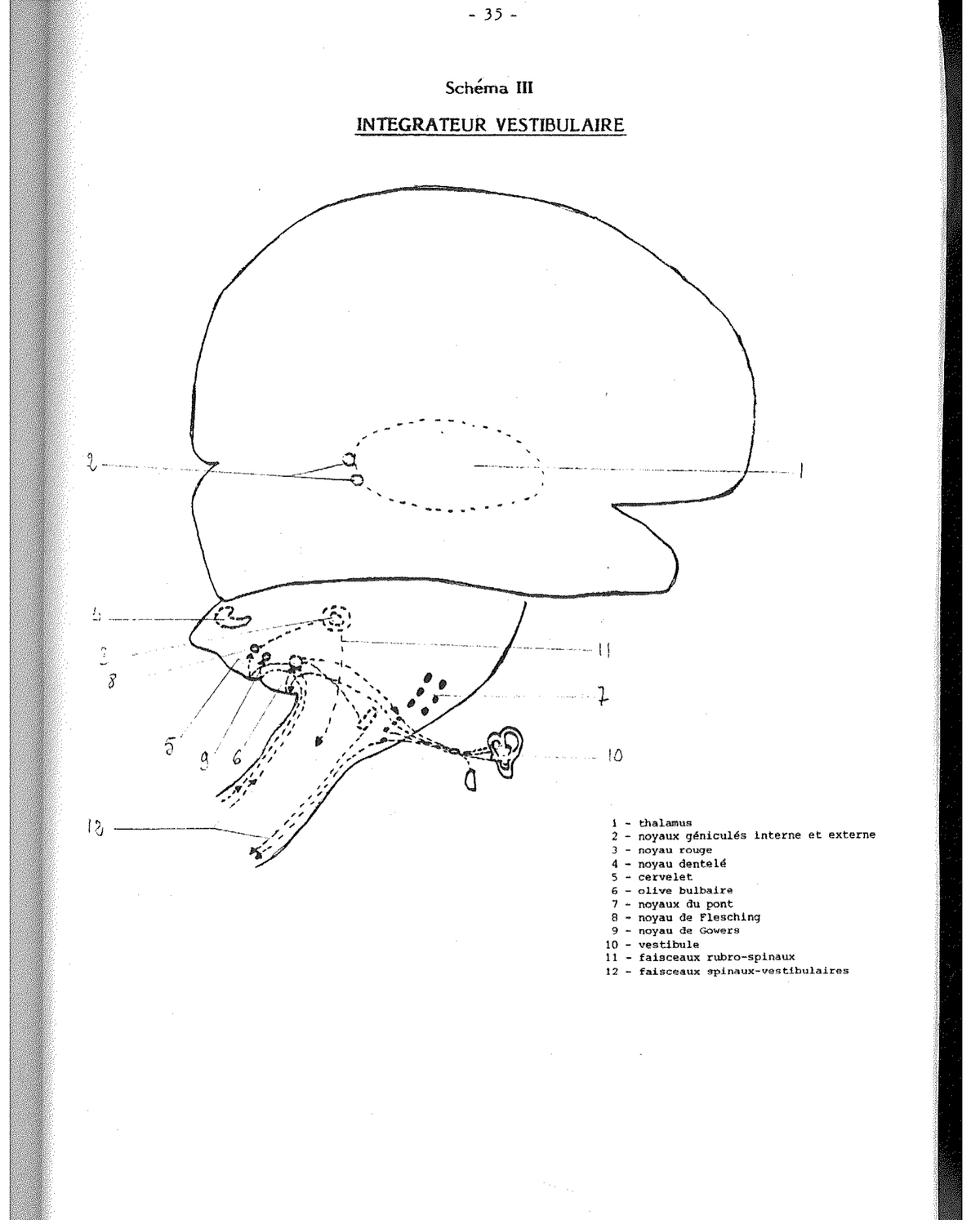
Diagram VII — Synthesis: Object (form/colour/volume/name) → Body in becoming (embryo-foetus, infans, young, adolescent, adult) → Vestibule + Cochlea → Engrammation/Reproduction (iconic, sign, arts) → Symbol, by evocation of the “lived with” the object.
Diagrams VIII and IX — Symbolic evocation of the tree (embryo-foetal progression, structuring dynamic vs photographic apparatus) and of the cavity (uterus-head sphere, house-fortress, church that sings, earth, empty cosmos; resonating cavern and Plato’s myth of the cavern).
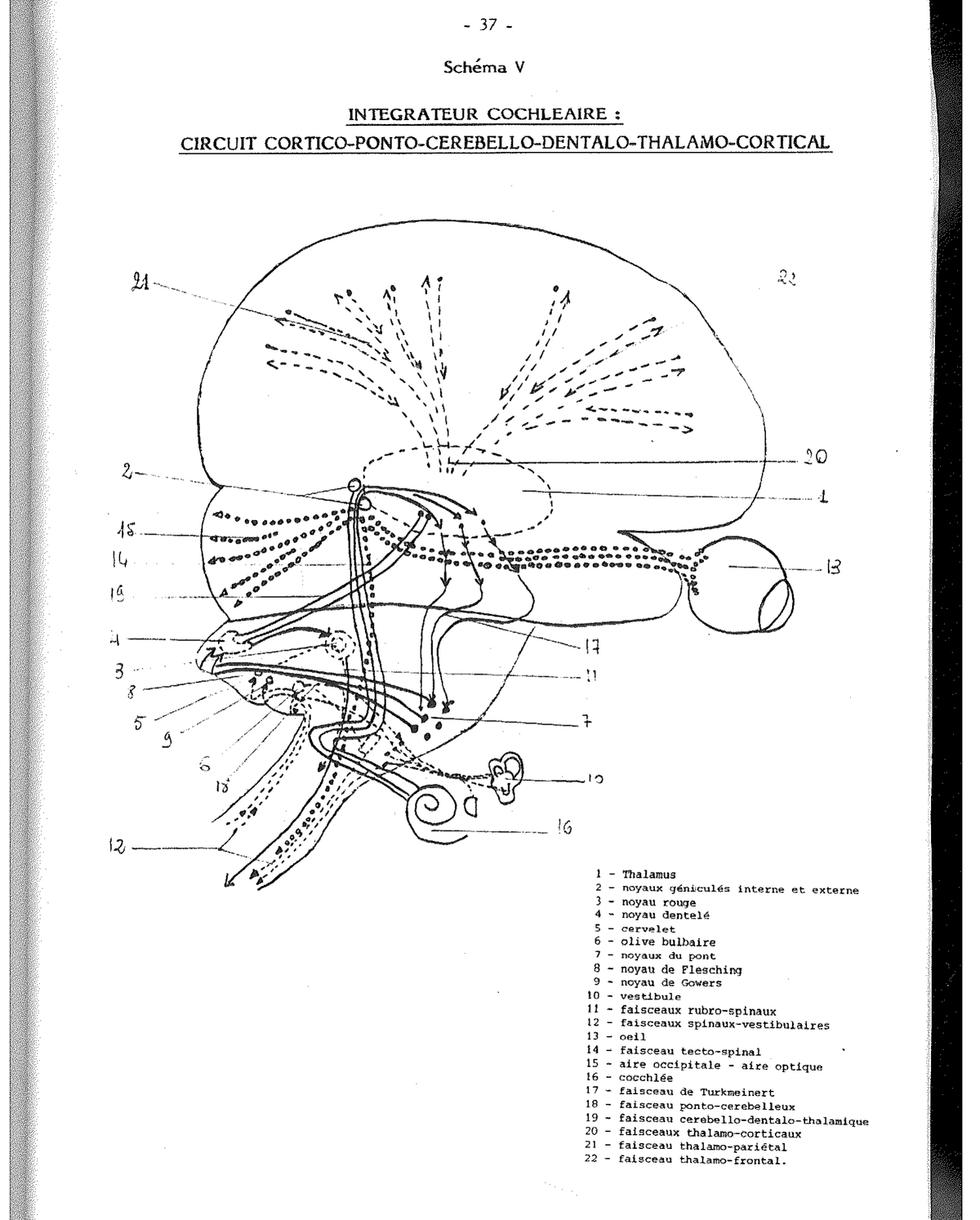
Diagram X — Evolution of the drawing of the tree: from the embryonic “little mushroom” (with umbilical cord) to the robust tree with spread-out crown of the Language stage.
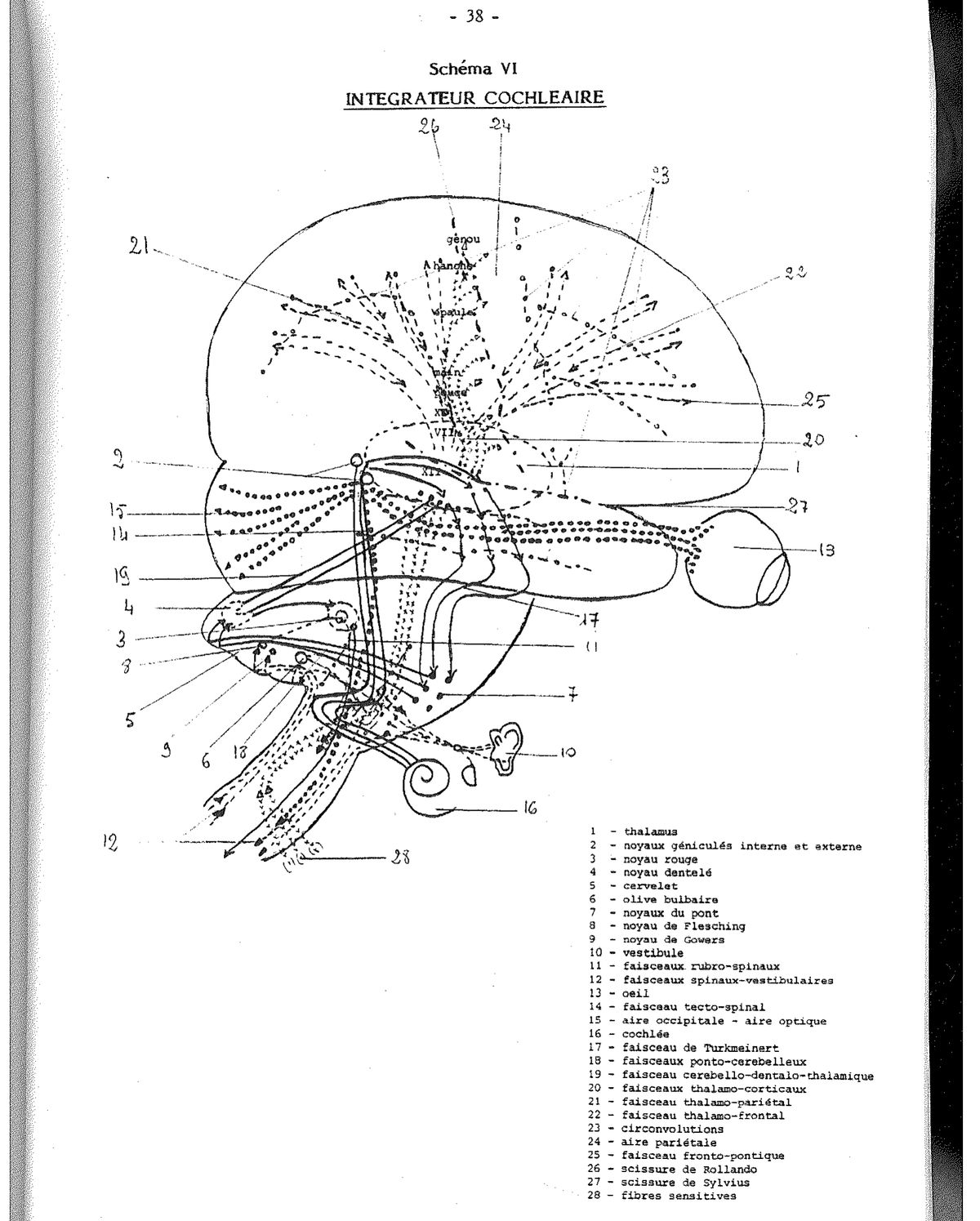
Diagram XI — Evolution of the drawing of the house: from the foetal round image to the open house (windows, door, road leading out, flowers with five petals = hands).
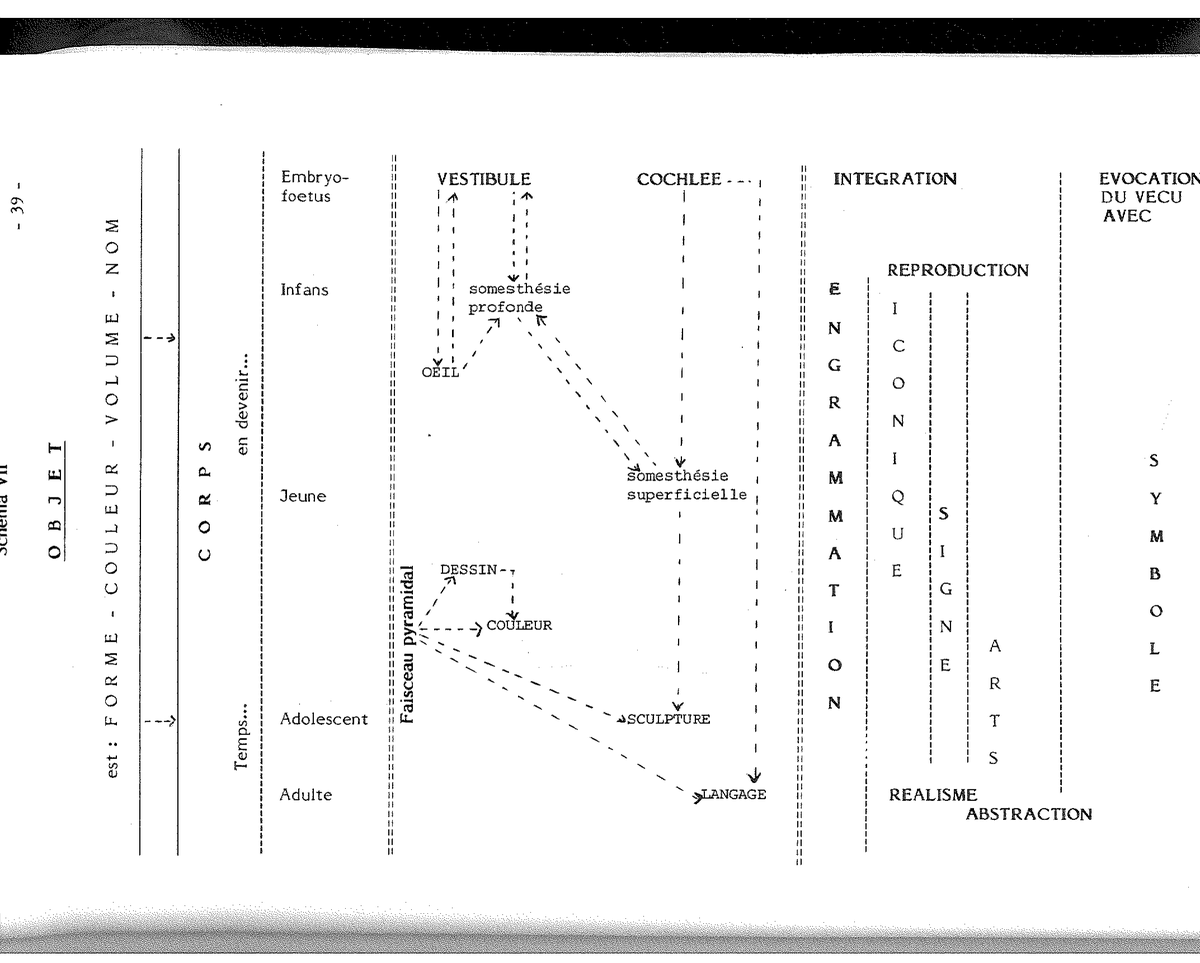
Diagram XII — Themes of drawings in Musical Sonic Return (RSM): (a) eye/face, (b) corner house, (c) geometry of securing, (d) second geometry, (e) cavity, (f) boat, (g) double tree.
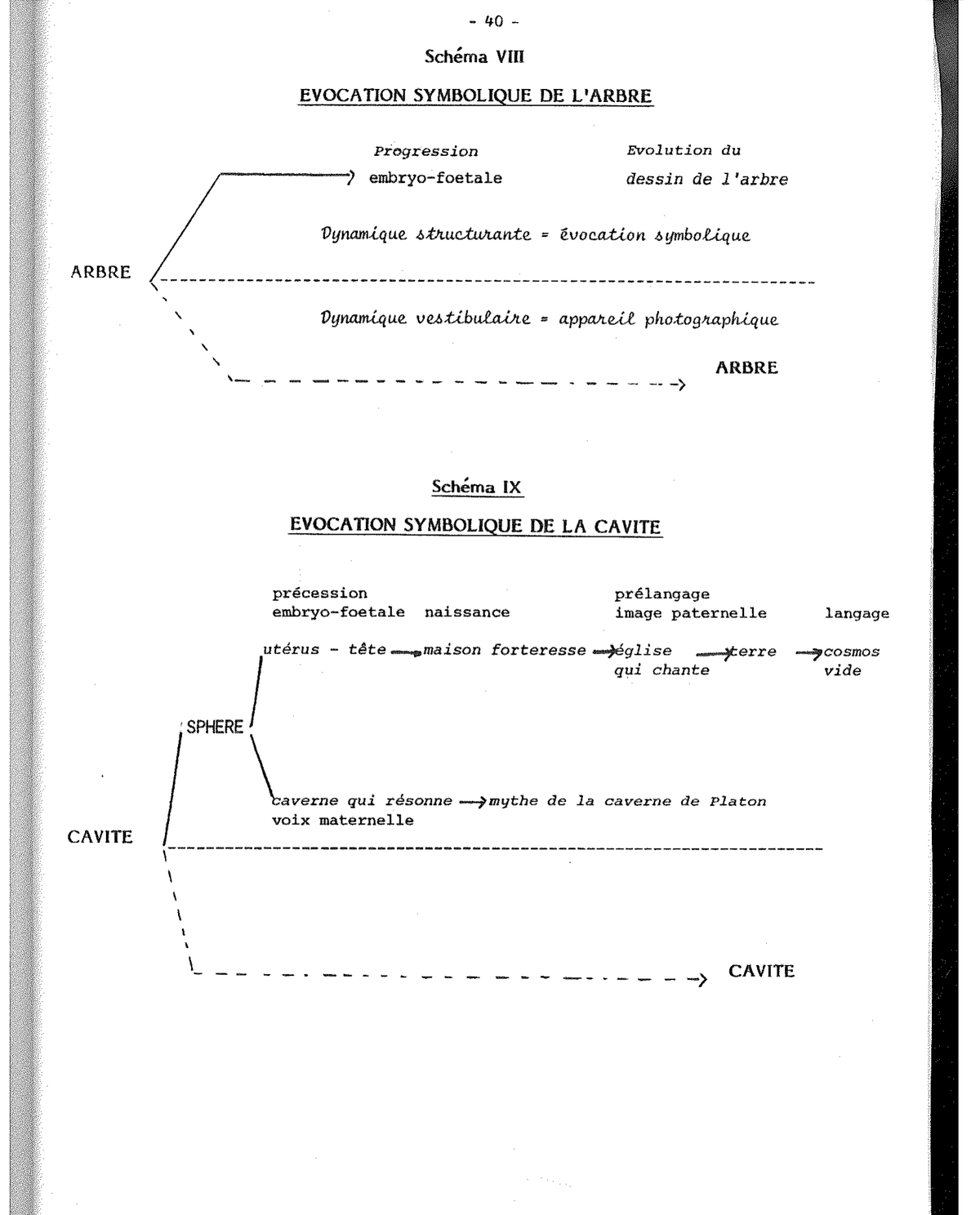
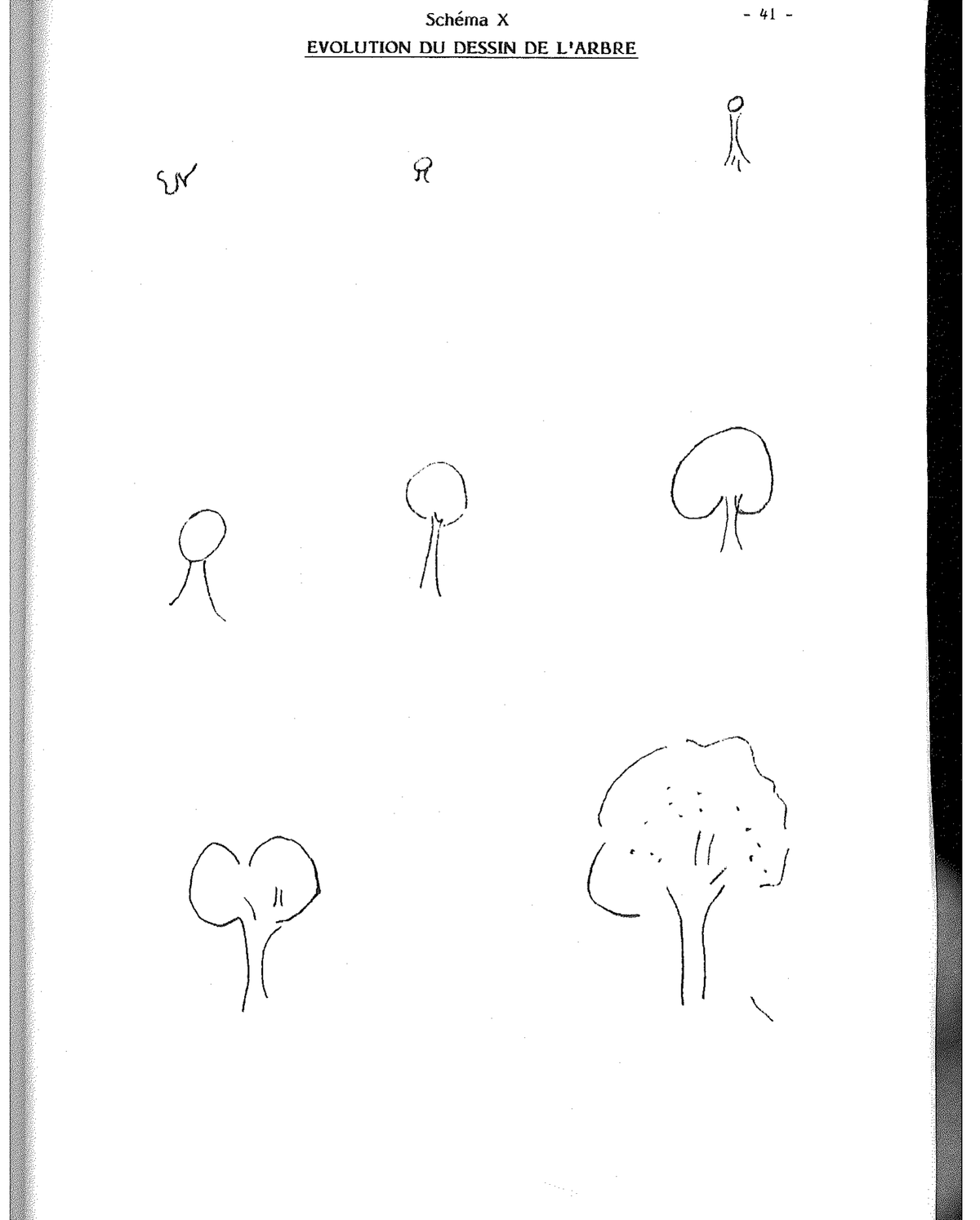
Diagram XIII — Themes of drawings in intra-uterine Memorisation (Filtered Music, filtered Maternal Voice): (a) foetal images / cavities with red edges, (b) umbilical cords, (c) boat in the water / submarine, (d-1, d-2) closed houses or with walls, (e-1 to e-4) tree-neurons with or without truncated trunk (suicidal sign), (f) geometric figure of securing, (g) coloured invasion of the sheet, (h) large red drawing (aggressiveness), (i) faces, (j) various (archaic rounded forms).
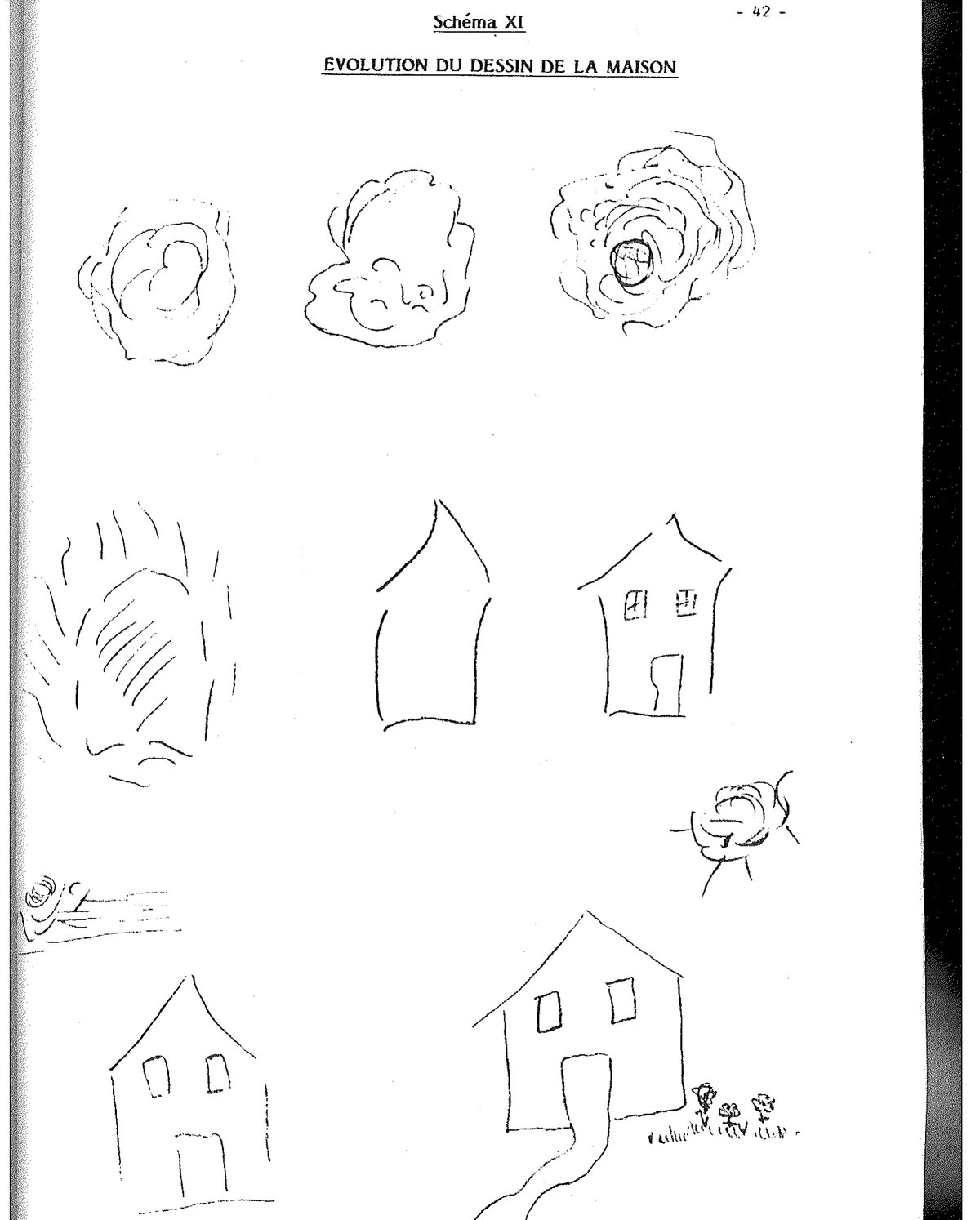
Diagram XIV — Themes of drawings in Sonic Birth: (a) rainbow, (b) open house with road, (c) explosion / volcano, (d) path going up or down with trees, (e) hills + sun + tree = chest of the mother, (f) bridge (passage to the father), (g) cord-vermicelli, (h) boat-sun-clouds.
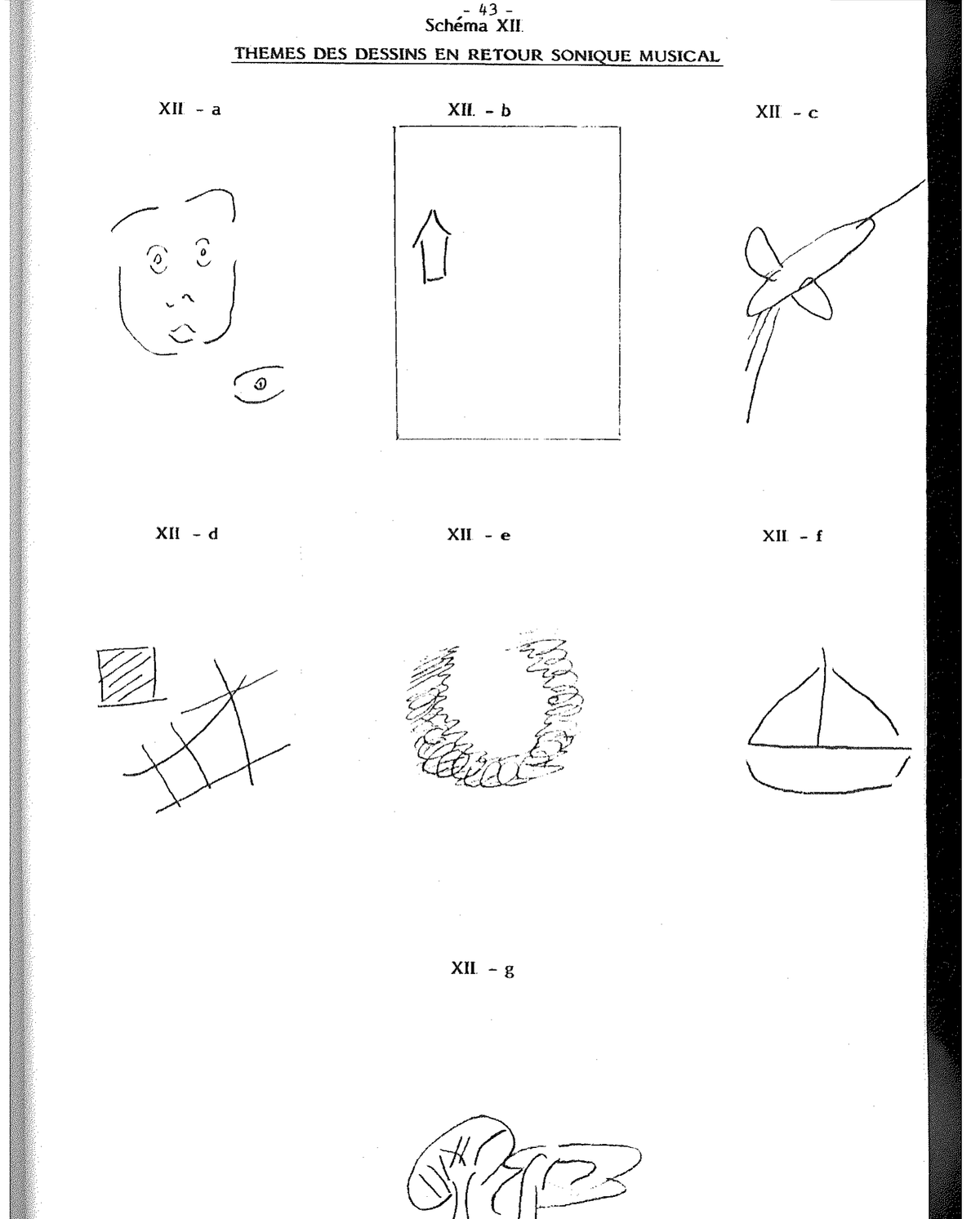
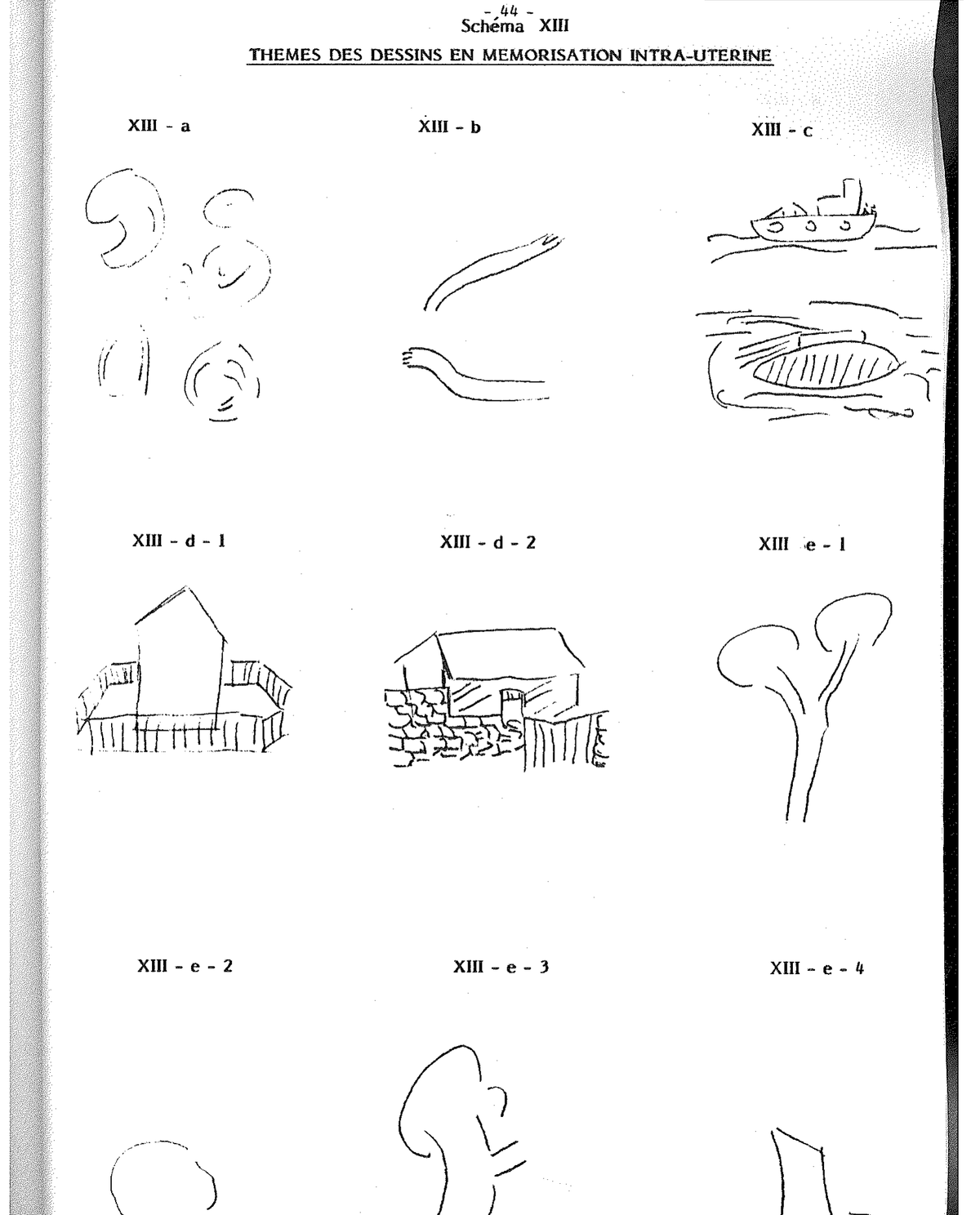
Diagram XV — Themes of drawings in Pre-language: (a) robust tree with spread-out crown and fruits/leaves on lateral lines (“holes in the sky”), (b) spring/ascending dynamic, (c) geometry of securing, (d) calmed dynamic (sea, sun, flying object), (e-1 to e-3) motifs of cut neck / taken by the throat / image of the father who takes the child by the throat (refusal of language).
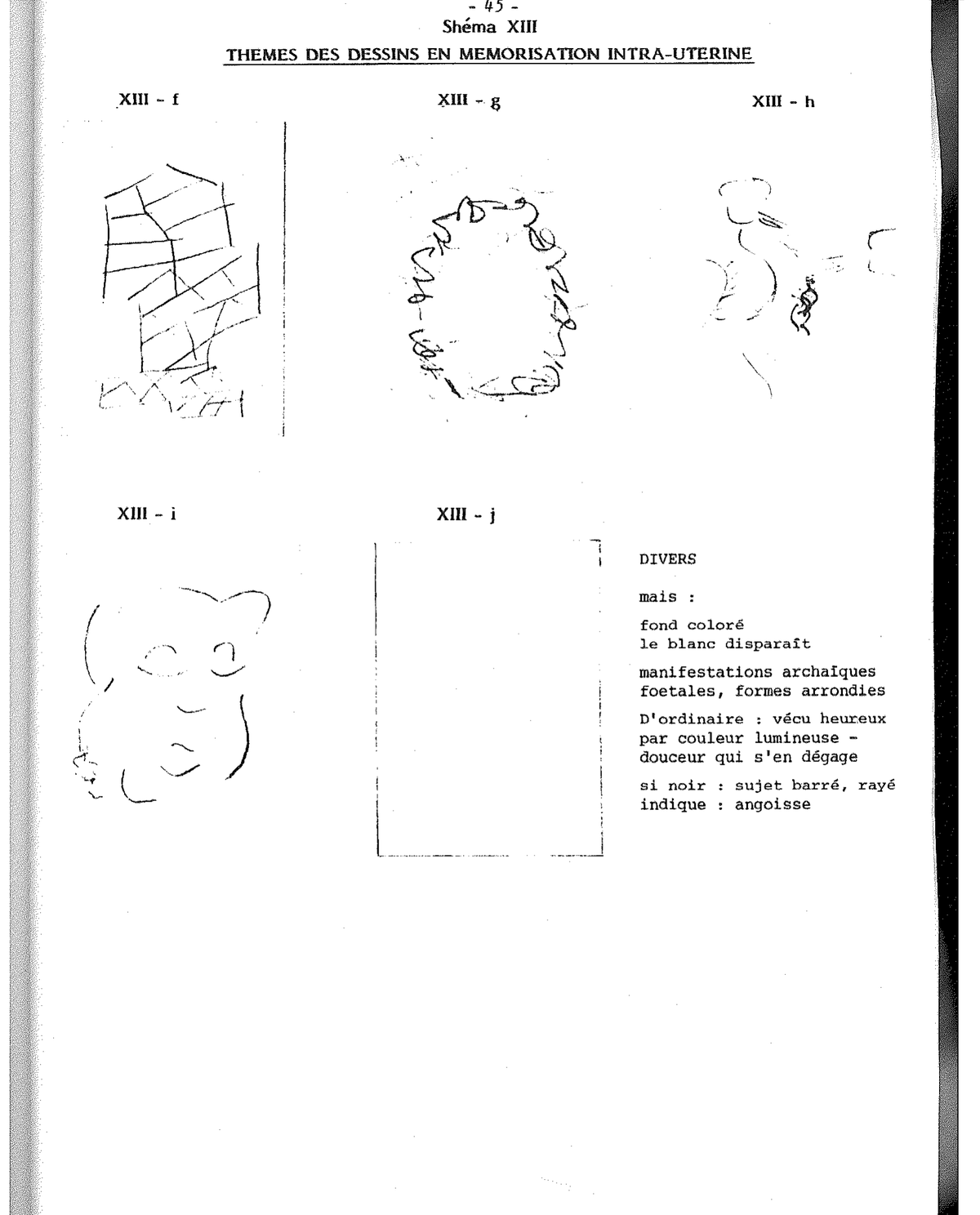
Diagram XVI — Themes of drawings in Language: (a) strong tree with spread-out crown, (b) vase (energy), (c) church-bell-tower (umbilical cord to the sky, hooked to the Creator), (d) lines of force / cross / Hebrew letter noun, (e) maze, (f) hills-sun-maternal then paternal head, (g) calm sea / sun / bird / butterfly (terminal phase).
A few abbreviations
-
RSM — Musical Sonic Return
-
MF — Filtered music
-
VM — Filtered maternal voice
-
AS — Sonic birth
Bibliography
A. A. Tomatis
-
- L’oreille et le langage. Paris, Le Seuil.
-
- Éducation et dyslexie. Paris, E.S.F.
-
- La libération d’Œdipe. Paris, E.S.F.
-
- Vers l’écoute humaine. Vol. 1 and 2, Paris, E.S.F.
-
- L’oreille et la vie. Réponse-Santé collection, Paris, Laffont.
-
- La nuit utérine. Paris, Stock.
-
- L’oreille et la voix. Réponse-Santé collection, Paris, Laffont.
Source: A. A. Tomatis, “Son et Symbolique du Dessin”, paper at the TOMATIS Network Seminar held on 2-3 March 1984 on the Île de Bendor (Var, France), organised by the Marseille Language Centre. Printing of fifty-six pages, deposit at the Société des Gens de Lettres de France no. J 2053 of 20.09.86. Document digitised from the personal archives of Christophe Besson.