The Integration of Modern Languages
As its title specifies, the present work does not pretend to set out all the resultants of the Tomatis Effect. Only the consequences relating to the integration of modern languages will be evoked here.
For applications whose importance reveals itself ever more considerable in the field of psycho-pedagogy, the reader is advised to consult the bibliography at the end.
Léna TOMATIS, Paris 1965
Introduction
The increasingly keenly felt necessity, on an international scale, of learning foreign languages has given rise to the flowering of a very great number of systems, almost all qualified, more or less emphatically, as audiovisual.
One is immediately struck, in examining these “miracle methods”, by the inadequacy of these systems, of which many rest on no scientific basis, ignoring the elementary laws of the psycho-physiology of language, and more particularly the relations which exist between audition and phonation — that is, between the possibilities of hearing a language and those of reproducing it.
Modern languages have for too long been approached as dead languages, by having pupils drone out words sometimes vanished from the spoken language and by sprinkling antiquated rules of grammar.
Since the last war, following the extraordinary development of facilities of communication, the rise of tourism and international commerce has generalised the need to address other peoples in an easy and direct manner. There were then born the so-called “audiovisual” methods. But these have too often been only the spoken or visualised transposition of an old system of teaching.
It is time now to move into top gear by using the most recent discoveries of the audition-phonation relation and by going beyond the notion of learning a language to reach the stage of integration of this language — an act much more complete and, paradoxically, much easier.
The primordial role played by the ear in linguistic learning — whether the mother tongue or a foreign language — cannot escape all those interested in the problem of verbal integration. It cannot indeed be ignored today that the great door open onto language is the ear. One learns a modern language by hearing it, and by hearing it correctly.
The key to this learning therefore consists in assuring the pupil an audition of quality. By this very fact, the audibility of the language studied becomes more efficient, all the acoustic nuances of that idiom being then constantly perceived. It is therefore necessary to know on the one hand the auditory possibilities of the subject and to permit him on the other hand to enter into the sonic universe of the ethnic ensemble whose language he wishes to master.
We cannot insist too much on this point. It is useless to teach a language to a subject who does not hear it or who hears it confusedly. The most beautiful language laboratories remain ineffective when they do not take account of this essential factor. This is why throughout this work we shall speak much more of integrating than of learning. This difference is for us absolutely primordial.
The apparatuses called “Electronic Ears with Tomatis Effect” allow the pupil to hear in the manner of an Englishman for instance, or a German or a Slav, and consequently, according to the Tomatis laws which we shall study in the course of this work, to speak, to reproduce correctly the language studied.
The aim of this brochure is not to advocate one method rather than another, but simply to try to establish the essential principles which must necessarily govern any serious study of a modern language.
The laws which are at the basis of this presentation will be evoked in their general context and in their very particular application to the teaching of modern languages. They will bring to light the primordial role of the ear in verbal acquisition, which has led Tomatis to say, in a lapidary formula: “One speaks with one’s ear”.
Thus, in a first part, we shall examine the principles of the “audition-phonation” relation. Our second chapter will study how these laws can be applied to the integration of a modern language. Chapter III will determine the “envelope curves” of some European languages, thus visualising the principal differences existing between these idioms. The fourth chapter will be devoted to the description and functioning of the Electronic Ear.
The three last chapters will deal essentially with the use of these new devices in current methods, and with the preliminary conditions of this use (audio-vocal test).
Our conclusion will try to determine very briefly what the integration of a language can bring on the psychological plane.
I — The Tomatis laws
It is in the practice of Occupational Medicine that Dr Tomatis was led to put forward hypotheses which now bear the name of “Tomatis Laws” and concern the relations existing between audition and phonation. These discoveries of considerable importance have made it possible to envisage the modification of either of these two essential functions, in a wide therapeutic and pedagogical perspective.
First law
In examining workers afflicted with occupational deafness as a consequence of long periods near noisy machines, Dr Tomatis was able to observe that ear traumas were always accompanied by a vocal deficiency. He then wondered whether defective audition was not the cause of the alteration of the voice.
A finer analysis of the mechanisms having brought about a sensible diminution of auditory perception with respect to certain frequencies allowed him to observe that the frequencies not integrated by the ear were precisely those absent from the vocal spectrum of the subject. This was the first fundamental discovery, the first Tomatis law, stated as follows:
“The voice contains only what the ear hears” or, in more specific language, “the larynx only emits the harmonics that the ear can hear”.
It is to this curious and interesting phenomenon that Raoul Husson, a remarkable specialist in the psycho-physiology of the voice, gave the name Tomatis Effect in a communication to the Académie des Sciences dated 25 March 1957 (1).
Under the impulse of Professor Monnier, R. Husson was able to verify in the Physiology Laboratory of the Sorbonne the fact signalled by Tomatis in 1952 (2) then in 1954 (3) and to express it thus:
“If a subject emits a sustained vowel into a microphone whose voltage passes through a system of filters which suppresses a band of frequencies before its return into the earphones placed on the ears, the suppressed band disappears from the spectrum of the vowel emitted by the subject. Likewise, in any subject presenting an auditory scotoma, the harmonics included in the affected auditory island are absent in the subject’s voice.”
Raoul Husson, in a communication to the Académie Nationale de Médecine on 4 June 1957, took up this study under the title “Phonatory modifications of auditory origin and physiological and clinical applications” (4).
This first Tomatis law therefore brings to light the striking parallelism between the auditory curves and the vocal emission curves of subjects damaged naturally or experimentally.
Second law
The second Tomatis law is in reality the corollary of the first. It is stated as follows:
“If one restores to the damaged ear the possibility of correctly hearing the frequencies lost or compromised, these are instantaneously and unconsciously restored in vocal emission.”
The comparison of emission curves before and after application of the “Tomatis Effect” apparatus — the role of which is to re-establish audition in the damaged frequency zones — allows the easy demonstration of the concomitant recovery of the vocal bodily schema.
Raoul Husson, in his communication of 4 June 1957 to the Académie Nationale de Médecine, signals this second law as a “consequence of the physiology and phonatory physiopathology of the Tomatis Effect”.
He specifies in particular that the excito-tonic contribution resulting from auditory stimulations of the 2,500-3,000 hertz band allows the subject to recover his habitual vocal bodily schema.
Third law
The third Tomatis law, called the “law of persistence”, brings to light the possibility of a conditioning of self-listening entailing, by educational reflex-therapy, the modification of phonation.
It may be stated as follows:
“Auditory stimulation maintained for a determined time modifies, by phenomenon of persistence, the posture of self-listening of the subject, and in consequence, his phonation.”
On the one hand the functioning of the ear sets in motion the muscles which modify the osteo-muscular position of the middle ear. The phonatory system acts, on the other hand, under the effect of a whole series of muscles which command the larynx, the buccal cavity, the tongue and the lips. These muscles of audition and phonation are themselves commanded by an innervation device belonging to the same neuronal reign. In the adult, this neuro-muscular ensemble is perfectly trained for the ethnic audition corresponding to his mother tongue. By contrast, if one modifies this audition, by introducing into the self-monitoring circuit an “Electronic Ear” tuned to another way of speaking, to a foreign language for instance, it is the whole neuro-muscular circuit of the subject that begins to work on this foreign rhythm; and it is thus that little by little a persistence is created by cerebral memorisation of this new activity and by muscular training.
This third law finds a wide application in the domain of the accelerated integration of modern languages. It calls upon the conditioning to self-listening necessary for the learning of a modern language, in all its phonetic and semantic parameters.
Auditory lateralisation
One of Tomatis’s fundamental discoveries consisted in bringing to light the predominance of one ear over the other in the processes of language integration. He was thus able to define the primordial role played by the Directing Ear in the aiming of sound, in the monitoring of the spoken chain (5).
The theory of auditory lateralisation put forward by him as early as 1951 and verified by long experimentation constitutes one of the essential foundations of linguistic learning, whether the mother tongue or a foreign language.
Continuing his research in this direction, Tomatis was subsequently able to demonstrate that the regulation of language was effected solely by the right ear (6), the latter always holding the role of directing ear for the monitoring of the different parameters of language: intensity, timbre, intonation, inflexion, semantics.
This is a considerable contribution in the field of language integration.
Auditory selectivity
Let us mention finally the auditory selectivity which introduces the notion of quality, of analysis, of auditory fineness within the pass bands specific to each language.
Tomatis, after having observed that “if it is true that an individual no longer reproduces the sounds he no longer hears, he does not for all that reproduce all those he hears”, put forward as early as 1954 (7) the hypothesis of the existence of a certain faculty of the ear to perceive a variation of frequency within the sound spectrum and to situate the direction of this variation.
He was also able to demonstrate, through a process of research now classical — by the analysis of the envelope curves of the acoustic spectra of each language — that the different ethnic ears (8) have very different selectivity bands, in which agglutinate the frequency affinities proper to each of them.
It is thus, for example, that the Italian ear inscribes its selectivity between 2,000 and 4,000 hertz, while the French ear has a selectivity situated between 1,000 and 2,000 hertz.
The Russians, by contrast, benefit from a very extended pass band going from the most low to the most high sounds. We shall have to return to this question in chapter III, when studying the envelope curves of each language.
The various Tomatis laws and theories that we have just briefly evoked, and which suppose a true conditioning of vocal emission by audition, have been used for many years in other domains, in particular for the treatment of various conditions such as:
Disorders of phonation and of the spoken and sung voice:
-
Disorders of timbre: aphonia, dysphonia
-
disorders of articulation: lisping, sigmatism, sibilant whistle
-
disorders of rhythm: dyslalia, stumbling, blockage, stammering.
Disorders of spoken and written language:
-
Language delay, absence of language
-
dyslexia
-
dysorthography
Disorders of expression and behaviour
Disorders of school integration
Disorders of audition:
-
Occupational deafness
-
psychic deafness.
This brochure, we wish to recall, does not pretend to study all the applications of the Tomatis Effect, but only to make known the use of these laws in the field of integration of modern languages. We shall therefore limit our discourse by showing how, in adjunction and not in competition with the classical methods of language teaching, the Tomatis Effect, through the channel of an apparatus called the “Electronic Ear”, allows a better integration of foreign languages by giving rise to a rapid acquisition of what has been called the ethnic ear.
The phonetic exercises carried out with the Tomatis Effect apparatus ensure a conditioning of the ear such that it leads the subject to hear correctly and to pronounce with an exact intonation the foreign phonemes.
Thanks to this training, the student spontaneously takes the phonetic posture and, in consequence, the psychological posture, necessary for the learning of the language he wishes to acquire, and this, whatever the method employed.
II — The integration of languages and the Tomatis Effect
And first, what is meant by integrating a language? To integrate a language is to be able to restore it “ad integrum”. It is not, as may be conceived, a question of reproducing only the letter of it, but also the spirit. In other words, to possess a language one decides to absorb is to use it to the point of existing through it. For a modern language is not, as has been believed for long, an assemblage of words according to rules, but indeed a combination of signals, of groups of sounds destined to communicate to others the thoughts, feelings and will of each.
A language, to be significant — that is, understood by the one or those with whom one wishes to communicate — can only use signs referring back to the realities they designate. And to the most courteous and amiable grammarian in the world addressing us in a language as polished as it is incomprehensible, we shall say, as Pantagruel to Panurge: “My friend, I doubt not that you know well how to speak diverse languages, but tell us what you wish in some language we can understand”.
These signals, to be understood and integrated immediately, without effort, without analysis, without decomposition, must above all be heard correctly. But it is also necessary that the pupil be able to reproduce them, to pronounce them with the greatest exactitude on the plane of sounds, rhythms, timbre and articulation.
Just as the pianist must train himself to reproduce a musical phrase as a whole, automatically, as a totality no longer decomposed, so the student in modern language must succeed in hearing and reproducing globally and unconsciously, without analysing or decomposing them, with their rhythm and intonations, the sonic groups which are at the beginning foreign to him and often in opposition to his own linguistic reflexes.
This is, as may be surmised, an ideal process of integration, rarely attained from the outset except in subjects endowed with an ear particularly adapted, open to the various frequencies of the language to be studied. But in most cases, the linguistic experience offers from the outset such difficulties that the simplest thing in appearance which is the learning of a language becomes a true adventure. Obstacles of all kinds rise up, insurmountable; and of the initial dream nurtured in the depths of the being, there remains only a secret evanescent desire to communicate, which fades little by little before the multiplicity of ever vain efforts.
For many pupils, babelism arises in this way, confining them irretrievably within the unbreachable enclosure of their mother tongue, while there emerge from this great tide a few elect endowed with exceptional possibilities, allowing them to move at will within the language of others. As though a mysterious faculty had loosened their tongues.
Yet, on full consideration, learning a foreign language ought to be easy, and the child’s enthusiasm on his entry into the sixth grade, as he is at last to plunge into the study of a language other than his own, shows how much goodwill is mobilised from the outset. Alas! how many disappointments — which will most often remain the lot of the study of languages!
Whence then comes this rupture which causes the sweet hope of linguistic discovery to evaporate in a few weeks? Intelligence is not to be invoked. It would seem absurd to be devoid of it essentially for a subject such as that of modern languages. It will, certainly, come to the rescue of the unhappy pupil who will desperately try to accumulate, through a thick, inextricable fog, the rudiments necessary for the obtaining at the end of his schooling of a limit mark, non-eliminatory, often compensated for by successes in other subjects. By saturation, by osmosis, a few scraps will pass through in an atmosphere of constraint and failure.
But what will remain at the end of this initiation? A nightmare, an indescribable repugnance doubled by a bad conscience at having missed some precious teaching, and a secret apprehension at being obliged to come back to it later.
It seems therefore opportune to reconsider the problem of the learning of modern languages by trying to elucidate what integration, the verbalised information, may be in the most general sense. Whether it relate to a mother tongue or a foreign language, the process of the mechanism in depth indeed remains the same.
There is no longer any doubt that a modern language sees its integration take place through the ear. This auditory acquisition, although aided by text and image, is essential and primordial. It is by hearing it that one learns a language, and by hearing it correctly.
But what does it mean to hear correctly? One is not deaf, it would seem, because one is unfit to learn English. However, one must resign oneself to admitting that, in this case, one is electively deaf to English.
To understand this new notion which may seem disconcerting at first sight, it is well to recall that the ear has been only secondarily conditioned to language. “Language has appeared as the ultimate stage of a transcendent adaptation which has been able to condition to acoustic ends a neuro-muscular ensemble destined for deglutition and respiration” (9).
The acoustic possibilities of the ambient milieu have permitted man to handle with finesse and agility the sonic gamut proper to his language. But what an acoustic world different from that of another language!
Not long ago, the author of an article entitled “Chinese in Paris” alluded to the necessity of a “tailor-made” auditory correction for the Chinese, particularly refractory to French. He gave as a reason for this necessity that “by dint of hearing exclusively the sounds proper to our mother tongue, not only our ear but the auditory centres of our brain are conditioned”.
This proposition, doubtless exact, demands some explanations: our auditory system being conditioned by the ethnic milieu, we remain insensitive to the intonations, to the sonic variations that we are not accustomed to hear.
Our language sees itself deprived of foreign consonances that our ear cannot capture, the auditory deficiency necessarily translating itself into a vocal deficiency. This is what the Tomatis Effect sums up by the formulation: “The voice contains only the harmonics that the ear can hear”.
“The impressions we receive on hearing a foreign language, even without understanding it” — already noted Mr Charles Bailly a few years ago (10) — “come in large part from a comparison made unconsciously with the phonological system of our own language, and the agreeable or disagreeable feelings we draw from it are due to this cause; the one who speaks this other language generally feels nothing similar, and his acoustic impressions are of an entirely different nature.
A Frenchman studying Russian will be struck by the frequency of palatal and sibilant sounds, by their contrast with the velar sounds, by the particular music of the intonations — all this because he perceives unconsciously a considerable difference between this pronunciation and his own. But the Russian who, in speaking, produces these impressions on a Frenchman, himself feels nothing similar, because these things are habitual to him.”
And another eminent phonetician, Mr Pierre Fouché (11), also remarked happily that “the representation we ordinarily make of a modern language is an acoustic representation. We retain what is commonly called its “accent”, we attribute to it a certain “colour”. We even say that it is sonorous, soft, monotonous, and so on”.
Each of us is therefore conditioned to hear in a certain manner, and the phonatory system, bending to the same demands of the ambient milieu, obliges the subject to pronounce in a certain manner. “Thus”, writes Wilder Penfield (12), “all Swedes speak English with a Swedish accent, and the French, the Germans and the Chinese speak with their own accent. This is a matter of common observation. Even if they travel the world, the Cockneys, the Scots and the Irish, to say nothing of the Canadians and Americans, betray throughout their lives, by a ’turn of tongue’ learned in childhood, their origin”.
We find ourselves therefore indeed before a general law, which moreover does not concern only certain peoples. Having the ear of our ethnic group, we are all by nature more or less refractory, depending on our race, to the learning of foreign languages — and precisely in the measure, as we shall see further in detail, that they are more distant from our auditory curve.
In this regard, we are all, in a way, “hard of hearing”, and this is why we are amenable to the procedures employed by phoneticians to re-educate the audition of subjects afflicted with auditory disorders. The only resource seems indeed to be to “force” the ear to hear what it does not hear naturally, which can only be effected by artificial devices.
It may seem strange, at first sight, to have recourse to electronic procedures where one most often sees only a pedagogical problem combining goodwill (and will tout court) with ever more perfected teaching techniques — to say nothing, of course, of those “miracle” methods presented through skilful and tempting publicity, flattering laziness and lulling the pupil with an insidious illusion that makes him believe it is possible to learn without effort.
Certainly, no acquisition is made without effort. But it does not suffice either, like Rimbaud, to shut oneself in a cupboard, equipped with a grammar, armed with an iron will, and swear that one will only emerge after having mastered the language one wishes to learn.
To integrate a foreign language, one must “want” to study it seriously, it is true. But one must also “be able to” — and this in the most physical sense of the word — learn it, that is, “hear and reproduce it”, then listen and repeat, finally hear and listen to oneself repeating or reproducing (13).
To hear and to reproduce — such are the two essential elements that the Tomatis Effect brings into play in its principle of regulation of audition and phonation. By applying this principle to the level of the learning of a language, one arrives at the setting in place of a self-monitoring circuit which allows the language student to benefit to the maximum from the sonic message transmitted to him and to reproduce it “ad integrum”.
By modifying the audition of the subject, by teaching him to hear in another way than that to which he is accustomed by his mother tongue, one triggers another way of speaking, another mode of expression characteristic of the language to be studied.
This audio-vocal effect brings about modifications bearing on timbre, on the organisation of the phonatory apparatus, on the use of the resonating laryngeal cavities above and below, on laryngeal tonus, on respiration, on facial expression — modifications which react in chain by reflex ignition extending step by step to the whole morphological structure of the subject.
These modifications therefore clearly bring out, during the integration of a language, the capital influence of the auditory receptor with regard at once to bodily and gestural behaviour, to psychological investment, to the engagement and then the elaboration of circuits of induction of psychosomatic origin.
It is easy, on the basis of these data, to evaluate the important consequences of such a process.
III — Envelope curves and modern languages
As we said in chapter I, Tomatis has demonstrated experimentally, thanks to the audio-vocal counter-reactions which are the foundations of his laws, that any modification of the auditory bodily schema entails without exception a modification of the vocal gesture. So much so that one may conclude that any vocal gesture corresponds, certainly, to a determined auditory gesture.
From this principle, Tomatis was able to isolate ethnic auditions corresponding to very precise characteristics that we shall evoke in this chapter.
A detailed analysis of the various elements of the spoken chain has been carried out thanks to images gathered with the help of panoramic analysers and sonographs capable of decomposing sounds, just as the prism manages to disperse light into a spectral rainbow. With the aid of these devices, it has been possible to visualise different frequencies of sounds while respecting quantitatively the relative values of each, and to individualise the different elements of a sentence in frequency, intensity and duration. On the phonograms and sonograms thus obtained, one has been able to find the envelope curves (Fig. 1) of the average values of the frequencies frequently encountered in the analysis of sentences gathered in the same ethnic groups.
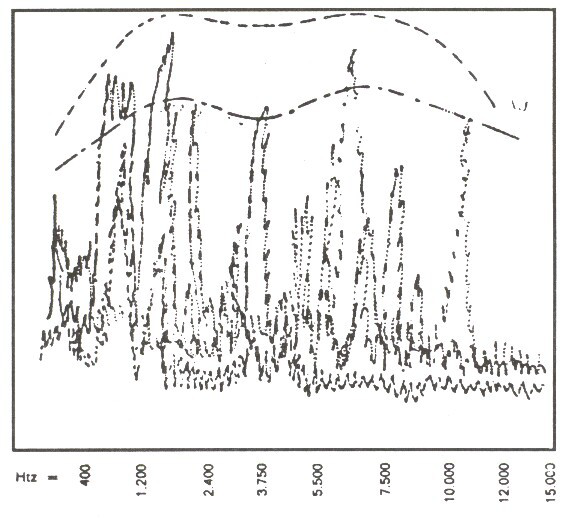
Fig. 1. — Example of a phonogram with the appearance of the envelope curve.
For example, the locus of election of the greatest frequency agglutination for French is encountered around 800 to 1,800 hertz, while for English it extends from 2,000 to 12,000 hertz. And this simple scientific observation already allows us to sense that everything happens as if a Frenchman were practically deaf when he hears English.
Likewise, the historical study of languages shows us how the evolution of human groups over the ages has led each of them to adopt in a totally involuntary manner a certain vocal mechanism composed of vowels and consonants whose pronunciation and timbre are clearly differentiated from one group to another.
From childhood, the ear models its sensitivity on the sounds it hears, and one can soon detect, through the audiometric study, that the curve of auditory sensitivity is closely akin to the curve of phonatory emission of the ethnic group.
In other words, in order to perceive correctly these clusters of frequencies, without risk of introducing distortions through the auditory receptor which functions from then on as a filter, we must accommodate, or better condition ourselves to perceiving in such a way that our optimal selectivity reach that of the desired frequencies during our emission. Thus, by the play of “audition-phonation” self-monitoring, the ethnic ear of the subject imposes upon him his ethnic phonation. To a way of speaking corresponds, let us recall, a way of hearing.
Tomatis has demonstrated, and subsequently verified, that by acting on the way of hearing one could modify the way of speaking.
Before setting out this process of modification, we shall try to specify what this “way of hearing” is.
It is characterised on the scientific plane by the curve of the sensitivity of the ear with regard to the various frequencies that it can hear. This curve is called by us “ethnogram”. We reproduce below, by way of example, the characteristic ethnograms of some ethnic groups.
Figure 2 represents the curve of audition specific to French; it is superposable, on the whole, on the phonogram of this language — to the linguo-gram in a way. It is obtained by integrating the greatest possible number of auditory response curves in a given ethnic group.
French language
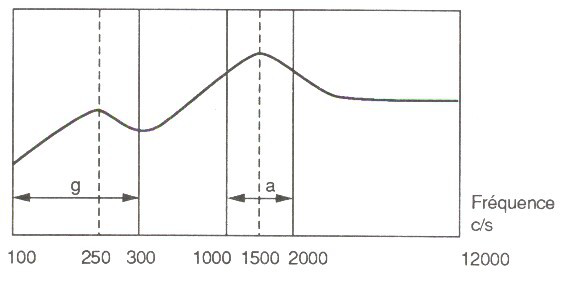
Fig. 2 — French curve
French, here in question, profiles itself typically with two peaks — in fact two zones with culminating points — one situated at 250 hertz in the low frequencies (g), the other at 1,500 hertz in a high zone (a) lying between 1,000 and 2,000 hertz. The difference of sonic intensity between these two levels being about 20 decibels. This last emergence at 1,500 hertz justifies, by the relative fall it entails towards the high frequencies, the appearance of nasals in the French language. By counter-reaction, the presence of this nasalisation in the spoken idiom entails ipso facto the appearance in the corresponding ethnogram of a characteristic peak at 1,500 hertz.
English language
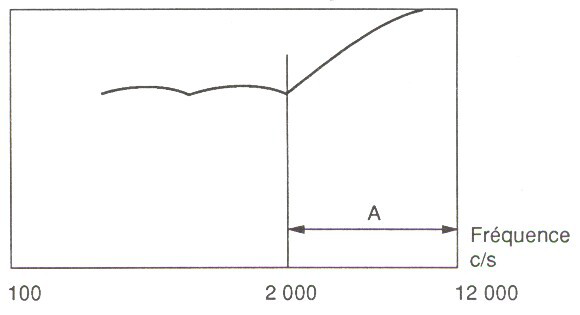
Fig. 3 — English curve
For the English language, one can observe on the profile that the essential characteristic of this type of audition is the great sensitivity to high frequencies. Indeed, from 2,000 hertz, the curve marks a clear progression of the order of 6 decibels per octave, which continues beyond 10,000 hertz — which confers on such an audition a response curve recalling that of high-fidelity amplification mountings.
The consequences are that the perception of the high frequencies beyond 2,000 hertz reaches such an exceptional sensitivity that the modulations at this level are found to be more particularly refined. The richness in sibilants in the English language is the consequence. Moreover, within the language itself, the attraction towards the high frequencies of the whole vocal schema, by auditory counter-reaction, explains the systematic diphthongisation of vowels. The latter, though existing in the initial spectrum, slide from the fundamental sound towards the frequency band situated beyond 2,000 hertz.
Indeed, the pass band of the high frequencies that the English ear perceives imposes on the bucco-pharyngeal output, by audio-vocal counter-reaction, a structure such that the fundamental sound — which is necessarily in the low frequencies, owing to the limited possibilities of the larynx (300 hertz) — cannot be maintained in its initial emission, since the ear does not “select” it. One thus witnesses a true slide towards the high frequencies, a phenomenon at the origin of diphthongisation (14). If, moreover, one tries to bring this auditory band closer to the previous one — that is, if one wishes to compare the English ear to the French ear — it is then self-evident that their meeting is troublesome. It is a secret to no one, indeed, that for the French ear English is difficult to perceive.
It is to be noted that the American language, which offers a lower band than English, with a culminating peak at 1,500 hertz, is better perceived by the French ear than is Oxford English. One perceives in each of the two languages — French and American — a nasalisation marking an increased selectivity at the level of the same pass band.
German language
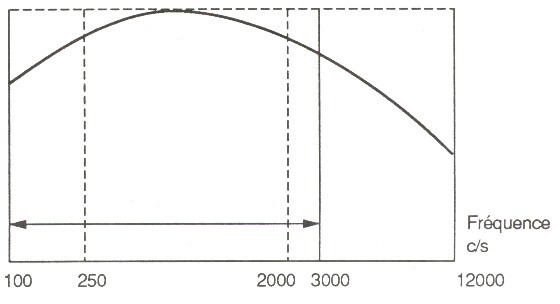
Fig. 4 — German curve
Figure 4 is that of the average curve of the German audition. There one notes the broad pass band starting from the low frequencies and reaching up to 3,000 hertz. The sensitivity is especially marked from 250 hertz and reaches 2,000 hertz with a greater amplitude between 500 and 1,000 hertz. The breadth of the German pass band allows it to integrate with ease phonemes belonging to other languages, provided that these phonemes are inscribed within its recording band.
To this broad pass band is added a very important characteristic of the German ear: a relatively long latency time (15). These two parameters — bandwidth and latency time — imply, in vocal emission, a pharyngeal push proper to German.
This pharyngeal push is moreover for us associated with the postural reflex observed in this ethnic group.
This audio-postural reflex is not, moreover, observable only in Germans. One may say that each ethnic group has the posture of its language — a consequence, let us recall, of its way of hearing.
Spanish language
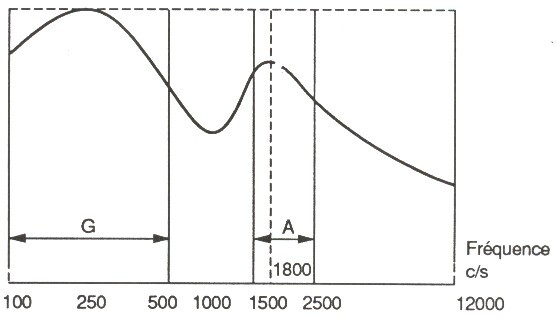
Fig. 5 — Spanish curve
The diagram of figure 5 is that of the Spanish audition. There one discovers the great sensitivity of this audition within a broad low-frequency band (g) spreading up to 500 hertz, and at a lower intensity level, within a narrow band going from 1,500 to 2,500 hertz, marking a peak around 1,800 hertz. The sensitivity is very reduced in the high frequencies. The peak at 250 hertz introduces, in the audio-vocal reaction, the “Jota”, while the lack of permeability in the high frequencies beyond 2,500 hertz explains the heaviness of the Spanish sibilants: the slide of f into aspirated h. The difficulties a Spaniard encounters in integrating certain foreign languages are here justified by a simple reading of this diagram.
We set out in chapter I the theory of auditory selectivity. If one pushes further experimentally the study of these various languages, one perceives that there exist also very great differences as regards the selectivity proper to each ethnic ear. Some peoples have a very restricted selectivity, others on the contrary a very extended selectivity. Here for example, figures 6 and 6 bis, a comparison of the Italian ear and of the French ear on the plane of their respective selectivity.
As may be observed, the Italian ear sees its selectivity inscribed between 2,000 and 4,000 hertz. It is null between 1,000 and 2,000 hertz, whereas the French ear, on the contrary, is rich between 1,000 and 2,000 hertz, and may explain the appearance, already signalled, of nasals in the French language.
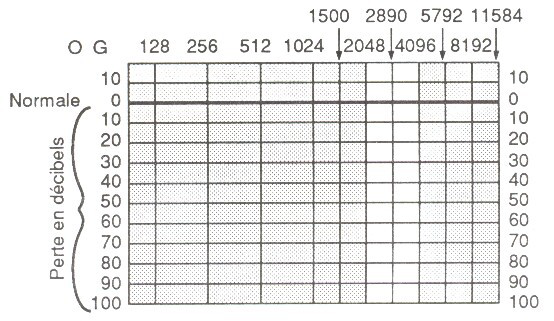
Fig. 6 — Selectivity of an Italian ear: the pass band is inscribed between 2,000 and 4,000 hertz
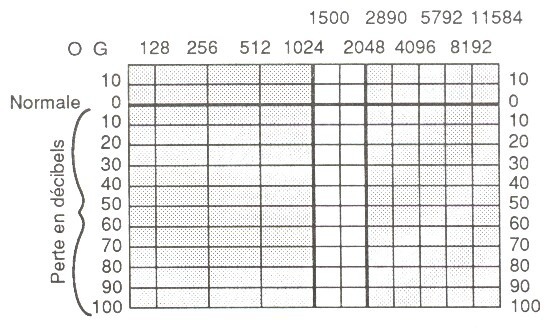
Fig. 6 bis — Selectivity band of a typical French ear, limited between 1,000 and 2,000 Hertz
The Slavs, in contrast, have a very extended selectivity with a greater affinity towards the low frequencies. Their voice is broad and warm. Their very extensive selective richness, contrary to that of the French and the Italians, allows them to perceive all the consonances. To be convinced of this, it suffices to examine the figure representing the selective field of a Russian ear, extending from the low to the extremely high sounds. (figure 7)
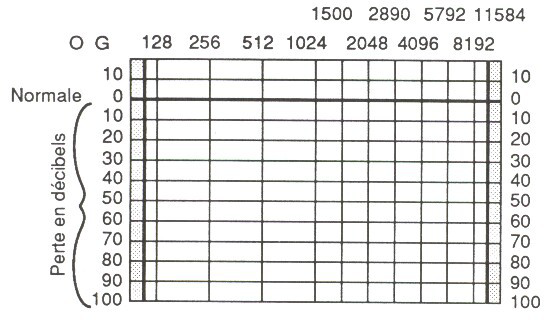
Fig. 7 — Selective field of a Slavic ear extending from the low to the extremely high sounds.
It is this faculty which allows the Slavs to register the whole gamut of linguistic sounds. It is known indeed with what ease they learn foreign languages. This phenomenon, which may often leave us admiring and slightly piqued, is due simply to their great auditory permeability.
In order not to weigh down this work, we voluntarily confine ourselves to citing a few examples. It is evidently indispensable to study, on the audio-psycho-phonological plane, all the idioms employed by the human being. Our research, hitherto bearing on hundreds of languages, has allowed us to detect only 12 different ways of hearing, each group presenting a different combination of the two parameters: bandwidth and latency time.
Thus for example, the Arabic language is characterised by a bandwidth of the Spanish type and a latency time of the German type. The Portuguese language has the characteristics of the Slavic language (bandwidth and latency time), so much so that it sounds like Spanish self-monitored by a Slavic ear.
Experimentally, it is amusing to verify this fact by passing a Portuguese sentence through filters whose response curve is that of a Spanish ear. For one who understands Spanish, the Portuguese sentence then becomes very readily comprehensible.
This rapid analysis of a few ethnograms allows us to conceive the fundamental differences which exist between the various ways of hearing of subjects speaking different languages.
On the basis of these diagrams, auditory conditioning techniques have been developed taking account on the one hand of the specific curves of each language and on the other hand of the more or less rapid and complex accommodation time, characteristic of the language studied. Each language possesses indeed an average time of emission of each syllable called “latency time” conditioning the response of the laryngo-resonantial adaptation, the origin of intonation.
IV — The Electronic Ear with Tomatis Effect
From 1950 on, as proof and application of his theories, Dr Tomatis concentrated his research efforts on the development of an apparatus capable of modifying the way of hearing and, in consequence, the way of speaking of a subject.
His concern was also to create a true audio-vocal conditioning, obliging the ear to use a mode of accommodation determining a way of hearing typical of a language and entailing the corresponding vocal gesture.
Alfred Tomatis, in a communication to the Académie Nationale de Médecine (16), set out in 1960 the fundamental principles of the audio-vocal conditioning engaged with the help of this apparatus. We reproduce below a summary of this communication.
“Let there be a vocal gesture G1 corresponding to an emission E1 and answering to a global audition A1. To substitute for the emission E1 — and therefore for the vocal gesture G1 — a vocal gesture G2 and an emission E2, it is necessary to condition the audition to a new mode of accommodation which determines the manner of hearing A2.
To realise this conditioning, the following mounting has been made (figure 8).
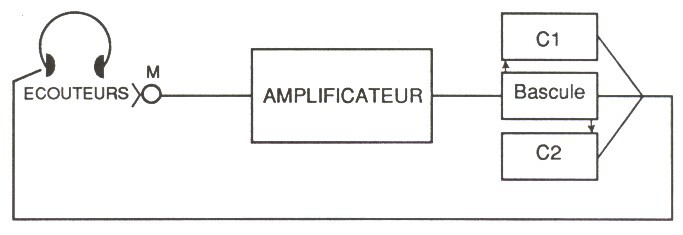
Figure 8
-
A microphone M drives an amplifier from which emanate two different circuits, these two circuits constituting two channels which do not function simultaneously.
-
For a given intensity, modifiable at will, channel C1 alone remains open. It is adjusted in such a way that it places the ear in a state of complete relaxation. The tympanum is then at its minimum tension, in a state of non-accommodation. One may say then, by proceeding by analogy with vision, that it is at its “punctum remotum”. It thus attains a position of total relaxation before tensing itself for the listening determined by the adjustment of the upper channel. Indeed, as soon as a sound is emitted by the subject or by another sound source coming for instance from a tape recorder — as soon as a complementary intensity is added to the pre-existing ambient noise — channel C1 closes and only channel C2 opens. This second electronic channel will constrain the ear to another mode of monitoring chosen beforehand, answering to the emission of the language to be studied.
The opening of channel C2 is made by a so-called “gating” system, allowing the automatic passage from the manner A1 of hearing, inherent in the gesture G1, to the manner of hearing A2 proper to the desired gesture G2.
The sonic emission ended, the intensity reduced accordingly tips the system in the reverse direction, and C1 opens while C2 fades away. This cycle starts again each time the subject wishes to speak, and the conditioning appears very rapidly. From the first days, after a half-hour session, there subsists a persistence of about half an hour. After two weeks, it becomes permanent.
Moreover, this gating play may rapidly become a conscious phenomenon and determine at will the possibility of hearing what one wishes.
With the aim of modifying then the rhythm and intonation of the chosen language, gating engagement times have been determined corresponding to the latency time characteristic of the language. Each language possesses indeed, let us recall, an average time of emission of each syllable: 0.15 second for French, 0.20 for English, and so on.
For those rebuffed by this rather austere exposition, one may say less scientifically that the Electronic Ear with Tomatis Effect allows the imposition upon any subject, even refractory, of a predetermined audition, obliging him thus to hear according to a desired accommodation.
How is this “education” achieved?
The Electronic Ear is essentially an apparatus of auditory education. Now it is known that human audition is only the result of a broad use of the VIIIth pair of cranial nerves. This nerve, which originates at the level of the sensory organ of the ear, lies in the inner ear and projects upon the telencephalon at the level of the centres of language acquisition.
This sensory organ par excellence behaves moreover as a piece of differentiated skin, highly specialised in the detection of variations of acoustic pressure. But it is worth only as much as the use one knows how to make of it. Likewise,
an excellent sight would serve no purpose if the eyelids remained closed; better still, an impeccable retina would render very little service if the corresponding lens did not allow the concentration of the image. In other words, the optic nerve — the retina in this case — is worth only what we know how to make of it.
It is the same for the auditory receptor, which must adapt to the sonic environment surrounding it. It is to the middle ear that this possibility of accommodation falls, and it is to it that we address ourselves in using the Electronic Ear.
The adaptation of the middle ear is made by the play of contractions of the muscle of the malleus and the muscle of the stapes — the first acting upon the convexity imposed on the tympanum, which then behaves as an acoustic lens, a sort of auditory crystalline; the second, that of the stapes, regulating the play of the inner ear which knows, in the manner of a prism whose angle at the apex is of 2 to 3 turns of a spiral, how to spread the gamut of sounds in an acoustic spectrum, in a sonic rainbow.
This more or less rapid, more or less complex accommodation determines the spatial position of the ossicular chain and allows the opening of such or such auditory pass band, the enlarging as needed of the aperture diaphragm.
The Electronic Ear imposes this play upon the human ear. By modifying at will the pass band, one “opens” — the word is not too strong — the ear to the elective sounds of a language. Moreover, whether it is a question of the assimilation of a mother tongue or of the integration of a foreign language, the process remains the same. To open oneself to language is above all to tune into the wavelengths of this language. But to be integrated and then reproduced correctly, the oral message must first be well heard, and this is what the Electronic Ear allows.
By a play of filters, this apparatus offers in the first place the possibility of an auditory diaphragmatic opening on such or such pass band — a simple fact which already determines a laryngo-resonantial response adapted to the use of the imposed filters. In the second place, it brings out the latency time inherent in the chosen accommodation, which conditions the response time of the laryngo-resonantial adaptation — the origin of intonation, as we have already noted at the end of chapter III.
The Electronic Ear therefore allows the superimposition upon any subject, even the most refractory, of this manner of hearing — obliging him thus to perceive sounds according to a desired accommodation, as a function of the diaphragmatic opening of the audition upon the elective pass band and of the latency time inherent in this accommodation.
This preparation is essential in the learning of a foreign language. As soon as the message is correctly perceived, the integration is immediate and the reproduction perfect, since phonation is closely linked to the mode of auditory perception and any modification of audition entails ipso facto a modification of phonation in its different parameters: rhythm, timbre, intensity, melody, and so on.
The acoustic structures of these parameters imprint into the ear their penetration in function of the coding they manage to determine. They awaken the conditionings which prepare the sensory cells to be excited electively at such or such frequency.
If therefore one introduces into the self-monitoring circuit of the audition an Electronic Ear tuned to another way of speaking, to a foreign language in this case, the whole neuro-muscular circuit of the subject begins to work on this foreign rhythm. It is this gymnastics — for that is what it is in the end — which renders us apt to hear and to speak “in a certain manner”.
The schema below shows how the “audition-phonation” self-monitoring is engaged by the intervention of the Electronic Ear in an unconscious mimicry (fig. 9).
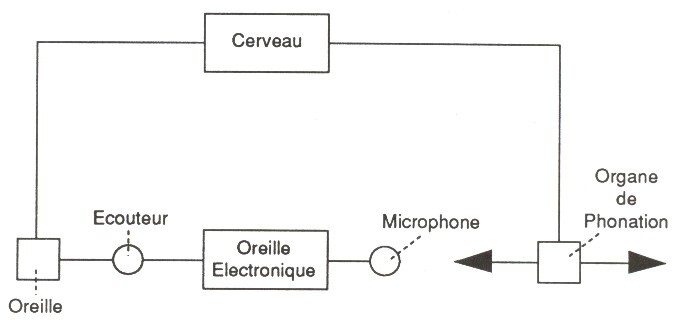
Figure 9
The one who reaches this “auditory automatism” is definitively conditioned. All his neuro-muscular circuit, which has worked on a foreign rhythm, will establish itself little by little in a state of persistence, by the cerebral memorisation of this new activity and by muscular training. From then on, the subject will be, so to speak, constrained to hear perfectly and to pronounce with total correctness and exact intonation the foreign phonemes and semantemes — whether they are proposed to him as models to imitate, or whether he has to speak the foreign language without other guide than the sonic image furnished to him by his auditory memory.
In short, it is as if he had been given what others like to call the gift of tongues. But this gift of speaking languages — which is the well-known gift and privilege of the Slavs, and which we have read clearly in the ethnogram of the Russian ear — is in the end only the fact of an audition particularly extended whose diaphragm, widely open, allows the inclusion without difficulty of the pass bands of other languages. From the gift of tongues, haloed with its mystery, we arrive at the aptitude, innate or acquired, which may be called the gift of hearing languages.
From then on, the American from Brooklyn or the Cockney of London, equipped with earphones and placed before the microphone of the Electronic Ear, will end up speaking “the King’s” English with the purest Oxford accent, as soon as the filter system has imposed upon him this way of hearing.
It is moreover what should happen, but with much lesser intensity, in the traditional study of languages. It is known how profitable, if not always effective, it is to learn the language in the country of origin: it is because the ear is then plunged into the desired ethnic atmosphere. But one rarely sees a Frenchman transported to London take on the English accent instantaneously, while this phenomenon is rapidly marked by the use of the Electronic Ear — and this while remaining in France.
As soon as the subject speaks, as soon as he engages the spoken chain, his audition is modified in such a way that all sounds necessarily pass into a selective channel which is tuned in a predetermined way to the characteristics of the language to be studied. The machine aims to impose upon the auditory system of a subject an audition conforming to that of the natives of the country whose language he studies, and for this to open his ear to the frequency bands he did not hear before. The Tomatis Effect explains that the phonetic initiation is thereby instantaneously realised, and this without the language student being asked for any effort whatsoever to reproduce the sounds and groups of sounds hitherto foreign to him. Everything happens as though the organs of his audio-vocal system and all the cerebral zones concerned were immediately adapted, exercised and reinforced.
This is one of the most spectacular experiments it is given to witness. An English sentence, for example, emitted by the teacher through these techniques, is almost immediately reproduced by the pupil with astonishing fidelity. The most striking phenomenon associated with it is the psychic liberation that such a procedure makes appear.
In the old systems of language learning, one indeed observed in the individual under conditioning an inhibition from fear of the ridiculous, which came from his incapacity to reproduce “ad integrum” the proposed sounds. The use of the Electronic Ear today allows not only the avoidance of this supplementary embarrassment, but also the euphorisation of the student.
This conditioning to which the ear is submitted in the course of the integration period of the chosen modern language may be effected in two ways:
-
Either the subject, equipped with a headset connected to an “Electronic Ear and teaching device” ensemble ensuring a correct audition, repeats what the teacher transmits to him, the auditory integration operating in parallel with the study proper of the language.
-
Or he works alone to acquire this conditioning, the apparatus directly transmitting to him phonic elements coming from a tape recorder and opening the ear to the correct audition of the foreign language.
Experience shows that for a normal subject, fifty to a hundred half-hours of work with the Electronic Ear suffice for, through the cerebral memorisation and the muscular training engaged, a definitive persistence to be created — and for one to be able to consider that this aptitude, this “gift”, is henceforth permanent with respect to the language studied.
From this flow several consequences:
-
As oral expression is linked, without possible contradiction, to a certain physical behaviour and a certain facial expression, one may rightly think that at the same time as the power of expression, the conditioned subject has more or less acquired the physical behaviour of those whose language he learns.
-
Moreover, the intellectual, sensitive, moral and social formation of an individual is, in large part, the result of linguistic habits representing the acquisition of past centuries, in the image of the national character. In the same way, this physical behaviour, the consequence and expression of a particular mental attitude, predisposes the language student to adapt progressively to the behaviour of the foreigners whose language he assimilates, while waiting for the deep and reflex understanding of the semantemes to make him penetrate further into the knowledge of their soul and lead him to understand intimately their way of thinking, feeling and acting.
-
By the very ease which, thanks to the use of the Electronic Ear, each feels in pronouncing well, there follows an improvement of auditory memory — a quality essential and indispensable for the study of a language. It is evident that the contribution the subject must bring in the form of personal effort should not be minimised. But his motivation, remaining incontestably a major element, must be sustained by the suppression of the initial inhibitions. These inhibitions come from the unintelligibility of the spoken language studied and, in consequence, from the fundamental incapacity in which the subject finds himself to reproduce it.
Without this conditioning, the unintelligibility itself renders the pupil inert before any attempt at articulated emission which he knows himself incapable of monitoring correctly. It seems to him vain, indeed, to exhaust himself in repeating sounds without being able to determine and regulate the easy reproduction of them.
In conclusion, if we had to summarise the merits of the Electronic Ear in its role of prolegomena indispensable to every study of a foreign language, we would take up the terms used by Dr Tomatis before the informed audience of the UNESCO Palace in 1960 (17):
The Electronic Ear allows the creation of the ambient climate so indispensable to the psychological imbibition of a foreign language. Moreover, its influence is very euphorising by:
-
the facility of elocution it procures,
-
the automatic triggering it brings about at the level of the mechanism of the organs of phonation, which adapt immediately to the use of the chosen language,
-
the rapidity of integration it entails, which often proves disconcerting.
In a way, concluded Tomatis, we recreate the auditory conditions of initial integration, those which permitted us the assimilation of our mother tongue.
V — The Electronic Ear and audiovisual teaching
We cannot insist too strongly on the pedagogical value of the new audiovisual techniques put at the service of the integration of modern languages.
As the term “audiovisual” precisely indicates, this teaching calls upon the two principal sensory organs of knowledge: audition and vision. But, while on the visual plane the aim is reached by allowing the pupil to monitor through the image what the object to be studied represents, there subsists, on the auditory plane, a great uncertainty as to the integration of the oral message. One has only to verify the extraordinary distortions obtained in the mouth of the subject who repeats, to realise to what point — by virtue of the laws governing the direct audition-phonation relations — the message has not been well heard.
It is precisely to palliate this drawback that the use of the Electronic Ear has been introduced within these new techniques. For if it is true that certain initiatives in linguistic matters have failed during the last ten years and that numerous language laboratories have been abandoned, it is nonetheless the case that we may today consider these methods of learning as active means for the acquisition of a well-structured, well-articulated, well-integrated language.
Without wishing to elevate these techniques to the level of a panacea, we think it is necessary to take stock and to evoke the conditions under which this linguistic initiation must be carried out. We shall endeavour to bring out the different aspects of true integration so that the audiovisual techniques may find, in the eyes and above all in the ears of our readers, the favourable echo to which they are entitled within modern pedagogy.
The success of such an undertaking demands the detailed analysis of the psycho-physiological processes implicated in this approach which is the acquisition of a foreign language.
The language laboratory constitutes, in our day, a precious aid for both teacher and learner through the conditionings it provokes at the level of the auditory and visual centres. It is voluntarily that we have placed audition before vision, for we like to recall that, to learn a language, one must above all hear it.
The introduction, within this active pedagogy, of the Electronic Ear with Tomatis Effect remains very important by the considerable sensory contribution it achieves in the domain of the transmission of the sonic message and of its integral reproduction. It ensures a perfect listening to all the elements of the spoken chain specific to the language to be studied and, by way of counter-reaction, allows the language student to reproduce exactly what he has perfectly heard. Thus, thanks to the tape-recorder–Electronic Ear setup, the acquisition of a language becomes easy.
We shall now approach the conditions under which audiovisual techniques must be practised — techniques whose purpose, let us recall, is to bring to the pupil not only a reminder of the master’s fundamental course, but also exercises of current language in the form of practical work.
The subject, left to himself before the apparatus, follows with his eyes the image projected for him, while the corresponding text is injected into his ears through a listening headset connected to a tape recorder. It is well to note here the interest of this individual teaching which allows the pupil to dispose of the machine at his personal rhythm, without external intervention, in a progression determined by his own speed of integration.
There is thus established a play of voluntary repetitions — easy, agreeable, amusing. Does not every linguistic acquisition remain the most fascinating human play, provided it is well conducted? But the fragility encountered in the infant during the constitution of his audio-vocal circuit is found increased still further in the adult. And this because his inhibitions are greater, stronger still: his social position invites him to stiffen, fear of ridicule keeps him at a distance from this play of linguistic construction. The habit he has of bringing his intelligence into play at every moment to assimilate something new not only renders him no service, but further hinders his progression.
Now, what matters at the outset is the setting in place of this rail, of this network which the different lines and the verbal flow diagrams must little by little install. The semantic crystallisation will be effected later, without confusion or hurry. It is of no use, indeed, to try to understand everything at first try. This is not how man began the learning of his mother tongue. Doubtless the need to go fast disturbs this first stage, but what is the use of hurrying? It is quite evident that the phonatory system of the adult, submitted for long years to the use of the mother tongue, no longer needs a time as long as that necessary for the infant to elaborate his auditory and verbal structures. The maturation from which the adult benefits will allow him to skip stages, but will not dispense him from going through them.
Among these stages, that of auditory integration remains essential. It matters little whether the pupil makes of the visual image presented to him on the screen a mental image somewhat different from that of his neighbour. The synthetic structure of vision dispenses to each a global value more or less identical.
It is not the same for audition. In the present state of current techniques, it is not known indeed how the auditory receptor, the essential apparatus of the audio-phonatory circuit, functions and analyses. On its regulation, and on it alone, depends the whole play of voluntary acquisition of articulatory movements, which call only very distantly on the normal automatic movements.
Language is made — one must constantly bear in mind — only of movements secondarily organised, highly elaborate, which are proper to man only insofar as the latter fully enjoys his faculties.
If the auditory receptor is defective, or merely fixed in one position alone, without its being able to modify its kinesthetic position unconsciously, all the practical means exercised will be without effect. All the recordings, however perfected, will pile up, like so many other things, at the back of a cupboard, awaiting, under a film of dust, some new half-hearted impulse.
It will be less the method in this case that must be incriminated than the factors of auditory integration. All the ingenuity put at the service of pedagogy will serve no purpose if the entry door, that is, the ear, remains closed to the linguistic message. One must first ensure that the door is perfectly open, that the audition is ready to receive the particular sounds of the language it must assimilate. Without this, the efforts will be in vain.
This is why the Electronic Ear must be associated with the tape recorder of the language laboratory. By allowing the factors of auditory integration to be modified with the help of the electronic gating it contains, the apparatus triggers the superimposition of another way of hearing, entailing another mode of listening and determining thereby a variant in the mode of monitoring, on which depends the resumption of the initial phenomenon.
The astonishing results brought to us by these new audio-vocal techniques come simply from the fact that they electronically create the acoustic imbibition milieu indispensable to the restoration of the self-monitoring device. The rest — phonation — can only flow from it naturally.
It is certain that the effects of the use of the Electronic Ear will be all the more effective in that they are combined with the use of a logical method of language teaching, founded on the progressive and coordinated acquisition of meaningful groups. The pedagogical problem remains entire, and one cannot insist too much on the necessity of adjoining to these techniques a learning method taking account of the deep mechanisms of the integration of a language.
The language laboratory has precisely the aim of promoting these techniques in a broad perspective of sensory integration, without which any learning of a language proves useless.
As has been said above, a modern language is learned by listening to it: the role of the ear in the phonatory act has, in our day, acquired a force of self-evidence. The ear must not only capture the sound, handle it, transform it, weigh it, analyse it — it must also distribute it at the level of the keyboard of the sensory neurons, whose excitation by the induction of numerous circuits determines the definitive sonic image. The ear is the conductor of speech under all its aspects: volume of the voice, tone, rhythm of delivery depend on it.
It therefore matters to ensure the perfect behaviour of the ear before the unaccustomed information of the language to be studied, which calls upon an auditory posture different in every respect from that in which the initial, maternal language has fixed it. The laboratory must allow the ear to open widely its pavilion to the linguistic information and to regulate automatically its opening upon the informing emission band. It must also give the possibility of governing the emission of the repetitions made by the pupil. Every phonetic act must indeed be monitored by the auditory receptor, which guides the articulatory unfolding to the integral restitution.
Thus must the pupil hear himself in his turn. To speak, we have already noted on several occasions, is to hear oneself; and to speak in a certain manner is to hear oneself in a certain manner. During emission, the ear holds in its power the role of “pilot” — of regulating cybernetically intensity, timbre, intonation, inflections, of ensuring semantic monitoring (18).
To speak a language is to adapt one’s own listening to the acoustic frequencies of this language. The ear adopts, to attain this, a specific posture for each language, which allows it to modify at will the articulatory counter-reactions that vary the emission and thereby the verbal flow — the testimony of a new neuronal coding.
Thus, the ear profiles its audition upon the pass band specific to the language to be integrated. There results a manner of hearing which moulds itself on the envelope curve of this new idiom. The sounds emitted in a language indeed comprise multiple “sonic objects” having a gait, a size, a morphology specific to the language.
The Electronic Ear has precisely the aim of leading the language student into the sonic world of the one whose language he wishes to adopt.
Experience has allowed us to bring out some rules that it is essential to know in order to obtain the desired effectiveness:
-
The Electronic Ear should be used during a preliminary period prior to the first lessons of teaching of the language proper, with the exclusive aim of conditioning the auditory and phonatory apparatus.
-
If one is dealing with pupils who have already begun for a longer or shorter time the study of the language and have a deficient pronunciation and audition, the best method will be to start again from scratch and to resume the study of the language proper only after a period of use of the Electronic Ear aimed solely at the conditioning of the audio-phonatory apparatus.
-
If, for some reason, one wishes not to interrupt the study of the language, it is appropriate to devote ten or fifteen minutes of each lesson to purely phonetic exercises under the Electronic Ear.
-
Whatever the duration of the use of the Electronic Ear, this use should have as its essential aim the progressive and methodical integration of all the sounds, rhythms or intonations specific to the language studied — that is, of the elements of the spoken chain most difficult to acquire in a pupil of another nationality. Its use will be all the more effective as the programme and the progression are adapted to the particular deficiencies of each pupil, notably with the help of the preliminary audio-vocal test which will be discussed further on.
-
If one wishes the phonetic exercises performed with the help of the apparatus to prepare more effectively the study of the language proper, the groups of sounds chosen for these exercises may constitute the essential mechanisms of the initial learning. Even if the pupil does not understand them and sees in their repetition only a pure phonetic exercise, he is nonetheless placed in a situation identical to that of the very young child who, at the same time as he progressively acquires the sounds and the behaviour of his mother tongue, fixes little by little in his reflexes the meaning and use of the groups of sounds, phonemes or semantemes he hears around him. It would not therefore be useless to employ in parallel with the phonetic exercise a synchronous projection of slides or still images destined to give a first, more or less precise notion of the meaning.
-
Although in general a single repetition of groups of sounds suffices, the teacher or monitor should however ask the pupil to make the effort to repeat each group, if necessary several times, until he has acquired an intelligible and, if possible, perfect pronunciation, answering to an audio-vocal conditioning of good quality.
-
As the pupil, thanks to the Electronic Ear, hears his own voice perfectly, the conjoined use of a dual-track tape recorder allowing self-monitoring is particularly recommended.
-
Finally, one cannot pass over in silence the imperious necessity of using in the language laboratories equipment whose characteristics answer to standards of very high quality. Any defective element in the assembly chain of the verbal system risks compromising not only the good transmission of the message one wishes to have heard, but also its integration — which may be rendered all the more difficult in that the alterations occurring along the way entirely modify its initial gait.
What therefore are the precautions to be taken, and the principal imperfections to be avoided?
These latter may be encountered in every element of the assembly. So the recording should be of excellent quality. The times left for the repetitions, called “sonic blanks”, should be judiciously distributed. The tape recorders should faithfully translate what the tape contains, without any distortion. The linearity that must be required is absolutely necessary up to 12,000 hertz, for example for English. It has been given to us many times to see entire laboratories falling into abandonment, wearying the pupils, because of tape recorders whose curves, all different from one another, introduced distortions making the initial acoustic signal unrecognisable.
If the pupil in a listening posture is asked to correct or to catch at every moment, at the cost of great effort, the sonic message transmitted to him, it becomes impossible for him to attain the integration sought. The abuse of cheap tape recorders has created, in this field, piles of harmful toys. One has seen (chap. III) the plasticity of an auditory curve which knows how to model itself on the imposed curve and on the message one has wished to confide to the sonic plane; one will then understand that an apparatus whose curve is truncated from 3,000 or 4,000 hertz may engender an auditory conditioning the inverse of that sought.
It has even been given to us to carry out verifications on tape recorders — whose destination was nonetheless to educate the ear — for which everything began to fade away from 500 hertz or even 300 hertz. The standards currently admitted, allowing a fall from 5,000 hertz, can only be defended for commercial ends; but they are not without danger and remain in the domain of ineffectiveness.
Without wishing to dwell unduly on these technical questions, we may however affirm that, in the field of audiovisual matters, “approximation” in apparatus leads inevitably to total failure.
In addition, we must insist on the fact that the pupil must actively participate in this linguistic initiation by a contribution of will and effort.
If it is now verified that the yield of active pedagogy methods is decupled by the use of the Electronic Ear, it nonetheless remains true that, once the auditory and phonatory apparatus is conditioned, the language with its grammar and vocabulary remains to be learned.
The effort to be made by the student should therefore not be minimised. However, it is also well to specify that his motivation — which remains incontestably a major element — is largely facilitated by the abolition of the initial inhibitions residing in the unintelligibility of the spoken language and, in consequence, in the impossibility of reproducing it.
The audiovisual techniques whose principles we have just evoked must thus — and this will be the conclusion of this chapter — be able to render large service to the teacher by allowing his pupils to open their ears perfectly to the teaching dispensed to them. It is no longer a question then of a “dialogue of the deaf”, but indeed of a fruitful exchange between individuals capable of communicating by means of one and the same language correctly transmitted.
The teacher, relieved of a singularly heavy task, is then in a position to have his pupils integrate all the subtleties, all the specific elements of the language of which he is the “spokesman”. On a perfectly conditioned ground, he will be able with ease to transmit the culture and psychology emanating from the ethnic group he represents.
As we noted at the beginning of this chapter, it is not our intention to present these techniques as a panacea. They must certainly remain means at the service of pedagogy, but they constitute an indispensable aid to the teacher of modern languages.
VI — The audio-vocal test
The fundamental Tomatis laws as well as the corollaries studied above bring out the necessity of a precise knowledge of the auditory possibilities of every person wishing to study a foreign language.
This measurement of audition may readily be effected with the help of a battery of tests which call upon both directly the auditory faculties of the subject and indirectly — by counter-reaction based on the principle of the Tomatis Effect — his vocal possibilities.
One may distinguish two kinds of examinations:
- — The auditory examination
This is carried out with the help of an apparatus called “audiometer” (19). The latter comprises sound generators, kinds of “electronic tuning forks” with pure, stable frequencies, without harmonics, and of measurable intensity.
The sounds emitted by the audiometer go from 125 Hz (20) to 8,000 Hz, octave by octave. Each of the frequencies presents a variable intensity which may extend from −10 dB to +100 dB (21), in steps of 5 dB.
The examination is carried out with the help of a listening headset and a vibrator. One proceeds by having each frequency heard successively, and by noting, for each of them, the threshold of auditory acuity. One thus obtains 4 curves, 2 for each ear (air conduction and bone conduction).
The test thus performed allows the obtaining of a curve of thresholds — that is, minimal thresholds or, better still, thresholds of minimum audibility.
When one has thus obtained a diagram bringing out the sensitivity of the subject’s ear to pure frequencies, one proceeds to a study of auditory selectivity. This test aims to make known the zones, the pass bands in which the subject knows how to effect a perfect analysis of the sounds received. One can thus know whether he is more sensitive to low sounds, intermediate sounds or high sounds, or to the ensemble of frequencies.
The spatialisation test succeeds, in third place, the investigation of selectivity. It consists in establishing on which side (right or left) the sounds sent by bone conduction arrive. It often happens, for people with poor spatialisation, that certain frequencies emitted on the left are heard on the right and vice versa. The errors are then noted on the diagram at the level of each frequency. The results obtained indicate the “stereophonic” capacity of the examinee.
Finally, a study of auditory laterality made with the help of an apparatus specially designed for this trial (the audio-laterometer) allows the determination of the dominant ear of the subject, the one that ensures the monitoring of the verbal flow.
With the help of the results obtained by these different examinations of audition, one may then evaluate the predispositions of the individual with respect to one or several foreign languages.
- — The vocal examination
It allows the completion of the measurement of the subject’s auditory capacities. Indeed, according to the principle of audio-vocal counter-reaction (Tomatis Effect), the analysis of the voice indicates with precision the corresponding way of hearing.
For a particularly trained ear, the listening to the spoken voice can already give very precious indications which may then be confirmed by instrumental analyses. The examiner may appreciate the timbre of the voice, the intensity, the modulation, the facial laterality (judging whether the person speaks on the right or on the left) — so many elements indicating the capacities of acoustic analysis of the subject being tested. A well-timbred voice, for example, emitted with sufficient intensity and mobilising the right face, indicates significant possibilities of analysis and monitoring of language.
As has been indicated above, these first investigations concerning the voice may be deepened by instrumental examinations made on panoramic analysers, sonographs, or with the help of a new apparatus called the “phono-integrator”. The recorded voice of the subject is then decomposed according to different processes allowing the individualisation of each of the characteristic elements in frequency, intensity, duration — and thus the obtaining of the spectral characteristics of the voice corresponding, we recall, to those of the subject’s audition.
These last researches are in reality only conducted in the laboratory. Simpler tests have been developed, such as those carried out with the help of the audiometer, allowing a precise idea of the possibilities of auditory integration of an individual with regard to the learning of a foreign language.
May we be permitted to insist on the utility of such examinations, which allow the avoidance of unfortunate errors of orientation and thereby a considerable loss of time, both for child and adult.
These audio-vocal tests, in our view, should be applied systematically before any learning of a modern language. They would spare many a misadventure to the future linguistic candidate by dispensing him from engaging in the study of a language which he is not apt to hear, that is, to integrate.
In truth, thanks to the Electronic Ear with Tomatis Effect, a great part of these difficulties are smoothed. Indeed, not to hear a language is not to possess the pass band of the language one wishes to integrate. Now, the Electronic Ear, by an auditory preparation, entails a modification of the curve, a widening of the pass band, and thus renders the pupil capable of taking such or such auditory posture, which must ipso facto provoke such or such posture of the whole bucco-pharyngeal apparatus.
The audio-vocal test has precisely the aim of making known how one must condition the child so that he may afterwards accede to the chosen language.
In case of a defect of selectivity, of spatialisation or of lateralisation, a preliminary treatment under the Electronic Ear should be envisaged in order to lift the barrier constituted by the initial defect. The repetition of the exercises moreover entails a profound and durable modification of the subject’s mode of listening, freeing him from his initial auditory non-adaptation.
The ease brought to the study is doubled by a perception of the slightest phonetic nuances of the language and procures a greater perfection of accent.
Successive tests, at regular intervals, allow the subject to measure objectively his progress and the educator to correct the adjustments of the apparatus until the obtaining of an auditory curve entailing a perfect pronunciation.
The contribution of such investigations for the orientation of studies of foreign languages constitutes one of the most spectacular practical applications — and also, it must be said, one of the most unsuspected — of the Tomatis Effect. It is only at present that one realises how necessary an auditory measurement is before the study of a language, in the same way as an examination of vision before piloting an aircraft.
May we be permitted, in this regard, to wish that school orientation — whose necessity and benefits no one today thinks any longer of discussing — would take into consideration the importance of having pupils of our schools undergo audio-vocal tests prior to the study of every foreign language.
VII — Conclusion
Arrived at the end of this exposition — or rather of this display of studies concerning the Tomatis Effect and its applications in the field of linguistic integration — our dearest wish is that the reader who has been willing to follow us to the end be profoundly convinced “that hearing”, and hearing well, is situated at the centre of the problems of language and more particularly here of the study of foreign languages. We believe we have sufficiently insisted on this point not to return to it.
So it is also on a note of hope that we should like to end these pages. Not so long ago, one could still write, speaking of the ease that young children feel in learning foreign languages: “This marvellous aptitude decreases rather quickly around the tenth year, and most pedagogues or psychiatrists agree in affirming that from the age of 14, a true bilingualism is no longer possible”. This impossibility, the Tomatis Effect allows us to push back its limits.
It is therefore no longer excluded, today, for an adult to think of learning a language other than his own to the point of integrating it as his mother tongue. This affirmation, which rests on scientifically established theories and verified by long experimentation, brings out the essential role of audition in linguistic study. By modifying the audition of a subject, we have said and repeated throughout this opuscule, and by imposing upon him the typical “ethnic” auditory curve of the language he has chosen to study, one ensures him thereby its integration.
If one admits — and who today does not understand this — that beyond the words of a foreign language, there is a whole process of thought, a whole ensemble of psycho-philosophical concepts that only a mastery of this language other than one’s own permits the acquisition of, one will agree that, much more than to the banal study of a language, it is to a true entry into a new sonic and psychological universe that we invite our readers.
Léna TOMATIS, Paris 1965.
Lexicon
(1) R. Husson: “Étude expérimentale des modifications éventuelles de la fourniture vocalique sous l’influence de fournitures auditives stimulatrices concomitantes”.
Note presented by M. Pierre P. Grasse.
(2) Alfred Tomatis: “Incidences observées dans les lésions auriculaires constatées chez le personnel de bancs d’essai et les professionnels de la voix”.
Bulletin du Centre d’Études et de Recherches médicales de SFECMAS (Nord-Aviation), September 1952.
(3) Alfred Tomatis: “Rôle directeur de l’oreille dans le déterminisme des qualités de la voix normale (parlée et chantée) et dans la genèse de ses troubles”.
Actualités Oto-rhino-laryngologistes Masson, Paris 1954, p. 264.
(4) Note presented by M. Moulonguet.
Extracts from the Bulletin de l’Académie Nationale de Médecine, tome 141, nos. 19 and 20.
(5) Alfred Tomatis: “L’Oreille directrice”.
Bulletin du Centre d’Études et de Recherches médicales de la SFECMAS, July 1953.
(6) Alfred Tomatis: “La dyslexie”.
Éditions du Centre du Langage, pp. 46 to 49.
(7) Alfred Tomatis: “Études sur la sélectivité auditive”.
Bulletin du Centre d’Études et de Recherches médicales de la SFECMAS, October 1954.
(8) This word is employed here in its most banal sense: it does not signify any adherence to such or such ethnological doctrine; it designates simply belonging to a determined linguistic collectivity. It is possible that the English ear be congenital in the English as is a certain complexion or a certain behaviour; it is possible also that it has been “learned” under the effect of socio-historical constraints. In André Le Gall, Inspector-General of Public Instruction: Le redressement de certaines déficiences psychologiques et psycho-pédagogiques, par l’appareil à Effet Tomatis.
(9) Alfred Tomatis: “L’oreille et le langage”.
Éditions du Seuil. “Le Rayon de la Science” series, no. 17-1963.
(10) Charles Bailly: “Le langage et la vie”, pp. 94-95.
(11) Pierre Fouché: “L’état actuel du phonétisme français”.
Revue des Cours et Conférences. 15 April 1937, p. 38.
(12) Wilder Penfield and Lamar Roberts: “Langage et mécanismes cérébraux”. P.U.F. 1963, p. 270.
(13) Alfred Tomatis: “L’oreille et le langage”.
Bibliographic notice
(14) Important note: the distance which exists between the fundamental sound — initially the same in all languages and always low — and the selective pass band of a given language explains the more or less great difference between the written reproduction of a language and its pronunciation. This modification is all the greater as the difference is more pronounced: for example Spanish, fixed principally in the low sounds (as we shall see further on), is written practically as it is pronounced, while English presents a maximum of distortions between the spoken language and its written reproduction.
(15) Important note: we shall develop further on what we mean by “latency time”. We may say simply here that it is the time a subject takes to self-listen.
(16) Alfred Tomatis: “Conditionnement audiovocal”.
Bulletin de l’Académie de Médecine. Tome 144, no. 11 and no. 12. 1960, pp. 197 to 200. Presentation of Professor A. Moulonguet.
(17) Congress of Modern Language Teachers: “L’électronique au service des langues vivantes”.
Lecture given at UNESCO on 11 March 1960 before the Association des Professeurs de Langues vivantes (APLV).
Published in the bulletin of the Union des Associations des Anciens Élèves des Lycées et Collèges français. March 1960.
(18) And even of modulating the extralinguistic affective charges. The study of this last point would exceed the framework of the present work.
(19) Test apparatus calibrated to Tomatis standards.
(20) Hz = Hertz = cycle/second = unit of frequency.
(21) dB = decibels = unit of intensity.
Bibliographic notice
Bailly Charles
- “Le langage et la vie”. pp. 94/95
Fouché Pierre
- “L’état actuel du phonétisme français — II” Revue des Cours et Conférences — 15 April 1937 p. 38
Husson Raoul
-
“Étude expérimentale des modifications éventuelles de la fourniture vocalique sous l’influence de fournitures auditives stimulatrices concomitantes”. Note presented by M. Pierre Grasse, Académie des Sciences, session of 25 March 1957
-
“Modifications phonatoires d’origine auditive et applications physiologiques et cliniques”. Communication presented by A. Moulonguet to the Académie Nationale de Médecine, Bulletin de l’Académie Nationale de Médecine 121st year, 3rd series, 141, nos. 19-20, sessions of 28 May and 4 June 1957.
Le Gall André
- “Le redressement de certaines déficiences psychologiques et psycho-pédagogiques par l’appareil à Effet Tomatis”. March 1961
Penfield Wilder and Roberts Lamar
- “Langage et mécanismes cérébraux”. P.U.F. 1963 p. 270
Alfred Tomatis
-
“Incidences observées dans les lésions articulaires constatées chez le personnel des bancs d’essai et les professionnels de la voix”. Bulletin du Centre d’Études et de Recherches médicales de la SFECMAS (Nord-Aviation), September 1952.
-
“L’oreille directrice”. Bulletin du Centre d’Études et de Recherches médicales de la SFECMAS (Nord-Aviation), July 1953.
-
“Rôle directeur de l’oreille dans le déterminisme des qualités de la voix normale (parlée ou chantée) et dans la genèse de ses troubles”. Actualités Oto-rhino-laryngologiques — Masson, Paris 1954.
-
“La sélectivité auditive”. Bulletin du Centre d’Études et de Recherches médicales de la SFECMAS (Nord-Aviation), October 1954.
-
“Relations entre l’audition et la phonation”. Annales des Télécommunications, tome I, no. 7-8, Cahiers d’Acoustique, July-August 1956.
-
“Audiométrie objective : résultats des contre-réactions phonation-audition”. Journal français d’Oto-rhino-laryngologie, no. 3 pp. 379 to 391, R. Gauthier Printers: Lyon, May-June 1957.
-
“Rééducation automatique”. École Polytechnique de l’Université de Lausanne, September 1958. Annales du GALF (Groupement des Acousticiens de Langue française).
-
“L’électronique au service des langues vivantes”. Lecture given at UNESCO on 11 March 1960. Published in the bulletin of the Union des Associations des Anciens Élèves des Lycées et Collèges français, March 1960.
-
“Conditionnement audiovocal”. Bulletin de l’Académie Nationale de Médecine, tome 44, nos. 11 and 12, 1960, pp. 197 to 200. Presentation of Professor A. Moulonguet.
-
“La voix”. Revue musicale — special edition devoted to “Médecine et Musique” (1962).
-
“L’oreille et le langage”. Microcosme Collection — Le Rayon de la Science no. 17, Éditions du Seuil (1963), 192 illustrated pages.