L'Oreille et la Voix (1987)
Alfred Tomatis’s great book on singing and the voice, published by Éditions Robert Laffont in 1987 and dedicated to the memory of his father, the baritone Umberto Tomatis. More than forty years of research into the Tomatis Effect — the law according to which “the larynx emits only the harmonics that the ear is able to hear” — find here their most accessible and most complete exposition. To be placed in the hands of every singer, singing teacher, speech therapist and lover of the lyric art.
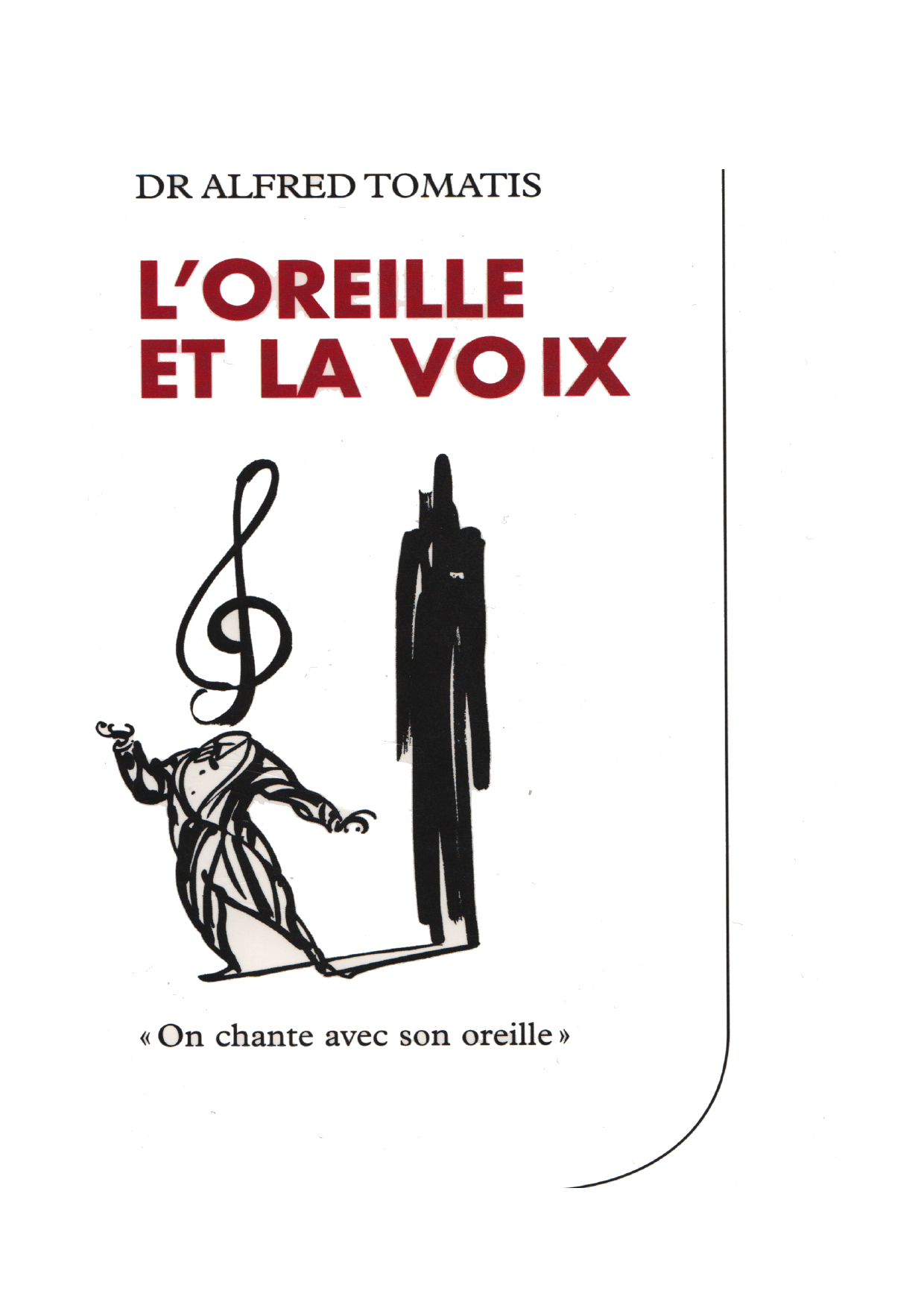
“We sing with our ear.”
— Conclusion (the axiom of the work)
Presentation
Forty years after the first communication of the Tomatis Effect to the Académie nationale de médecine (1957), Alfred Tomatis returns to the subject where it all began: the voice. But this time he no longer addresses only physicians or scientists: he writes for singers, for teachers of singing, for cultivated amateurs. The book is dedicated to his father, a baritone at the Paris Opera, who was the very first patient on whom the young ENT Tomatis tested, in the 1940s, his clinical intuitions.
The work progressively unfolds the links between ear and voice: why does an operatic singer suddenly lose his voice after a great success? Why is the voice restored when one readjusts that singer’s listening? How does the Electronic Ear allow the singer to recover harmonic control of his own emission? How are we to explain the apparent “dead voices” of Maria Callas, Mado Robin, Lily Pons and so many others — and how are they to be revived through listening?
Tomatis also takes up more unexpected subjects: the voice in spoken theatre (Romy Schneider, Gérard Depardieu), the voice in the learning of foreign languages, the “national colouring” of voices (French nasality, the extended Russian pass-band, the Italian attack), and the imperatives of singing which find in each vocal tradition their historical and cultural expression.
Contents
-
To my father — a long dedication, a tribute to the baritone Umberto Tomatis and the birth of a vocation.
-
My beginnings in the theatre — childhood in the world of the Paris opera.
-
Remarks on listening — the audio-physiological foundations.
-
The imperatives of singing — anatomy, posture, breathing, attack, support — seen from the ear.
-
The spoken voice — theatre, lecture, cinema.
-
A pedagogy of listening for the singer — the Electronic Ear, exercises, unblockings.
-
Conclusion — the great synthesis: “we sing with our ear”.
Place in the work
It took Tomatis forty years to write this book. “Forty years constitute, as is well known, the minimum required for an idea engrammed during twenty years in the intimacy of a researcher to begin to gather adherents”, he writes in the conclusion. This is the work in which the Tomatis Effect, first formulated before the Académie nationale de médecine in 1957, completes its public trajectory: it becomes a general-audience book, to which all the teachers of singing interested in the Tomatis method will refer.
In brief
Obligatory reading for every practitioner of singing: teachers, amateur singers, opera, pop, jazz, choristers; but also for actors, lecturers, teachers confronted with vocal fatigue. Tomatis demonstrates here, with clinical examples to support him, that most disorders of the voice are in reality disorders of listening — and that the royal road of re-education passes through auditory re-education. To be placed alongside L’Oreille et la Vie (1977), which opened the biographical diptych.
Available in libraries — BnF, Sudoc.