L'écoute, c'est la vie
L'écoute, c'est la vie — An Introduction to the Tomatis Method
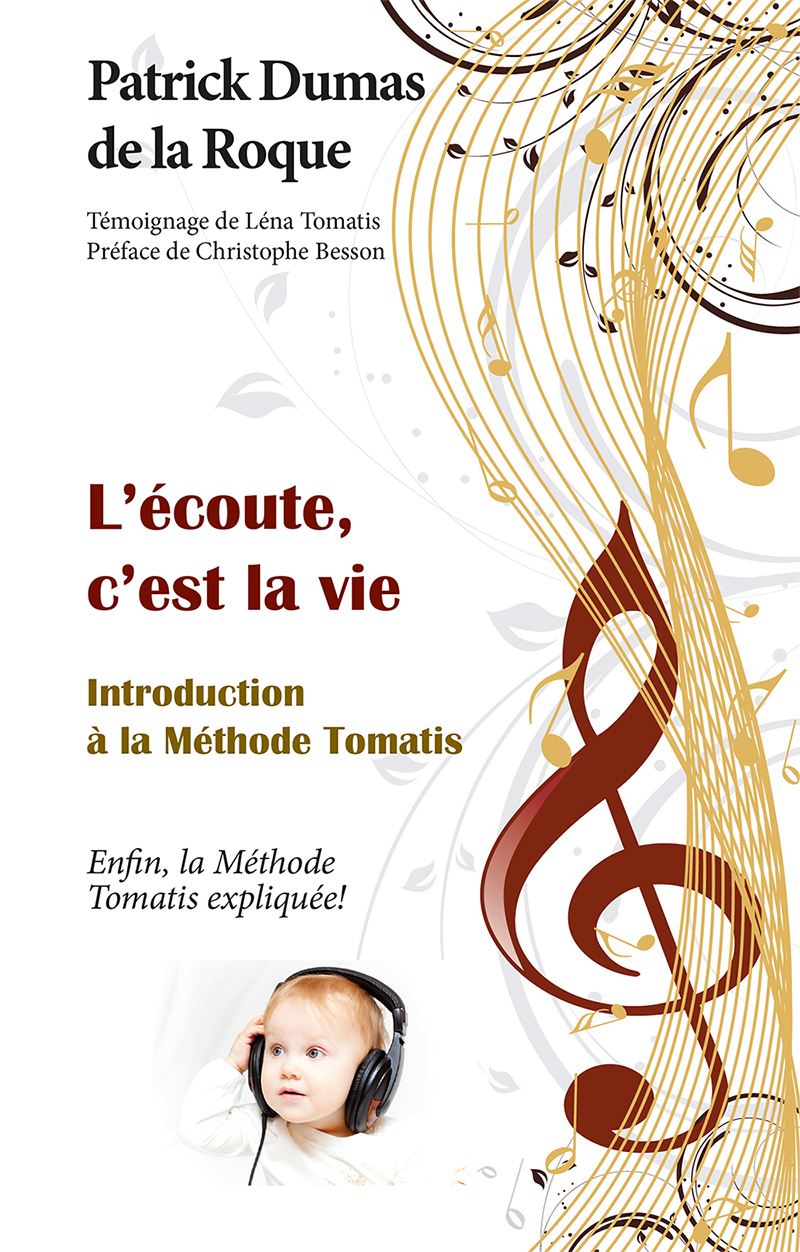
Revised second edition of Patrick Dumas de la Roque’s work originally published in 2007 by Jouvence — a classic general-audience introduction to the Tomatis Method. This re-edition, published in 2014 by Éditions Besson with the support of the F.I.A.P.E. (International Federation of Audio-Psycho-Phonology and Pedagogy of Listening), opens with a testimony by Léna Tomatis and a foreword by Christophe Besson in which the latter, for the first time, recounts the path that led him from the Neuchâtel École technique to the industrial manufacture of the Besson® Electronic Ear. The work is dedicated “to Léna Tomatis and my patients”.
“The ultimate aim, if there is one, is indeed to know how to listen.”
— Alfred Tomatis, quoted by Patrick Dumas de la Roque
Presentation
The book’s project is at once simple and ambitious: to offer for the first time an accessible synthesis of Alfred Tomatis’s considerable œuvre, without yielding on rigour. Patrick Dumas de la Roque, a consulting psychologist, trained by Tomatis himself and settled in Toulouse after several years spent assisting Prof. Tomatis in England, had both the scientific authority and the pedagogical warmth required. He explains the aim in his introduction: “This work is intended for all those who wish to discover what listening is through the considerable œuvre of Dr Alfred Tomatis” — parents, teachers, teachers of singing and of modern languages, psychologists, physicians, and any adult simply curious.
Audio-Psycho-Phonology is presented here as the organic articulation of three disciplines long held apart: audiology (the ear), phonology (the voice) and psychology. The voice depends on the ear, the ear depends on the psyche, the psyche is formed in listening: “man is, in his entirety, an ear”. The work unfolds this insight in two major parts — a theoretical part on the ear and its functioning, followed by a practical guide studded with case studies, in which the author treats both children’s learning disorders and adult vertigos, existential depression or epilepsy.
A testimony and a foreword worth the detour
The 2014 edition opens with two texts that make of this book a document in its own right, beyond its merely introductory value.
Léna Tomatis signs the opening Testimony, in which she evokes her husband, departed thirteen years earlier, with the modesty and depth one finds in all her writings. She recalls Alfred Tomatis’s motto — “Receive all in order to give all” — and the epigraph he had chosen for his autobiography L’Oreille et la Vie in 1976: “Provided I accomplish the mission entrusted to me…”. She confides: “I used to say that he was always 300 metres above the ground while I was struggling on our Earth.” The text closes on the death of Prof. Tomatis on Christmas Day 2001.
Christophe Besson signs the Foreword, and recounts there — a rare thing — his own trajectory. As a young student at the Neuchâtel École technique in the mid-1980s, passionate about acoustics and electronics, “a slightly hyperactive child suffering from dyslexia, who had a terrible compulsory schooling”, he was hired by the Neuchâtel Listening Centre to repair and maintain the Tomatis equipment. He there discovered a method that, as a child, might have spared him years of school suffering. From 1990 onwards, he took charge of the installation and maintenance of nearly all the Tomatis Listening Centres in Switzerland — “the method was then enjoying a strong development in that country because the treatment was recognised and reimbursed by the health insurance funds”. In 1991, he met Alfred Tomatis: “the meeting was extraordinary, overwhelming”. From 1992, he assembled some twenty Electronic Ears in Paris, then moved production to Neuchâtel; two years later, a wholly new generation of Besson® Electronic Ear saw the day. It was in this context that he met Patrick Dumas de la Roque, of whom he praises “the openness of mind and the respect free of all prejudice”.
Contents
The work is organised into two symmetrical major parts — theory then practice.
First part — Audio-Psycho-Phonology
- Genesis of Audio-Psycho-Phonology — “No use bothering with him: he is dead!”; a new discipline.
- The Tomatis laws — “To lend one’s ear is to lend the right one — that is, the right-hand one!”
- The great functions of the ear — movement, verticality and body image; the ear as dynamo for the brain; the sounds and movements that recharge; cortical energy.
- Hearing versus listening.
- The functioning of the ear is no longer a mystery.
- “My soul is heavy.”
- From intra-uterine listening to the voice of the father — in the beginning was the ear; child, what do you hear?; the voice of the father; the Earth and the Sun.
- Listening therapy — the listening test; the apparatus with “Tomatis effect”; the unfolding of the process; the programme “from intra-uterine life to the acquisition of language”.
- Why Mozart? — vertical music versus horizontal music; “Gregorian does not heal, it saves!”
Second part — Practical guide to Tomatis therapy
At the service of children:
- Motor delay, dyspraxia, language delay.
- School failure is not inevitable (the case of Jean: “as much in need of glasses for seeing as for listening”).
- A new hope for autistic children (case of Olivier).
- Epilepsy (“the fuses have blown!”).
- Around adoption.
At the service of adults:
- Personal development.
- Singers and musicians: “we sing with our ear!”; “my instrument is my body”.
- The integration of modern languages: “we are all born polyglot”; the gift for languages; the Audio-lingua project; “we are sculpted by sounds”.
- Accompanying pregnant women.
- Depression and listening therapy — existential depression; the case of Pierre.
- Ménière’s vertigo: “the world is collapsing under my feet!”
The work closes on a bibliography of Alfred Tomatis’s books, a musical selection recommended by Prof. Tomatis, and a directory of APP practitioners’ associations.
Place in the work
Where Pierre Sollier’s Listening for Wellness offers a methodical treatise in six books and more than 340 pages, L’écoute, c’est la vie makes the opposite choice: the lively synthesis, in 150 pages, that can be read at a single sitting. The two works complement each other — one for the reader who wishes to sit down and learn, the other for the reader who wishes to understand quickly. Patrick Dumas de la Roque, trained both by clinical practice at Tomatis’s consulting rooms and by years spent in England assisting the Professor, restores with finesse the master’s thought without freezing its letter.
It is also, through the grace of Christophe Besson’s foreword, one of the rare texts in which is set down the founding narrative of Besson of Switzerland: without that 1991 meeting and without the collaboration that followed, the industrial production of the Electronic Ears would no doubt have taken a different turn. On this account, the book interests as much the reader curious about the method as the historian of its network.
In brief
The book to put into every hand for an entry into the Tomatis Method: short, clear, lively, run through with case studies that make theory breathe. To be recommended to parents, to teachers, to practitioners in training, to students of psychology or speech therapy, and to every adult who questions the relation between their listening, their voice and their inner life. The second edition, augmented with the two opening texts by Léna Tomatis and Christophe Besson, makes of it a precious volume.
Patrick Dumas de la Roque — 2nd edition, Éditions Besson, 2014 (ISBN 978-2-8399-1378-2). 1st edition: Éditions Jouvence, 2007 (ISBN 978-2-88353-567-1). Layout and cover: Sandra Huguenin. Edition published with the support of the F.I.A.P.E. — International Federation of Audio-Psycho-Phonology and Pedagogy of Listening.